
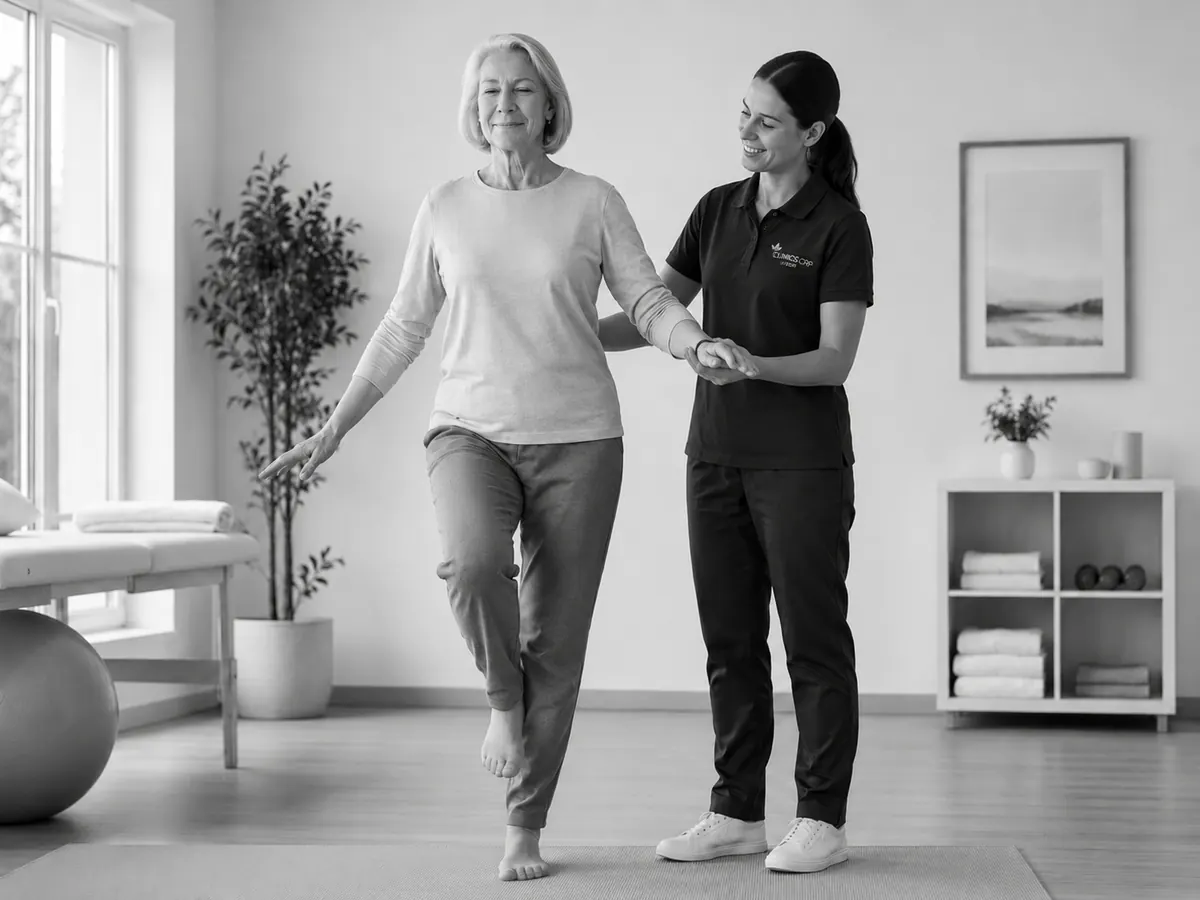
Balance Is More Than Strength: The Clinics GRP Approach to Balance in Older Adults
How sensory information, movement, confidence and surroundings contribute to balance, and how Clinics GRP connects care with meaningful participation.
Ageing in Full
Balance connects movement, sensory information, confidence and everyday surroundings. Through Ageing in Full, Clinics GRP explores what these connections mean for meaningful activity and individual care.
Our central guide to the Clinics GRP approach to balance in older adults.
How sensory information, movement, confidence and surroundings contribute to balance, and how Clinics GRP connects care with meaningful participation.
Falls history is important, but it cannot show every change in balance, exposure, confidence or the strategies a person uses to avoid falling.
7 min read
Sensory reweighting is the nervous system's ability to rely more on useful balance information and less on information that has become uncertain.
7 min read
Sensorimotor control is the continuous conversation between what your body senses, how your nervous system interprets it and how you move in response.
7 min read
Dual-task walking examines what happens when a person walks while completing another cognitive or movement task.
7 min read
Walking while talking combines a movement task with a cognitive task and can reveal how a person allocates attention under everyday conditions.
7 min read
A comprehensive balance assessment combines the person's story, relevant health factors, physical capacity, task performance, environment and goals.
7 min read
A near-fall can show that balance was disturbed and recovery was required, even when the person did not reach the ground.
7 min read
Turning redirects the head, trunk and feet while the body is moving, making it a revealing everyday balance task.
7 min read
Clinic testing samples balance under selected conditions, while daily life combines variable surfaces, distractions, fatigue and meaningful decisions.
7 min read
A near-fall can show that balance was disturbed and recovery was required, even when the person did not reach the ground.
7 min read
Turning redirects the head, trunk and feet while the body is moving, making it a revealing everyday balance task.
7 min read
Dual-task walking examines what happens when a person walks while completing another cognitive or movement task.
7 min read
A fall is an event, not a diagnosis. Understanding it means examining how health, movement, attention, environment and activity came together.
6 min read
Age influences falls risk without explaining why a particular person fell or what should happen next.
7 min read
Falls management addresses risk and harm while keeping meaningful activity, support and participation visible.
7 min read
Useful balance is the capacity to adjust when the body, task or environment changes, not the absence of all movement.
7 min read
How trip recovery differs from standing balance, where strength and power fit, and what evidence says about reactive balance training.
7 min read
Why strengthening can help without resolving every balance difficulty, and how balance practice, assessment and adaptation fit alongside it.
7 min read
New research links the period after hospitalisation with a higher relative risk of major fractures. Another study offers a reason to pay attention when someone feels unsteady after standing. Here is what the findings can—and cannot—tell us about recovery at home.
7 min read
Friday 30 October 2026 edition: four recent studies examine access to falls programmes, knee osteoarthritis treatment choices, stroke walking practice and participation after home rehabilitation.
7 min read
New research compares conventional exercise with virtual-reality-enhanced rehabilitation during hospitalisation. Other findings explain why strength, medicines and everyday function need separate attention during recovery.
8 min read
Assessment and rehabilitation for balance changes, unsteadiness, falls and reduced walking confidence, shaped around everyday function and participation.
Clinician-guided balance classes with Beginner, Intermediate and Advanced levels of challenge.
Assessment and rehabilitation for dizziness, vertigo, and balance-related vestibular concerns in a calm, structured pathway.
Clinics GRP provides in-home physiotherapy across Brisbane for older adults who need assessment, treatment or rehabilitation in their usual environment. Also known as mobile physiotherapy or home-visit physio, the service supports mobility, strength, balance, falls prevention and recovery following hospitalisation, illness or surgery.
Broader or continuing rehabilitation for functional goals after illness, injury, surgery, neurological change or complex mobility decline. People can enter directly or continue after a focused Post-Hospital Rehabilitation episode.
Call Triple Zero (000) for a life-threatening situation. Sudden new stroke-like symptoms, loss of consciousness or serious injury need emergency medical attention. Do not wait for a routine website enquiry.
Head impact, acute severe dizziness, rapidly changing function, unexplained recurrent falls or acute illness may need prompt medical assessment before balance training. If symptoms are serious or urgent, seek emergency care.
Healthdirect: when to call Triple ZeroFor help choosing a routine care pathway, contact intake if you are unsure where to start.
Contact intake