
Some people perform well on balance tests in a clinic yet report genuine difficulty at home or in the community. This is not necessarily a contradiction. The clinic and the real world can place very different demands on the balance system.
A clinic usually has firm flooring, even lighting, clear space and a defined task. Daily life may involve rugs, steps, slopes, crowds, pets, traffic, carrying, conversation, fatigue and time pressure. The person also has to decide where to go and what to attend to.
Balance emerges from the interaction between the person, task and environment. That is why the Clinics GRP approach in Balance Is More Than Strength connects clinical findings with meaningful participation.
Key points
- A clinic test is a sample of performance under selected conditions.
- Real-world balance often combines several demands at once.
- Familiarity, attention, fatigue and confidence can change performance.
- No single test predicts falls with high certainty.
- History, task-specific testing and real-world observation can build a more useful explanation.
The clinic controls many variables
Control is valuable. It allows a clinician to compare performance, repeat a task and examine one factor at a time. If a person is unsteady with head movement on a firm floor, that observation helps guide further assessment.
The same control can reduce the demands that trouble the person. There may be no moving crowd, poor lighting, uneven surface or need to carry an object. The clinician provides clear instructions and close supervision. The person can direct full attention to the test.
A good result means the person managed that task under those conditions. It should not be expanded into a claim that balance is normal everywhere.
Daily life combines demands
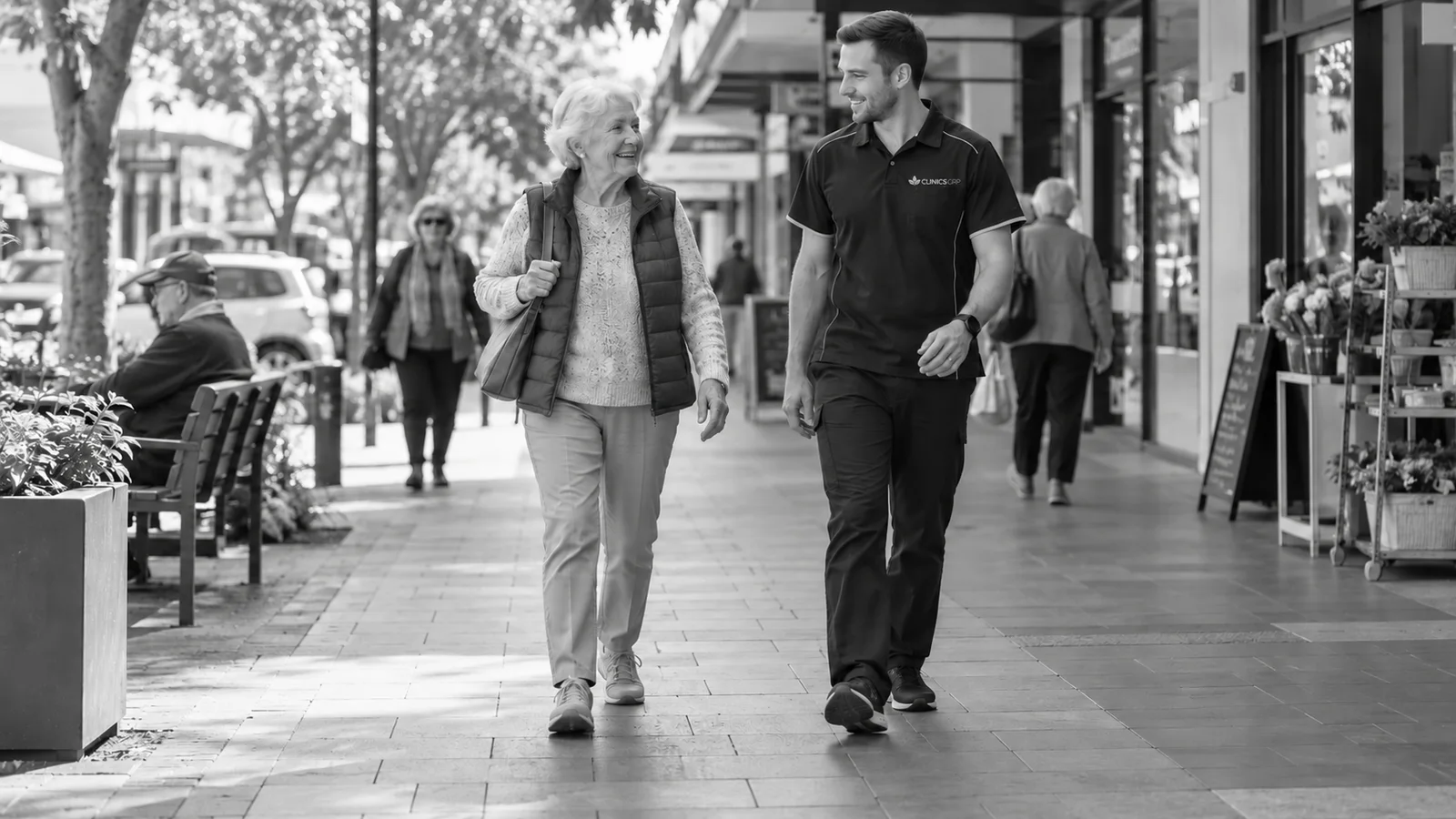
Consider walking through a shopping centre. The person may need to:
- change speed around other people
- scan signs and shopfronts
- avoid a trolley or child
- carry a bag
- remember where they are going
- respond to noise and visual motion
- turn into a narrow aisle
- continue despite fatigue.
Each demand may be manageable alone. Together, they can expose limited reserve. A person may slow down, stop talking or seek support because the combined task approaches their current capacity.
Surfaces and lighting change sensory information
Firm clinic flooring provides clear information from the feet. Even lighting makes edges and obstacles easier to see. At home and outdoors, the surface may be soft, sloped, wet or broken, while shadows and glare reduce visual certainty.
The nervous system must adjust which sensory information it relies on. If this adjustment is slow or one source is less reliable, the person may only become unsteady in the more complex setting.
This is explored further in What Happens When Sensory Information Becomes Less Reliable?.
Attention in a test is different from attention in life
During a balance test, the person knows that balance is the main task. In daily life, balance is often a background task. Attention is directed toward conversation, navigation, traffic or an object being carried.
Walking while talking can reveal a change in speed, step timing or task accuracy that is not visible during ordinary straight walking. This does not mean conversation is dangerous. It can show how the person allocates limited attention when two tasks compete.
Systematic reviews of cognitive-motor dual-task walking report consistent average effects on gait in older adults, but methods and outcome measures vary.1 Dual-task findings should be interpreted with the person's history and other assessment results.
Fatigue and time of day matter
A brief morning appointment may not reproduce the end of a long shopping trip, a hot afternoon or a poor night's sleep. Pain, medication timing, hydration and anxiety can also change performance.
Asking when the problem occurs may be as important as asking where. A diary of near-falls, symptoms and circumstances can reveal patterns that a short test cannot.
Confidence and supervision can change behaviour
People often move differently when a clinician stands nearby. Supervision may increase confidence, while the unfamiliar clinic may make another person more cautious. Neither response is false. Both are part of the context.
The clinician should ask about activity avoidance, concern about falling and the strategies used when alone. Current falls guidelines include concerns about falling and personal goals within a broad assessment.2
What does real-world measurement add?
Wearable sensors and activity monitors can measure aspects of walking outside the clinic. A systematic review of walking measured in daily life found that these observations may add information when combined with clinical tests, but the included evidence was limited and observational.3
A 2022 systematic review of wearable sensor technologies found that results depend on sensor location, sensor type, selected features and analytical methods.4 These findings support careful use rather than a universal device-derived risk score. Real-world data can enrich an assessment, but technology is not a replacement for clinical reasoning or a guaranteed fall predictor.
Measures also require context. Fewer steps could reflect poor mobility, illness, weather or a deliberate choice. More variability could reflect a complex route rather than impaired control.
Why one normal test cannot close the question
An umbrella review of instruments assessing gait, balance and functional mobility found that no single test predicted falls with high certainty. Gait speed had moderate evidence as one useful component, but results across tools were inconsistent.5
This means a normal score can be reassuring within its scope, but it does not invalidate a person's report. Likewise, a poor score does not explain the cause by itself.
How assessment can better represent daily life
A comprehensive assessment can start with the person's difficult activities and build relevant tasks safely. Depending on the concern, this may include:
- different walking speeds and distances
- turning, stopping and starting
- head movement and visual scanning
- carrying or reaching
- conversation or another cognitive task
- steps, obstacles or surface changes
- the person's usual footwear and walking aid
- assessment at home or in a relevant community setting.
Not every task belongs in every appointment. The clinician should select conditions that test a clear hypothesis and remain appropriate for the person.
The person's description is evidence too
Objective measures are valuable, but they do not make the person's account secondary. A detailed description can identify the exact combination a clinic has not reproduced: the supermarket after twenty minutes, the back step at dusk or the turn from the bed while half awake.
The clinician can test parts of that account and look for consistency. If the initial assessment is normal, a useful response is to refine the question, not to conclude that nothing is wrong. Equally, symptoms that suggest cardiovascular, neurological, visual or vestibular causes may require referral rather than repeated balance testing.
Home assessment can reveal practical barriers
At home, the issue may be a narrow bathroom turn, a loose mat, poor night lighting or difficulty managing an aid at a threshold. Seeing the task can clarify whether treatment, equipment, environmental change or a combination is most useful.
An adaptation is not an admission that rehabilitation has failed. Moving a frequently used object, adding a rail or improving lighting can reduce unnecessary demand and preserve participation while capacity is addressed.
What treatment should aim to transfer
Improvement on a clinic exercise is valuable when it transfers to the activity the person wants to perform. Treatment can progress from controlled practice to relevant variation: turns, obstacles, different surfaces, divided attention and community tasks.
Transfer should be checked rather than assumed. The person may need a different cue, aid or strategy in the real environment. Progress can include greater confidence, fewer pauses, more efficient recovery or return to a valued place.
Follow-up can use the same real-world marker that brought the person to care. This might be reaching the local shop, walking from the bedroom at night with appropriate lighting or completing a community outing without a near-fall. A task-specific outcome makes the purpose of clinic measures clearer.
When to seek assessment
Seek assessment if you feel unsteady in daily life despite passing a simple screen, if difficulty occurs in specific settings, or if near-falls and activity avoidance are increasing. Sudden neurological symptoms, fainting, chest pain, severe new dizziness or sudden inability to walk requires urgent medical assessment.
Understand more
- Balance Is More Than Strength
- Why Uneven Ground Becomes Harder as We Age
- Is Cautious Walking a Problem or a Smart Adaptation?