
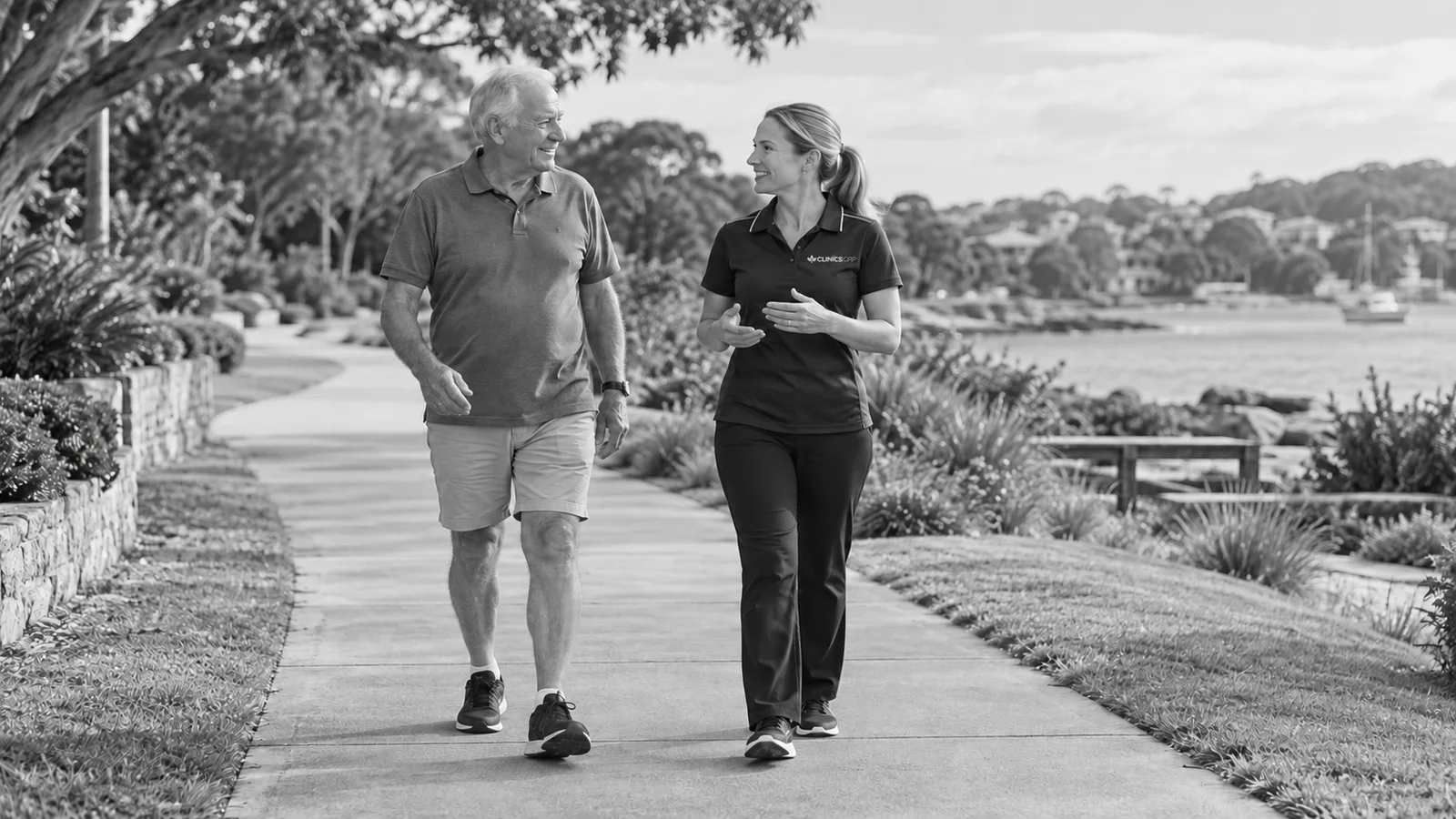
Walking and talking feels ordinary because most people have practised both for decades. Yet doing them together asks the nervous system to manage movement, attention, language and the environment at the same time.
If balance changes only when attention is divided, straight walking in a quiet clinic may not reveal it. A person may slow down, shorten steps, pause the conversation or make more errors in the talking task.
These changes do not prove that a person will fall. They provide information about reserve and task prioritisation within the broader system described in Balance Is More Than Strength.
Key points
- Walking while talking is a common example of dual-task walking.
- Performance can change in the walking task, the talking task or both.
- Slowing down may be a protective choice rather than a failure.
- The type and difficulty of the conversation affect the result.
- Dual-task findings should be interpreted with history, sensory, physical and environmental findings.
Walking is not fully automatic
Walking becomes highly practised, but it still requires control. The nervous system must regulate posture, foot placement, clearance, speed and direction while updating information about the environment.
On a clear familiar path, this may require little conscious attention. Demand rises with obstacles, crowds, turning, poor lighting, pain, unfamiliarity or fatigue. Adding conversation can expose that increased demand.
What makes talking a second task?
Talking involves listening, understanding, retrieving words, forming a response and monitoring the other person. A simple greeting is different from explaining a complex event or calculating an answer.
The added task can therefore range from casual conversation to naming words, counting backwards or responding to questions. These are not interchangeable. A useful assessment records what the second task was and how accurately it was performed.
What can change during walking while talking?
A clinician may observe:
- slower walking speed
- shorter steps
- longer time with both feet on the ground
- greater variation between steps
- reduced foot clearance
- wider or narrower step placement
- stopping before answering
- reduced accuracy or fluency in conversation
- less awareness of obstacles or direction.
The change from single-task performance is often called a dual-task cost. It can be calculated in different ways, which is one reason results across studies are not always directly comparable.
Which task does the person prioritise?
People do not always divide attention evenly. Some preserve walking and simplify the conversation. Others continue talking while gait becomes slower or less stable. A person may also stop walking to answer, an approach sometimes described as “stops walking when talking”.
Prioritising balance can be sensible in a difficult setting. The concern is whether the person notices the demand and selects an effective strategy.
The clinician should observe both tasks. If only gait is measured, a person could appear stable because they stopped engaging with the cognitive task. If only the answer is scored, an important gait change could be missed.
What does the evidence show?
A systematic review and meta-analysis found that adding a thinking task changes walking on average in older adults, including speed, cadence and stride timing.1 That group-level finding helps explain why the same person may walk differently while talking. It does not mean that a slower step during one conversation predicts a fall.
Dual-task tests vary in what they ask people to do and how they measure performance.4 A useful result therefore depends on the task, instructions and context, as well as what changes in both walking and talking. There is no universal talking test or cut-off that provides a complete individual risk prediction.
Why conversation can reveal limited reserve
Reserve is the difference between what a task requires and what the person can currently provide. If ordinary walking uses a large proportion of available attention or physical capacity, adding conversation leaves less room for adaptation.
The reason may be sensory uncertainty, pain, reduced strength or power, neurological change, anxiety, unfamiliarity or a demanding environment. The dual task reveals competition. It does not identify the cause by itself.
Why the setting changes the result
Walking while talking in a clear hallway is different from doing so on a kerb, in a crowd or while carrying a bag. Real life layers cognitive and environmental demands.
Assessment can begin in a controlled setting and progress only when appropriate. The purpose is not to distract someone into losing balance. It is to understand how task demands interact and which strategies keep the person safe.
Talking is only one kind of added task
Some people manage conversation but struggle when carrying, searching or making a time-sensitive decision. A light manual task can alter arm swing and remove the option of using a hand for support. Visual search can redirect the head and eyes. Route finding adds memory and decision-making.
This is why a negative walking-and-talking test does not exclude all dual-task difficulty. The chosen task should relate to the person's report while remaining safe and interpretable.
How should walking while talking be assessed?
A clinician can compare:
- walking without the added task
- the talking or cognitive task while seated or standing safely
- walking while completing the same added task.
This comparison shows whether performance changes because the cognitive task is difficult in itself or because combining tasks creates interference.
The clinician should use the person's usual walking aid and appropriate guarding. Hearing, language, education and familiarity with the task must be considered.
A systematic review of the measurement properties of dual-task balance assessments found wide variation in reliability and validity across tests.4 Standardising instructions and repeating comparable tasks improves usefulness, but results still belong within a comprehensive assessment.
Is stopping the conversation a problem?
Not necessarily. Pausing conversation before a step or obstacle can be a mature safety decision. Drivers turn down the radio while navigating a difficult route for a similar reason.
The question is whether the person can recognise the demand and resume the task after it passes. If every small environmental change forces walking or talking to stop, the person's reserve may be limited and everyday participation may be affected.
Can dual-task walking improve?
Practice may include walking with graded cognitive or manual tasks, but it should follow assessment. The added task can start simple and become more relevant: conversation, route finding, carrying or scanning for signs.
Strength, power, sensory, vestibular or walking-specific treatment may also improve reserve. The second task is not always the main treatment target.
Two reviews published in 2024 and 2025 found that dual-task training can improve balance and functional mobility in older adults. The larger review included 44 studies and 2,782 participants, but rated certainty across outcomes from very low to moderate.23 An earlier review also found improvements in aspects of gait-related dual-task interference.5 Programme content and outcomes vary, so training should be individualised and measured against meaningful goals rather than a generic multitasking score.
Repeated testing also needs care. Performance may improve because the person becomes familiar with the words or counting task. Using a comparable alternative and recording instructions helps distinguish practice effects from broader change.
Everyday strategies
Useful strategies can include:
- pausing conversation for steps, kerbs or road crossings
- reducing speed before turning
- using a rail or walking aid
- keeping the path clear before carrying
- completing one task at a time when fatigued
- asking a companion to wait while attention is redirected.
These strategies do not represent failure. They manage demand so that participation can continue.
Family and companions can help by avoiding complex questions at kerbs or steps and allowing time for the person to stop before answering. This supports effective prioritisation without removing conversation from ordinary life.
The same principle applies in busy places. Choosing a quieter route, stopping before checking directions and keeping one hand available can reduce competing demand. These are practical ways to manage the environment while assessment and rehabilitation address underlying capacity.
When to seek assessment
Consider assessment if walking changes markedly during conversation, if the person repeatedly stops or loses track of the route, if near-falls occur while distracted, or if family notices a new decline. Sudden confusion, weakness, speech difficulty, fainting or sudden inability to walk requires urgent medical assessment.
Understand more
- Balance Is More Than Strength
- How the Brain Keeps You Balanced
- Is Cautious Walking a Problem or a Smart Adaptation?