
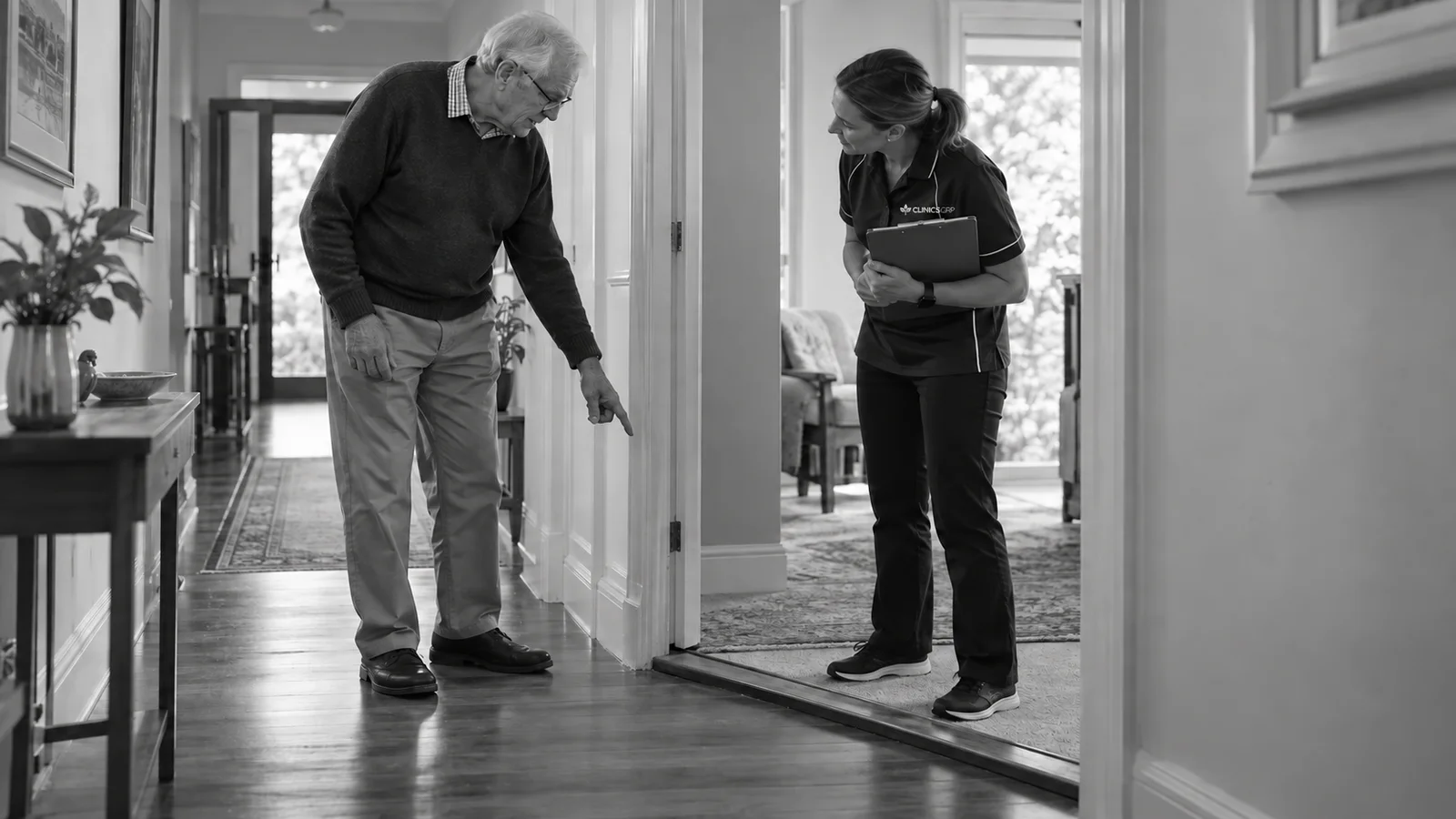
“Have you fallen?” is an important question, but it is not a complete balance assessment. A person can have substantial balance difficulty without reporting a fall. They may have caught a wall, stopped going outside, used furniture for support or changed their routine enough to avoid the situations that expose the problem.
Falls history records events that have already occurred. It does not fully describe current capacity, future exposure or the cost of staying safe.
The Clinics GRP approach in Balance Is More Than Strength considers sensory, mechanical, cognitive, psychological and environmental factors alongside meaningful participation.
Key points
- A previous fall is relevant, but absence of a fall does not prove that balance is adequate.
- Near-falls and protective reactions can reveal emerging difficulty.
- Reduced activity may lower exposure while also hiding loss of capacity.
- Confidence, dizziness, walking changes, medication, health and environment all matter.
- Assessment should connect risk factors with the person's goals and actual daily tasks.
Why falls history can underestimate difficulty
Falling is an event, not a single body characteristic. It occurs when the demands of a situation exceed the person's available response and the environment does not provide an effective recovery option.
A person with reduced balance may not fall because they rarely encounter challenging situations. Another person with good physical capacity may fall during an unusual event. Falls history is therefore influenced by both capacity and exposure.
An umbrella review found that no single gait, balance or mobility assessment predicts falls with high certainty.1 The same caution applies to one history question. Useful assessment combines several sources of information.
Falls history is still worth examining carefully
Looking beyond falls history does not mean ignoring it. Previous events can reveal triggers, injuries, recovery strategies and patterns across time. Ask where the person landed, whether they could get up, whether there was warning, and what happened afterwards.
The date matters because capacity, health and environment may have changed since the event. A fall two years ago during an acute illness has a different context from two unexplained falls this month. The history becomes more useful when it is specific rather than reduced to yes or no.
Near-falls can be early information
A near-fall may involve a slip, trip or loss of balance that is stopped by a rapid step, a hand on furniture or help from another person. The person has not reached the floor, but the event can reveal that the system was tested.
Definitions vary across studies, which limits comparison. A small prospective cohort found that reported near-falls were associated with subsequent falls, but the estimate was imprecise and should not be treated as an individual prediction.2 A feasibility study also showed that older adults can record near-falls prospectively, while highlighting the practical difficulty of defining and capturing them consistently.3
A 2026 systematic review of wearable near-fall detection found promising sensor performance, but most included studies were experimental or observational and the authors called for real-world validation.4 Technology may improve future monitoring, but it does not yet replace a careful history and contextual assessment.
Clinically, the value is not a numerical forecast. It is the detail: what disturbed balance, what recovery occurred and whether the same situation is likely to recur.
Activity restriction can hide the problem
A person may stop gardening, shopping or using stairs because these tasks feel unsafe. Their fall count remains zero, but participation has narrowed.
This creates an exposure problem. If the person no longer walks on uneven ground, falls history cannot tell us how they would manage it. Reduced activity can also contribute to loss of strength, endurance and confidence over time.
Ask what the person has stopped, changed or delegated. The difference between “can do” and “still does” is clinically meaningful.
Confidence affects behaviour
Concern about falling can lead to sensible caution, but it can also produce stiff movement, excessive visual monitoring or avoidance. Confidence should be assessed together with observed capacity.
Someone may be confident but underestimate a hazard. Another may be physically capable but remain fearful after a previous event. Neither falls history nor a single physical test resolves that mismatch.
Current falls guidelines include concerns about falling and the person's priorities when assessing the many factors that can contribute to a fall.5 This recognises that function is shaped by both capacity and perceived safety.
Walking changes may appear before a fall
Changes in speed, step length, foot clearance, turning or use of support can provide useful information. The person or family may notice shuffling, hesitation at thresholds, difficulty in crowds or a need to stop talking while walking.
These patterns do not diagnose one cause. Pain, sensation, vestibular function, vision, cognition, strength, cardiovascular response and medication may all contribute. They tell the clinician where to investigate.
Dizziness and faintness require distinction
People use the word dizzy for different experiences: spinning, light-headedness, unsteadiness or visual disturbance. The timing and trigger matter.
Symptoms when rolling in bed suggest a different pathway from faintness after standing or unsteadiness in a busy visual environment. Asking only about falls can miss these distinctions and delay appropriate review.
Medication and health changes belong in the history
Balance can change after illness, hospital admission, medication adjustment, pain flare, sleep disruption or reduced nutrition. Vision, hearing, feet, continence and cognition can influence how a person moves and plans activity.
The World Guidelines for Falls Prevention and Management recommend assessment across these domains for older adults at higher risk.5 The goal is not to create an endless checklist. It is to identify factors that could change the plan or require referral.
The environment shapes whether difficulty becomes a fall
Home layout, lighting, steps, floor surfaces, pets and bathroom access can change the demand. Community environments add traffic, crowds, kerbs, slopes and time pressure.
Ask where events occur and inspect the task when possible. A loose mat may be an obvious hazard, but the solution may also involve foot clearance, turning, urgency or aid use. Environment and individual capacity should be considered together.
Walking aids can reveal good judgement
Using a stick or frame is sometimes recorded as evidence of decline without examining its effect. An appropriate aid may prevent falls, improve sensory feedback through the hands and extend the distance a person can travel.
Assessment should consider whether the aid is the right type and height, whether it is used consistently, and what happens at doors, turns, steps and during carrying. The meaningful outcome is improved function and safety, not independence from equipment at any cost.
What should be asked alongside falls history?
A broader conversation can include:
- slips, trips, stumbles and near-falls
- use of walls, furniture, rails or another person
- change in walking speed, turning or foot clearance
- dizziness, faintness, numbness, pain or weakness
- recent illness and medication changes
- concern about falling and attention devoted to walking
- activities that are avoided or completed differently
- footwear and walking aid use
- home and community environments
- goals, responsibilities and preferred activities.
The answers guide physical examination. They do not replace it.
Assessment should produce a working explanation
The clinician may combine history with standing, walking, turning, strength, sensory, cardiovascular and cognitive findings. The aim is to explain which demands expose difficulty, which strategies are protective and which factors are modifiable.
A systematic review and meta-analysis of history questions and performance measures found that individual tools have limited ability to determine fall risk on their own.6 The most defensible approach is a structured, person-centred combination rather than a single cut-off.
Why early assessment can be useful
Waiting for a fall can mean waiting for injury or loss of confidence. A near-fall, new reliance on furniture or withdrawal from activity may be enough to justify assessment.
Early action can include treatment, equipment, environmental change, medication review or simple monitoring. The response should be proportionate. Not every change requires an intensive programme, but every person's account deserves careful consideration.
Family or carers may add observations, especially when the person has difficulty recalling events. Their account should complement the older adult's priorities and preferences rather than replace them.
When to seek urgent help
Sudden weakness, facial droop, speech difficulty, fainting, chest pain, a new severe headache or sudden inability to stand or walk requires urgent medical assessment. New or persistent dizziness, repeated near-falls or a clear decline in mobility should be discussed with an appropriate health professional.
Understand more
- Balance Is More Than Strength
- Balance, Power and Reaction Time
- Is Cautious Walking a Problem or a Smart Adaptation?