
Work with purpose
Help older adults move, recover, stay independent, and participate in the lives they value.
Careers at Clinics GRP
Meaningful older-adult healthcare. Structured professional development. A career with room to grow across clinical practice, education, quality, and leadership.
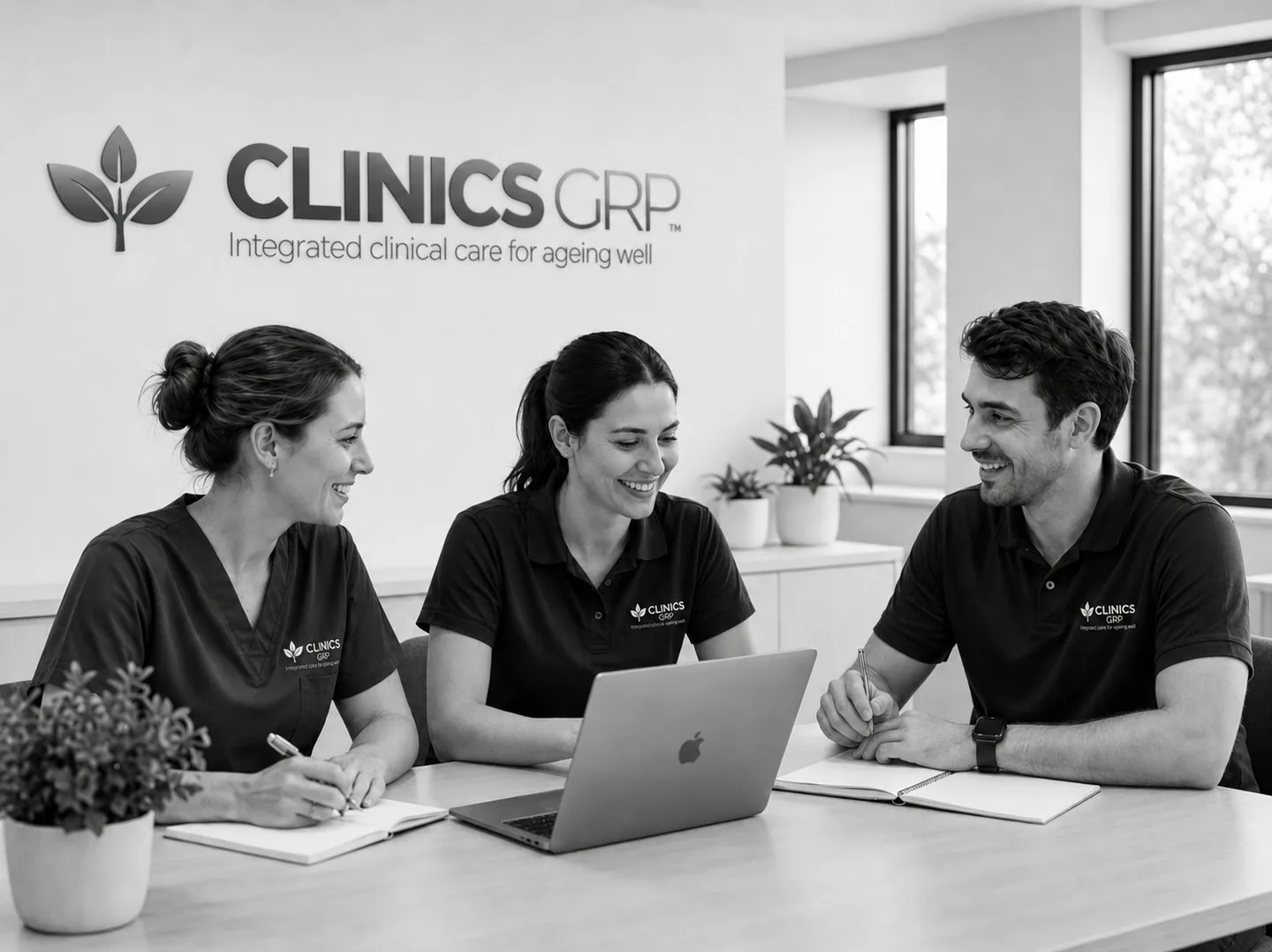
The career model connects meaningful older-adult care with the support, standards, and opportunities clinicians need to keep developing.
Help older adults move, recover, stay independent, and participate in the lives they value.
Build capability across clinic, home, community, and residential-care environments where relevant to your role.
Use clearer capability expectations and career conversations to plan your next stage.
Induction, supervision, case discussion, feedback, and education are part of safe clinical development.
Develop through mentoring, education, quality improvement, pathway design, or clinical leadership.
Work in a model that values communication, documentation, continuity, and practical teamwork.
We are building a workforce that values clinical quality, communication, continuity, curiosity, and respect for the person behind every care plan.
Movement, mobility, falls prevention, rehabilitation, and healthy ageing.
Explore the detailed pathwayAssessment, monitoring, education, escalation, and coordinated clinical care.
Explore the detailed pathwayPain, movement readiness, comfort, and recovery within a connected care team.
Explore the detailed pathwayProgressive activity, strength, balance, and confidence for healthy ageing.
Supervision, capability development, case review, and practice-based learning.
Intake, coordination, administration, and systems that make reliable care possible.
Development follows a clear rhythm while adapting to your discipline, experience, goals, and the needs of the service.
Select a step to explore the detail.
Understand the service model, care standards, documentation, and escalation pathways.
Build confidence across settings, presentations, and increasingly complex care.
Contribute to case review, education, mentoring, and service consistency.
Deepen advanced practice or shape a clinical, education, quality, or leadership pathway.
Start with the page closest to where you are now.
See how clinical, education, specialist, and leadership pathways can develop.
Explore pathwaySee how physiotherapy capability can develop beyond the graduate years.
Explore pathwayExplore capability development across connected older-adult nursing care.
Explore pathwayExplore a clinically connected remedial massage career direction.
Explore pathwayExplore our two-year GPY1 and GPY2 graduate physiotherapy program in Brisbane.
Explore pathwayReview the current Brisbane GPY1 vacancy, requirements, and direct application route.
Explore pathwayBroaden your impact through advanced practice, mentoring, and service development.
Explore pathwayStructured learning for students and university partners.
Explore pathwaySearch genuine roles that are currently open.
Explore pathwayTell the recruitment team where you would like your career to go next.
Explore pathwayNot for every pathway. Relevant clinical foundations, curiosity, communication, and a willingness to learn can be just as important. Individual vacancies explain the experience required for that role.
Roles may involve Clinics GRP clinic locations and, where relevant, home, community, or residential-care settings across Brisbane. Each vacancy states its expected location and work pattern.
The recruitment team reviews your discipline, experience, work preferences, and timing against current or developing workforce needs. An expression of interest is not a job application or a guarantee of contact.
Yes. Students can register placement interest, while university and education partners can use the clinical placements enquiry form to discuss supervised learning opportunities.