
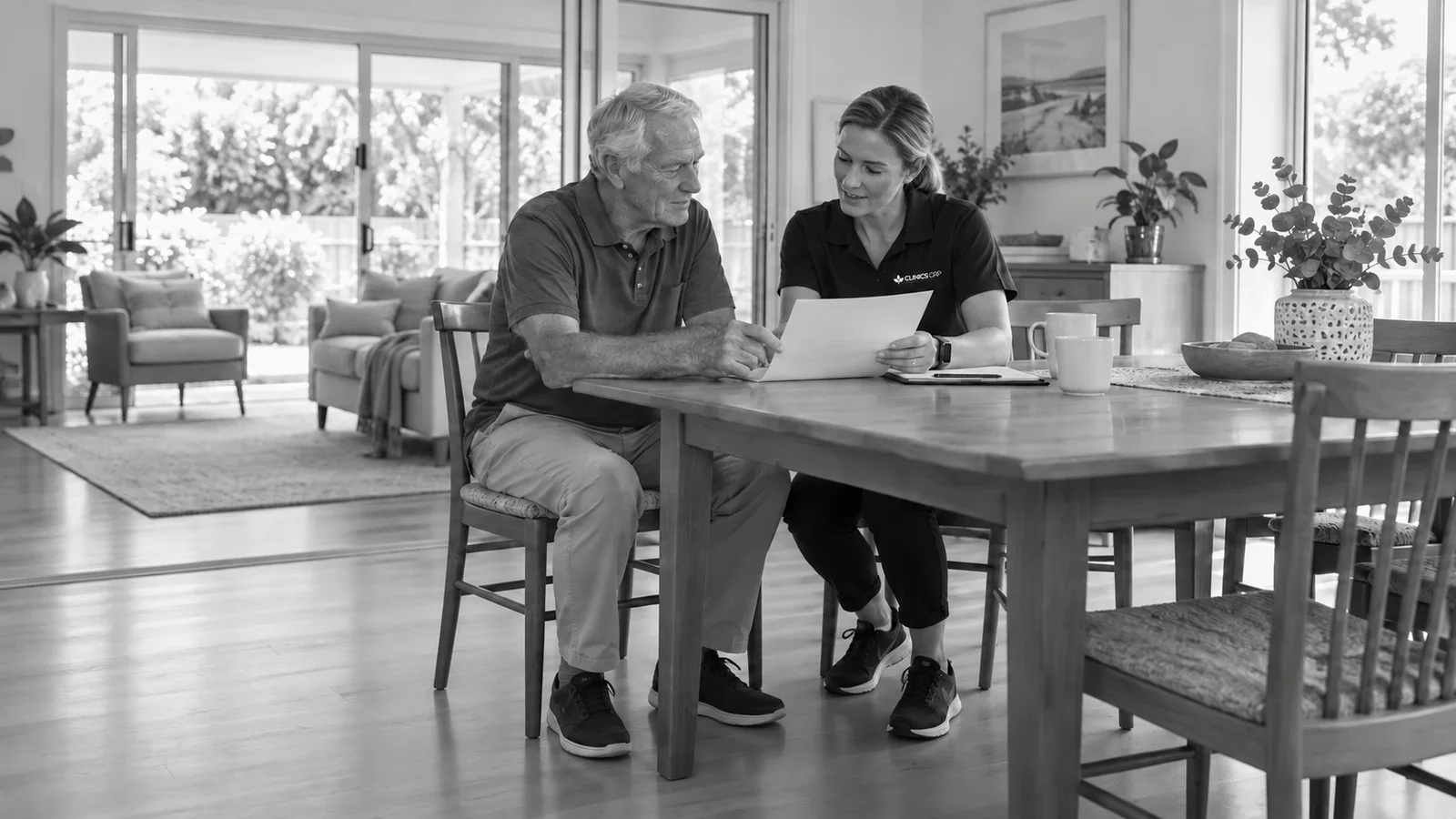
A comprehensive balance assessment is more than a test of how long someone can stand on one leg. It asks why balance has changed, when difficulty appears and what the change means for the person's life.
The assessment should connect health, sensation, movement, cognition, confidence, equipment and environment. It should also identify urgent concerns and decide whether another health professional needs to be involved.
This broad approach follows the principle in Balance Is More Than Strength: balance is an integrated capability, and the findings should lead back to meaningful participation.
Key points
- The person's history and goals direct the assessment.
- Physical tests sample different parts of balance rather than producing one complete answer.
- Medication, cardiovascular, sensory, cognitive and environmental factors may be relevant.
- Falls, near-falls, confidence and activity avoidance all provide useful information.
- The outcome should be a clear explanation and a prioritised plan, not only a score.
Start with the person's story
The first task is to understand what has changed. Useful questions include:
- When did the difficulty begin, and was the change sudden or gradual?
- Is the problem unsteadiness, dizziness, weakness, pain, faintness or something else?
- Does it occur when standing up, walking, turning, using steps or moving the head?
- Is it worse in darkness, crowds or on uneven ground?
- Have there been falls, slips, trips or near-falls?
- What was happening before and after each event?
- Which activities have become harder or are now avoided?
- What would the person most like to do more safely or confidently?
The wording matters. A person may not describe an event as a fall if they caught a bench or landed on a chair. Asking about losses of balance and near-falls can uncover important changes earlier.
Screen for urgent or medical concerns
Balance can change because of neurological, cardiovascular, vestibular, visual, medication-related and other medical factors. A clinician should consider whether symptoms require medical review or urgent action.
Sudden weakness, facial droop, speech difficulty, a new severe headache, chest pain, fainting, sudden inability to walk or severe continuous vertigo with new neurological signs requires urgent medical assessment.
Non-urgent referral may still be appropriate for new dizziness, suspected medication effects, vision change, significant foot problems, cognitive change or unexplained episodes.
Review health conditions and medication
The assessment should consider diagnoses, recent illness, surgery, pain, sleep, continence, nutrition and alcohol where relevant. Medication review is particularly important when drugs may affect alertness, blood pressure or balance.
Current international guidelines recommend assessing several contributing factors for older adults at higher fall risk. These include medication, heart and blood pressure concerns, dizziness, vision and hearing, cognition, nerve and muscle conditions, feet and footwear, nutrition, environment and concerns about falling.1
The clinician does not need to manage every domain alone. Comprehensive care often means recognising a factor and coordinating the right review.
Check cardiovascular responses
Light-headedness or unsteadiness when standing can relate to a fall in blood pressure, heart rhythm or other cardiovascular causes. Assessment may include symptoms, pulse and lying-to-standing blood pressure when appropriate.
The pattern should be documented carefully. A person who feels faint on standing needs a different pathway from someone who is stable standing still but unsteady when turning the head.
Understand the signals from the eyes, inner ears and body
Balance uses information from the eyes, the vestibular system in the inner ear, and receptors in the skin, muscles and joints.
Assessment may ask about clear vision, contrast, glare, double vision, dizziness, spinning sensations, vision that seems to bounce with head movement, numbness, altered foot sensation and the effect of different surfaces. Head movement, changes in visual information and safe surface variation may help clarify the pattern.
These findings should not be reduced to a single sensory label. The systems interact, as explained in How the Brain Keeps You Balanced.
Examine strength, power, movement and pain
Strength is important for standing up, controlling descent, climbing steps and supporting the body. Power is the ability to produce force quickly and becomes particularly relevant during a rapid recovery.
The examination may consider lower-limb strength, repeated sit-to-stand, ankle function, joint range, foot structure, pain and the ability to move the trunk. The choice of test should reflect the person's capacity and goals.
Strength findings should be integrated with timing, coordination and task performance. Strong legs do not guarantee an effective response if sensory information is uncertain or the step is initiated too late.
Sample standing balance under relevant conditions
Standing tasks may vary foot position, support surface, reach, head movement or visual information. The clinician should provide appropriate guarding and avoid removing support simply to make the task look difficult.
The observation includes how the person organises the task: excessive stiffness, breath-holding, toe gripping, delayed correction, need for hand support and ability to recover. A score may assist measurement, but the movement strategy adds clinical meaning.
Assess walking as a changing task
Walking assessment can include usual and faster speed, step length, foot clearance, symmetry, use of an aid and the ability to stop or change pace. Turning, obstacles, steps, head movement and carrying may be added when relevant.
Gait speed has moderate evidence as one useful fall-risk indicator, but an umbrella review concluded that no single gait, balance or mobility tool predicts falls with high certainty.2 A normal straight walk does not exclude difficulty in more complex conditions.
Include reactive and anticipatory control
Anticipatory balance prepares the body for an intended movement such as reaching or lifting a foot. Reactive balance responds after an unexpected disturbance.
Assessment may explore stepping to a target, changes in direction and safe responses to small disturbances. Reactive testing requires suitable expertise, guarding and an environment in which the task can be stopped immediately.
The purpose is to identify available responses, not to provoke a fall.
Consider attention and dual-task performance
People often walk while talking, scanning, carrying or deciding. A dual-task condition may show that gait slows, becomes more variable or takes priority over the added task.
The added task should be standardised enough to interpret and meaningful enough to relate to life. Education level, language, hearing and familiarity can affect cognitive task performance.
Systematic review evidence indicates that dual-task measures can detect changes in gait, but protocols and predictive value vary.3 They should complement, rather than replace, the rest of the assessment.
Review confidence, behaviour and participation
Concern about falling can change movement and reduce activity. Ask what the person avoids, whether they rush or restrict fluids, and whether they rely on another person for tasks they previously did alone.
Confidence is not a test of bravery. It can reflect previous events, current capacity and the realism of the environment. A plan should address both actual demands and the person's experience of those demands.
Examine footwear, walking aids and the environment
Footwear affects contact, comfort and clearance. A walking aid should be appropriate in type, height and condition, and the person should be able to use it during turns, thresholds and everyday tasks.
Environmental review can identify lighting, rails, steps, clutter, pets, bathroom access and the routes the person uses. Australian falls guidance released in 2025 emphasises person-centred, evidence-based assessment and prevention across care settings.4
Changing the environment can remove avoidable risk while rehabilitation builds capacity.
What should the person receive at the end?
A useful assessment ends with an explanation:
- the main findings and how they relate to symptoms
- factors that need medical or other professional review
- the tasks and environments that reveal difficulty
- protective strategies that are helping
- priorities for treatment, equipment or adaptation
- how progress will be measured against the person's goals.
The explanation should acknowledge uncertainty. A balance assessment estimates contributors and options. It cannot promise that a fall will or will not occur.
When to arrange an assessment
Assessment is appropriate after a fall, near-fall or noticeable change in balance, and when dizziness, walking difficulty, activity avoidance or concern about falling is increasing. It may also be useful before returning to a demanding activity after illness or injury.
Understand more
- Balance Is More Than Strength
- Why Strength Training Alone May Not Fix Balance Problems
- Balance, Power and Reaction Time