
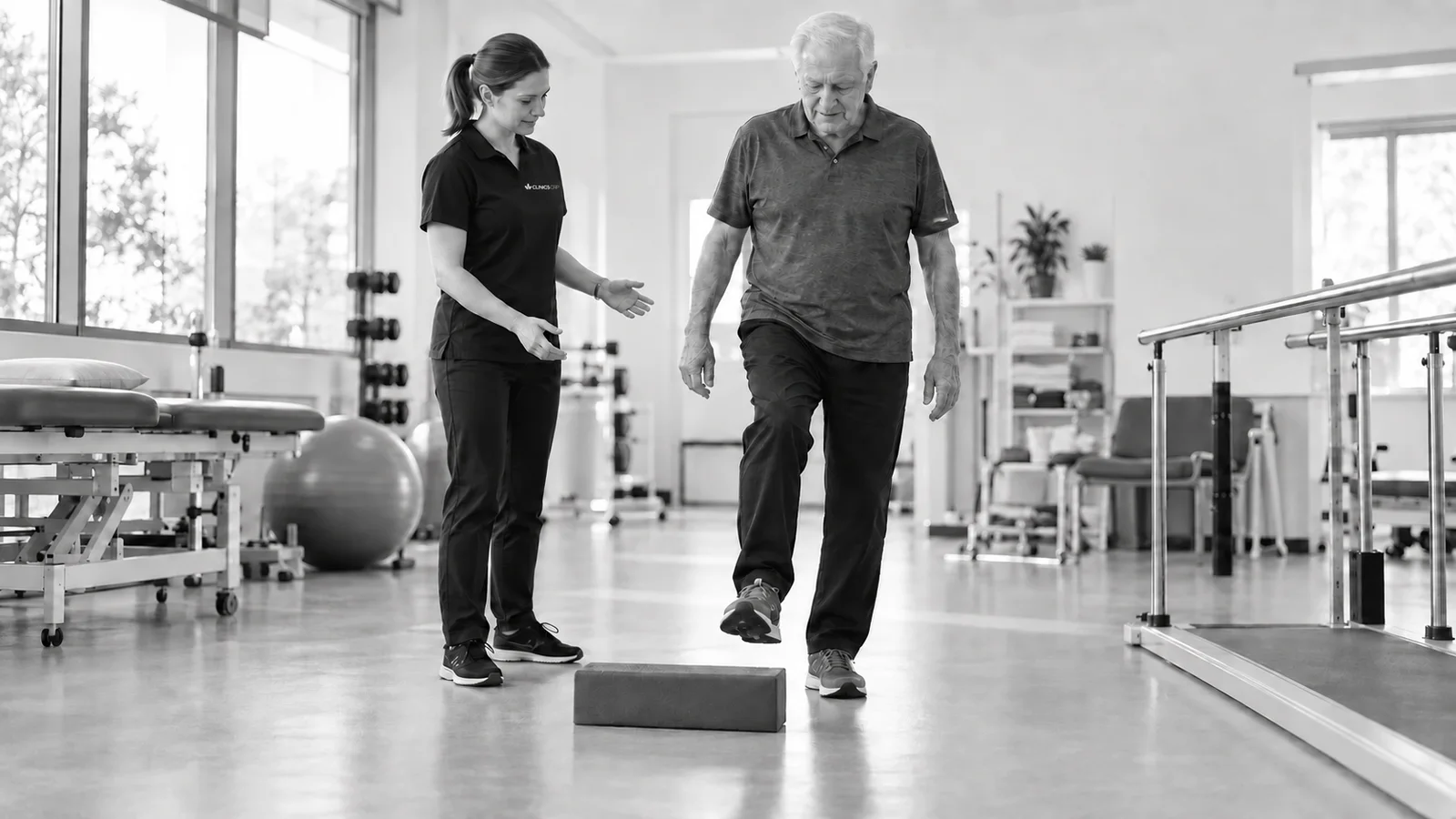
A near-fall is a loss of balance that does not end on the ground because the person recovers. They may take a quick step, grab furniture, use a rail or receive help from someone nearby.
It is easy to dismiss the event because no injury occurred. Yet a near-fall can provide useful information about what disturbed balance, what recovery strategy was available and whether the same situation is likely to happen again.
Near-falls fit the Clinics GRP approach in Balance Is More Than Strength: balance includes detection, reaction, movement capacity, confidence and environment, not only whether a fall was recorded.
Key points
- A near-fall involves a loss of balance and a successful recovery.
- The event can reveal a trip, slip, turn, sensory or attention challenge.
- Near-fall definitions vary, so counts are not a precise prediction tool.
- The recovery response is as important as the disturbance.
- Repeated near-falls, changed confidence or reduced activity justify assessment.
What counts as a near-fall?
There is no single definition used across all research. Common descriptions include a slip, trip or loss of balance that would have resulted in a fall if the person had not recovered.
Examples include:
- catching the toe and taking two rapid steps
- slipping but holding a bench
- losing balance during a turn and reaching the wall
- being steadied by another person
- sitting unexpectedly onto a nearby chair
- stumbling on a kerb and regaining control.
A deliberate use of a rail during a planned task is not necessarily a near-fall. The distinction is whether an unexpected loss of balance required recovery.
Why near-falls are often missed
People may not mention an event because they were not injured, feel embarrassed or consider it a normal part of ageing. They may also use different words: stumble, wobble, misstep or “I nearly went”.
Recall can be difficult when events are frequent or seem minor. A short prospective diary may capture more detail than asking about the previous year.
A feasibility study found that older adults could report near-falls prospectively, but it also highlighted challenges in definition and recording.1 This is why the story around each event matters more than a raw count alone.
The disturbance provides one part of the explanation
Ask what happened immediately before the near-fall:
- Did the foot catch an obstacle?
- Did the surface move or change?
- Was the person turning or stepping backwards?
- Did dizziness or faintness occur?
- Were they carrying, talking or rushing?
- Was lighting poor?
- Was the walking aid available and correctly used?
The trigger may be external, internal or a combination. A rug can be a hazard, but foot clearance and attention may explain why it caused difficulty on that occasion.
The recovery tells us about available responses
Recovery may involve an ankle or hip adjustment, a rapid step, a reach or use of support. The response shows which options the person could access under time pressure.
A successful recovery is evidence of capacity, but it may also have been narrow. If the wall had not been present or the step had been slower, the outcome could have differed.
This is why Balance, Power and Reaction Time distinguishes recovery from quiet standing.
What does research suggest about future falls?
A small prospective study found that near-falls were associated with subsequent falls in community-dwelling older adults.2 The confidence interval was wide, and one small study cannot provide a precise prediction for an individual.
Other observational work has examined balance provocations and near-fall responses, supporting their clinical relevance while showing that the field still lacks fully standardised measurement.3
A 2026 systematic review of wearable technologies for detecting near-falls included 18 mostly experimental or observational studies. Sensor performance was promising, but the authors identified a need for validation in real-world settings and assessment of acceptability.4 The technology is developing, yet it does not turn a near-fall count into a certain forecast.
The responsible conclusion is that near-falls deserve attention. It is not that every near-fall predicts an imminent fall.
Frequency, pattern and consequences all matter
One unusual event on a difficult hike is different from several near-falls each week in the hallway. Assessment should consider:
- how often events occur
- whether the pattern is changing
- common triggers and locations
- the recovery used
- injuries or pain caused during recovery
- confidence afterwards
- activities that have been changed or stopped.
The consequences may include more than physical injury. A person might stop visiting friends, shower less often or rely on furniture indoors.
Exposure changes how the count should be understood
Near-fall frequency depends partly on opportunity. A person who walks outdoors every day encounters more variable surfaces than someone who has stopped leaving home. A falling count could mean improvement, but it could also mean reduced exposure.
Ask what the person was doing during the period being compared. Changes in activity, supervision, aid use and environment help explain whether the count represents better control or a narrower life.
Near-falls can reveal adaptability
A well-timed recovery step is an adaptive response. Holding a rail on stairs is also appropriate. The concern is whether the response is available, effective and suited to the environment.
Someone who always reaches for furniture may have support at home but no strategy in an open car park. Someone who can step quickly may still struggle when carrying an object or turning.
Assessment can explore how recovery changes across relevant conditions without deliberately creating unsafe situations.
Confidence can change after a near-fall
A near-fall can be frightening. The person may slow down, stiffen or avoid the place where it occurred. These reactions can protect in the short term, but persistent avoidance may reduce activity and confidence.
Concern about falling belongs in the assessment. It should be discussed without minimising the event or assuming that fear is the only problem.
Current international falls guidance recommends a person-centred assessment of several contributing factors for older adults at higher risk. These include walking and balance, strength, medication, heart and blood pressure concerns, dizziness, vision, cognition, feet, environment and concerns about falling.5
What should an assessment include?
The clinician may examine:
- the detailed event history
- walking, turning and foot clearance
- strength, power and joint movement
- preparation for movement and quick recovery responses
- information from the eyes, inner ears, skin, muscles and joints
- lying and standing blood pressure when indicated
- medication and health changes
- cognition and divided attention
- footwear, walking aid and environment
- confidence, activity and goals.
No single test can guarantee whether a future fall will occur. An umbrella review found inconsistent fall-prediction performance across common gait and balance tools.6 The value comes from combining evidence and deciding what action is reasonable.
What action might follow?
The response depends on the findings. It may include:
- medical, medication, vision or vestibular review
- strength, power and balance training
- reactive stepping or turning practice
- changes to footwear or a walking aid
- lighting, rail or layout changes
- strategies for divided attention or rushing
- graded return to an avoided activity
- monitoring if the event was isolated and no ongoing concern is found.
An adaptation can improve function immediately while rehabilitation develops capacity. Installing a rail or using an aid does not remove the value of treatment.
Keeping a useful record
After a near-fall, note the date, place, task, symptoms, footwear, aid, trigger and recovery. Record whether fatigue, rushing or distraction was present. This information can reveal patterns and make an assessment more precise.
Avoid repeatedly recreating the event alone. A clinician can decide which elements can be tested safely.
How family and carers can help
Another person may notice events, changes in walking or increasing furniture use. They can record the circumstances and help identify patterns, particularly when recall is difficult.
Support should remain proportionate. Hovering or taking over every task can reduce confidence and practice. A clinician can help families distinguish when close assistance is needed, when equipment is useful and when the person can move independently.
After a near-fall, check for pain or injury even if the person remained upright. A forceful grab or recovery step can strain a shoulder, back or leg.
When to seek urgent help
A near-fall accompanied by fainting, chest pain, sudden weakness, facial droop, speech difficulty, a new severe headache or sudden inability to walk requires urgent medical assessment. Seek timely assessment for repeated near-falls, new dizziness, unexplained episodes or a clear decline in walking and confidence.
Understand more
- Balance Is More Than Strength
- Balance, Power and Reaction Time
- Why Uneven Ground Becomes Harder as We Age