
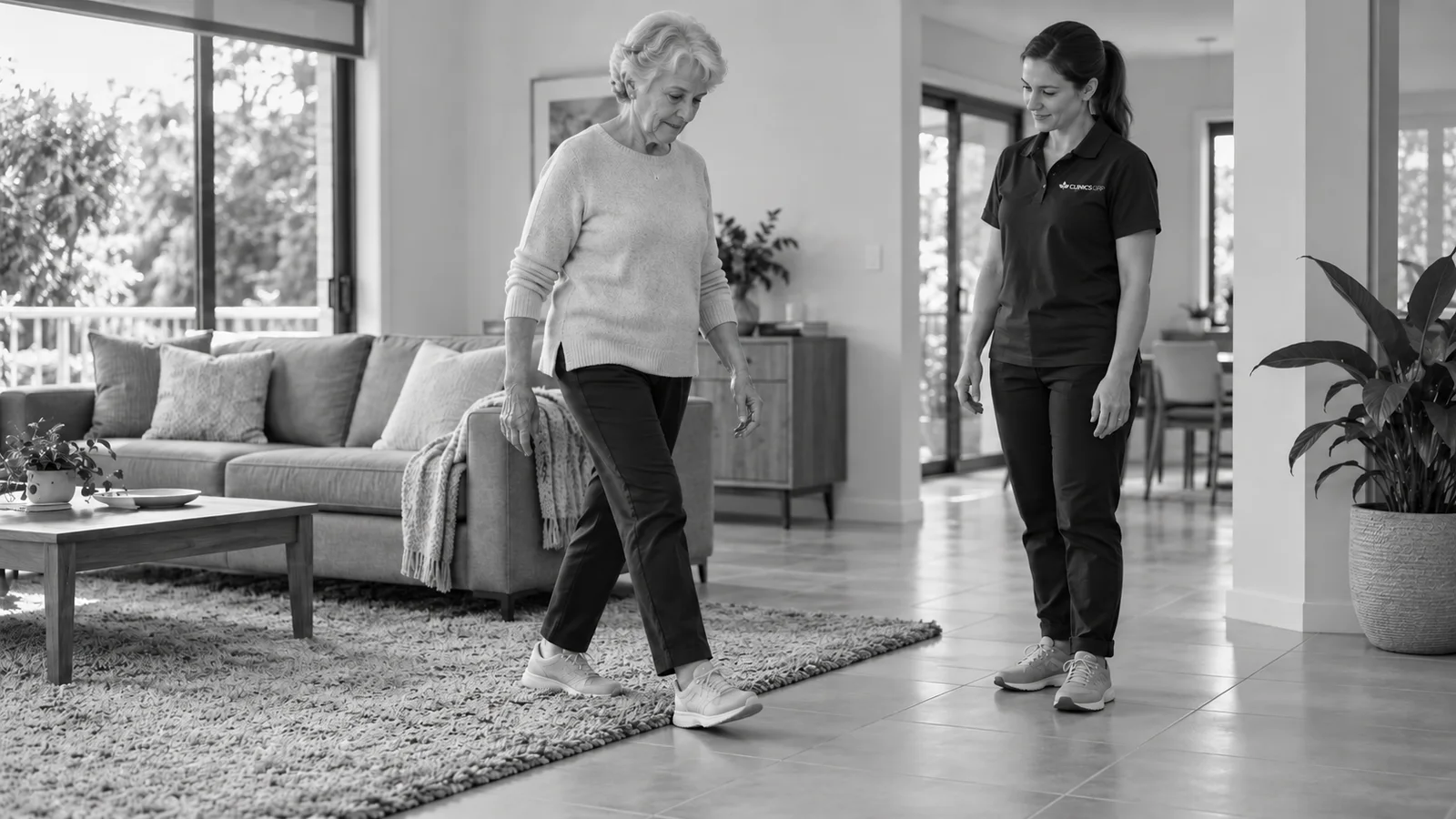
Balance is sometimes described as if it were a single physical skill. In everyday life, it is closer to a continuous conversation. Your eyes, inner ears, feet, joints and skin provide information. Your brain and spinal cord interpret that information in the context of what you are trying to do. Your muscles then produce a response, and the result of that movement creates new sensory information.
That loop is called sensorimotor control. The word joins two ideas: sensory information coming into the nervous system, and motor action going out to the body. The process helps you stand, walk, turn, reach, step over an obstacle and recover when something unexpected disturbs you.
Sensorimotor control is central to the Clinics GRP view that balance is more than strength. Strength matters, but useful balance also depends on detecting what is happening, choosing an appropriate response and producing that response at the right time.
Key points
- Sensorimotor control links sensation, interpretation and movement.
- It is active during ordinary tasks, including standing up, walking and turning.
- The system continually updates its response as the person, task and environment change.
- Ageing can affect several parts of the loop, but change is not identical for every person.
- A useful assessment looks for where the process becomes less reliable and how that affects meaningful activity.
A simple example: stepping from carpet onto tile
Imagine walking from a carpeted room onto a smooth tiled floor. Before your foot lands, vision gives information about the surface ahead. As the foot contacts the tile, receptors in the skin, muscles and joints provide information about pressure, position and movement. The vestibular system in the inner ear helps indicate how the head is moving in relation to gravity.
The nervous system combines these signals with your goal, your previous experience and your estimate of the surface. It adjusts muscle activity, step length and body position. If the tile is more slippery than expected, the response may need to change again within a fraction of a second.
This is sensorimotor control in practice. It is not a sequence that happens once. It is an updating process. The body predicts, senses, responds and checks the result.
The sensory side of the conversation
Three sensory systems make major contributions to balance.
Vision provides information about the surroundings, the direction of movement and the relationship between the body and objects nearby. It helps identify edges, steps, obstacles and changes in surface.
The vestibular system detects head movement and head position relative to gravity. It also contributes to keeping vision stable while the head moves.
Somatosensory information comes from the skin, muscles and joints. Proprioception is part of this system. It helps the nervous system estimate where body parts are and how they are moving without having to watch them.
These systems overlap. The nervous system does not simply add three equally reliable readings together. It adjusts how much it relies on each source according to the situation, a process discussed in how the brain keeps you balanced. Foundational work on postural control describes this flexible integration as a key part of maintaining orientation and stability.1
The motor side of the conversation
Once the nervous system has interpreted the situation, movement still has to be organised. That includes selecting a response, activating muscles in a useful sequence and scaling the response to the task.
For a small, slow disturbance while standing, the body may make subtle adjustments around the ankles or hips. A larger disturbance may require a rapid step or a hand reaching for support. During walking, the system must control the moving body while one foot is off the ground. During a turn, it must redirect the head, trunk and feet while continuing to manage momentum.
Muscle strength contributes to these actions, but so do power, joint movement, coordination, timing and the ability to change strategy. This is why a person can become stronger yet still report difficulty on uneven ground, in dim light or when turning quickly.
The brain also uses prediction
Sensorimotor control is not purely reactive. The nervous system uses past experience and the visible task to prepare for what is likely to happen.
When you approach a step, your body begins organising the movement before the leading foot reaches it. When you lift a shopping bag that looks heavy, muscle activity is prepared in advance. When the load is lighter or heavier than expected, sensory feedback helps correct the movement.
This combination of preparation and correction makes movement efficient. It also explains why an unfamiliar environment can feel more demanding. There is less reliable experience to draw on, so the person may slow down, look more carefully or seek support.
What may change with age?
Healthy ageing can be accompanied by changes in vision, vestibular function, sensation, muscle function, reaction and cognition. Health conditions, pain, medication effects, footwear and reduced activity can also influence the sensorimotor loop. These factors vary widely between people.
Current systematic review evidence suggests that exercises involving sensorimotor or proprioceptive challenges can improve some measures of balance and function in older adults, but the studies use varied programmes and outcomes.2 More recent reviews of multisensory approaches also report potential benefits while highlighting differences in methods, participant groups and certainty.3 These findings support individualised practice, not a claim that one exercise or one sensory system explains every balance problem.
Why the environment matters
A person does not bring a fixed amount of balance to every situation. Performance emerges from the interaction between the person, the task and the environment.
Standing in a quiet room with good lighting is different from walking across grass while looking for a gate. A familiar hallway is different from a crowded shop. Carrying a cup, talking to another person or moving quickly to answer a door changes the task.
The World Guidelines for Falls Prevention and Management recommend a broad, person-centred assessment when risk is higher. Relevant domains include gait and balance, strength, medications, cardiovascular factors, dizziness, vision and hearing, cognition, feet and footwear, the environment, confidence and the person's goals.4 That breadth reflects the integrated nature of sensorimotor control.
What can a sensorimotor assessment explore?
A clinician may observe how a person performs under several conditions rather than relying on one standing test. Depending on the person's history and goals, assessment may include:
- standing and walking with different bases of support
- changes in lighting or visual information when appropriate and safe
- head movement, turning and changes of direction
- different surfaces, obstacles or step tasks
- reaction to a small loss of balance
- walking while carrying, looking or talking
- strength, power, joint movement and foot function
- dizziness, sensation, confidence and attention
- the walking aid, footwear and environments the person actually uses.
No single gait or balance test predicts future falls with high certainty. An umbrella review found inconsistent predictive performance across commonly used tools and supported gait speed as one useful element within a comprehensive evaluation.5 The purpose of assessment is therefore not to reduce a person to one score. It is to build an explanation that connects findings with real tasks.
What treatment may involve
Treatment should follow the assessment. One person may need progressive strength and power work. Another may need practice using sensory information under carefully graded conditions. Others may benefit from turning, stepping, walking outdoors, dual-task practice, vestibular rehabilitation, footwear changes, a walking aid or changes to the home.
The difficulty should be sufficient to promote learning while remaining safe and purposeful. The aim is not perfect stillness. It is a system that can detect change, organise an effective response and support the activities that matter to the person.
When to seek assessment
Consider an assessment if balance has changed, if you have had a fall or near-fall, if dizziness is new or persistent, or if you are avoiding valued activities because movement feels less secure. Sudden severe dizziness, new weakness, facial droop, difficulty speaking, chest pain, fainting or a sudden inability to walk requires urgent medical assessment.
Understand more
- Balance Is More Than Strength: The Clinics GRP Approach to Balance in Older Adults
- How the Brain Keeps You Balanced
- What Is Proprioception and Why Does It Matter for Balance?