
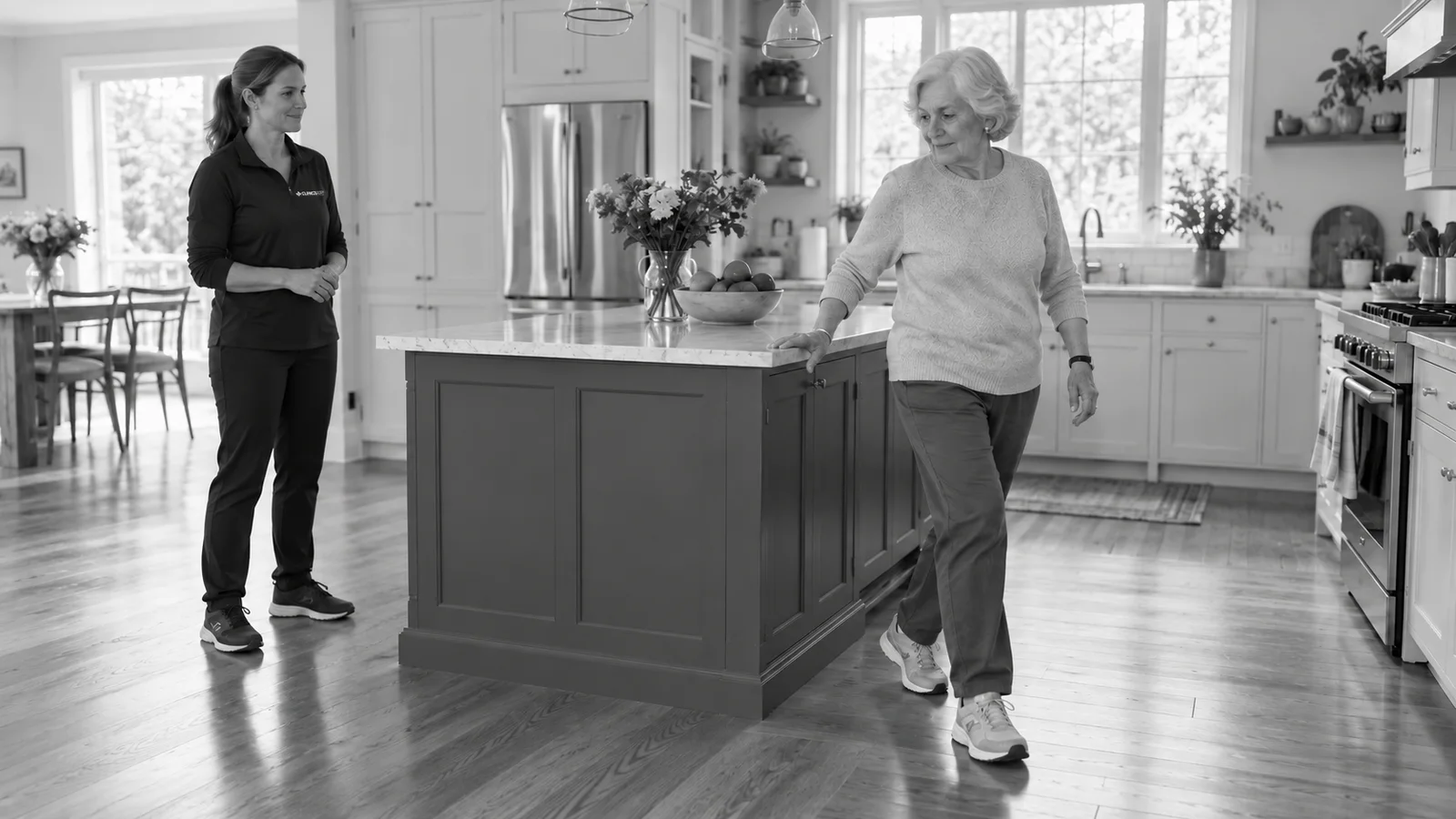
Walking in a straight line is only one part of mobility. Daily life is full of turns: leaving a chair, entering a bathroom, moving around a kitchen bench, changing direction in a hallway or looking back when someone calls.
Turning is important because it combines several balance demands in a short period. The head and eyes redirect, the trunk rotates, the feet create a new base of support and the body manages momentum. Attention may also be divided by the destination, other people or objects being carried.
That makes turning a useful part of the integrated assessment described in Balance Is More Than Strength.
Key points
- Turning changes direction while the body is moving.
- It challenges visual, vestibular, sensory, mechanical and cognitive control.
- The number of steps is only one feature; timing, foot clearance and strategy also matter.
- Several small steps may be appropriate in a narrow or uncertain setting.
- Assessment should include turns that reflect the person's actual environments and goals.
Why a turn is more complex than straight walking
During straight walking, the body repeats a broadly cyclical pattern. Turning changes that pattern. The inside and outside legs travel different distances, step placement becomes asymmetric and the centre of mass must be redirected.
The person must decide how sharply to turn and how much to slow down. A quick open turn may be appropriate in a clear space. A narrow bathroom may require several small steps.
The best strategy depends on the environment. There is no ideal number of steps for every person and every turn.
The head and eyes often lead
People commonly look toward the new direction before the feet complete the turn. This visual preview helps plan the route. The vestibular system detects head movement and contributes to keeping vision stable.
If head movement provokes dizziness or blurred vision, the person may turn the whole body as one unit or avoid looking ahead. If vision is reduced, the destination and obstacles may be harder to judge. If foot sensation is uncertain, precise placement can require more attention.
Turning therefore offers information that a straight, head-forward walk may miss.
Momentum has to be redirected
The moving body carries momentum. A turn requires braking, rotation and re-acceleration. Strength contributes, but timing, power, joint movement and coordination are also important.
A person may slow before the turn to reduce demand. This can be protective. Difficulty arises when slowing is insufficient, when the feet cross unexpectedly, or when the person cannot restart smoothly.
The article Balance, Power and Reaction Time explains why rapid responses depend on more than maximum strength.
Common turning strategies
People may use:
- a step turn with several steps around an arc
- a pivot-like turn over one foot
- a wider turn that preserves forward movement
- a pause, then a sequence of small steps
- a hand on a rail, bench or walking aid.
Each strategy can be appropriate. Pivoting may be quick but mechanically demanding. Multiple steps may provide control but take more time. Hand support can add stability and sensory information.
Assessment should ask whether the strategy is deliberate, efficient enough for the task and adaptable when space changes.
What might a clinician observe?
Useful observations include:
- preparation and slowing before the turn
- head and trunk sequence
- number, size and rhythm of steps
- foot clearance and crossing
- width of the base of support
- pauses or freezing
- use of hands or an aid
- dizziness, pain or loss of orientation
- stability when the person starts walking again.
The direction matters. Pain, weakness, vestibular asymmetry, vision and environment can make one direction different from the other.
What does research tell us?
An observational study using wearable sensors compared 30 older adults with a history of falls and 30 without. The faller group took longer and used more steps during a 180 degree turn. Both groups changed gait as they entered the turn, and the authors described the faller pattern as a possible cautionary strategy.1
This study supports close observation of turning but does not establish a diagnostic threshold. The sample was small, and turning differences can have several explanations.
A systematic review of whether dual-task tests predict falls noted that tests involving turns and transfers may be promising, while overall evidence remained heterogeneous.2 A broader umbrella review found that no single gait or balance test predicts falls with high certainty.3
The practical conclusion is to include turning within a comprehensive assessment, not to treat one turn time or step count as a verdict.
Current international falls guidance supports assessing gait and balance within a broader review of strength, medication, cardiovascular, sensory, cognitive, environmental and confidence factors.4 Turning contributes a useful task sample inside that assessment.
A turn should be tested more than one way
One scripted 180 degree turn provides limited information. When appropriate, the clinician can compare left and right, open and narrow space, planned and naturally occurring turns, and turns made with the person's usual aid.
The destination also matters. Turning around a cone is different from turning to sit, enter a doorway or reach a bench. A turn-to-sit adds judgement of distance and controlled lowering. A turn after someone calls adds head movement and attention.
Variation should remain purposeful and safe. It is not necessary to test every angle or make the person dizzy. The aim is to reproduce the situations that matter and identify whether the strategy changes effectively.
Why turning while talking is different again
Conversation, route finding or carrying can change how a person turns. They must allocate attention between the turn, the environment and the added task.
Someone may stop talking before the turn, which can be an effective strategy. Another may keep talking but miss the intended direction or become less stable. Both the movement and the second task should be observed.
Learn more in What Is Dual-Task Walking and Why Does It Matter?.
Turning in the home
Many important turns happen in small spaces: beside the bed, around a toilet, at the shower entrance or between a bench and table. Furniture, doors and an aid can restrict foot placement.
A clinic test around a cone may identify a general issue, but it may not reproduce the person's actual problem. Home assessment can show whether the solution involves practice, aid technique, a rail, furniture position or another change.
Turning with a walking aid
A stick or frame changes the base of support and sequence of movement. The aid needs to stay available during the turn rather than being lifted, left behind or placed too far away.
The correct technique depends on the aid, the space and the person's capacity. Assessment should include real doors, thresholds and destinations when possible.
An aid that makes turning slower may still improve safety and independence. Speed is one outcome, not the only outcome.
How turning can be trained
Training may begin with deliberate turns in a clear space and progress through:
- both directions
- different turn angles
- changes in speed
- head and visual scanning
- narrow spaces
- a walking aid
- carrying or conversation
- relevant home or community routes.
Strength, power, ankle movement, vestibular rehabilitation or reactive stepping may be included according to assessment findings.
The clinician should avoid prescribing rapid pivoting simply because it uses fewer steps. The goal is a stable, efficient and adaptable strategy for the person's real task.
Progress can include less hesitation, clearer foot placement, improved head movement, safer use of an aid or more confidence in a previously avoided room. These changes may be more meaningful than completing the turn with fewer steps.
Practical strategies
Helpful options can include slowing before the turn, looking toward the destination, clearing enough space, keeping the aid close and using several controlled steps. Good lighting and contrast at thresholds can reduce uncertainty.
If a person becomes dizzy, freezes or repeatedly loses balance during turns, assessment is preferable to relying on a generic cue.
When to seek assessment
Seek assessment if turning causes near-falls, dizziness, foot crossing, freezing, repeated grabbing or avoidance of small spaces. Sudden severe dizziness, new weakness, speech difficulty, fainting or sudden inability to turn or walk requires urgent medical assessment.
Understand more
- Balance Is More Than Strength
- Balance, Power and Reaction Time
- How the Vestibular System Affects Balance in Older Adults