
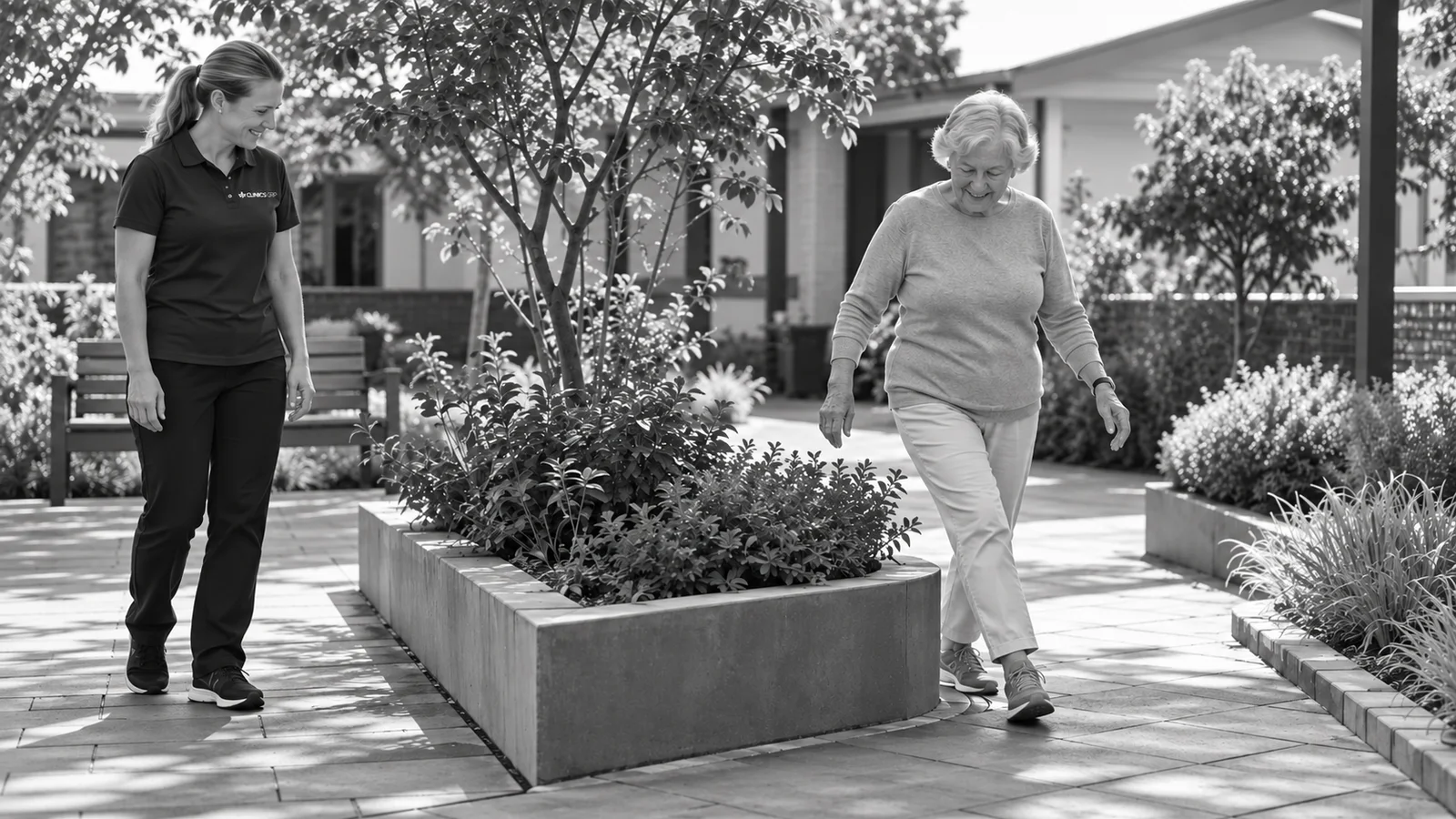
Standing still is one way to sample balance, but it is not the main way people use balance in daily life. Most meaningful tasks involve movement: standing up, reaching, turning, walking, carrying, stepping over an obstacle or responding when the ground is not as expected.
Good balance is therefore better understood as adaptability. It is the capacity to select and change a movement strategy as the person, task and environment change.
This view fits the Clinics GRP approach described in Balance Is More Than Strength. Strength supports balance, but balance also requires sensory integration, prediction, attention, coordination, confidence and the ability to respond to error.
Key points
- Normal standing includes small movements. Perfect stillness is not the goal.
- Daily balance requires transitions, turning, stepping and responses to unexpected events.
- Adaptability means having more than one effective strategy.
- The best assessment varies tasks and connects findings with meaningful activity.
- Training should be specific enough to the person's real demands and progressed safely.
Why the body is never completely still
During quiet standing, the body makes small adjustments. Pressure moves beneath the feet, muscles change activity and sensory information is updated. This movement is part of control, not evidence that control has failed.
A sway measure can provide useful information in some contexts, but less sway is not always equivalent to better function. A person may reduce sway by stiffening, holding their breath or gripping with the toes. That strategy might help briefly but offer fewer options when a larger disturbance occurs.
The practical goal is enough stability for the task, with the capacity to move when movement is required.
Stability and mobility work together
Balance involves a changing relationship between the body's centre of mass and its base of support. During standing, both feet usually form the base. During walking, the base changes with every step. During single-leg support, it becomes much smaller. During a rapid recovery step, a new base must be created in the right place.
Mobility is therefore not the opposite of stability. Functional stability depends on controlled mobility. A person must be able to move the trunk, transfer weight and step without losing the ability to organise the next action.
Adaptability means choosing among strategies
Small disturbances may be managed through ankle or hip adjustments. Larger disturbances may require a step or a reach for support. A narrow space may require several small turning steps, while an open space may allow a wider turn.
No one strategy is ideal for every problem. Adaptability means that the person can access different responses and scale them to the demand.
This is why simply repeating one static pose has limits. It may improve that pose, but the transfer to walking, obstacles or real-world perturbations cannot be assumed.
Anticipatory and reactive balance
Some adjustments happen before the movement. The body prepares when reaching for an object, lifting a foot or changing direction. These are anticipatory adjustments.
Other responses occur after an unexpected event. A slip, trip, bump or moving bus creates a disturbance that must be managed quickly. Reactive balance may include rapid muscle activity, a recovery step or use of a hand.
The article Balance, Power and Reaction Time explains why recovering from a trip is different from standing still.
Adaptability also involves perception and decisions
The nervous system must recognise the demand before it can select a useful response. A person approaching a kerb estimates its height, the available support, traffic, surface conditions and their own capacity. They may step up, use a rail, choose a ramp or wait for more time.
Each option can be functional. Adaptability includes choosing the safer route, not only performing the hardest movement.
Walking aids and environmental adaptations can expand options. A correctly used aid may allow a person to cover more distance, manage a surface and direct attention to the environment rather than to every step.
What does the evidence say about adaptable gait training?
A systematic review and meta-analysis of gait adaptability training in community-dwelling older adults found a reduction in fall rates across included trials, although certainty varied by outcome and some findings were based on small numbers of studies.1 The training commonly required people to adjust stepping to environmental demands rather than walk in an unchanging pattern.
This evidence supports task variation as one element of fall prevention. It does not mean that obstacle or perturbation practice is suitable for everyone or should be attempted without appropriate supervision.
Research on perturbation-based balance training also suggests potential benefits for reactive balance and fall-related outcomes, with variation in protocols, settings and participant characteristics.2 The safest interpretation is that recovery responses can be trainable, but the method and challenge must fit the person.
Why adaptability may narrow
The range of available strategies may reduce because of:
- lower strength or power
- pain or restricted joint movement
- reduced sensation or vestibular function
- visual change
- slower reaction or processing
- neurological or cardiovascular conditions
- fear after a fall
- limited exposure to varied tasks
- an unsuitable walking aid or environment.
These factors can combine. A person may have enough leg strength for a step but insufficient time to organise it during a sudden disturbance. Another may respond quickly but lack the ankle movement needed for an incline.
Adaptation is not the same as making every task harder
Useful adaptation can include changing the environment or selecting equipment. A person who chooses a ramp, switches on a light or uses a rail is responding to the actual demand. These decisions can preserve energy for the parts of the task that cannot be simplified.
Training should distinguish necessary challenge from avoidable hazard. A clear obstacle course may be useful practice under supervision. A loose mat in a dark hallway offers uncertainty without a controlled learning purpose. Improving the environment and improving the person can occur together.
How can adaptability be assessed?
Assessment can sample different demands, such as:
- sit-to-stand and controlled lowering
- changes in walking speed
- turns in both directions
- reaching and carrying
- stepping over or around an obstacle
- narrow spaces and changes of surface
- head movement and visual scanning
- an added cognitive task
- responses to a small, safely delivered disturbance
- use of the person's usual walking aid.
The aim is not to create a circus of difficult tests. Each task should answer a clinical question and relate to the person's goals.
An umbrella review found that no single gait, balance or functional mobility tool predicts falls with high certainty.3 Current international guidance recommends a broad assessment that includes physical, medical, sensory, cognitive, psychological and environmental domains.4
What adaptable training can look like
Training may begin with a stable task and gradually vary one element. A person might practise shifting weight, then stepping to targets, then responding to an unpredictable target. Walking may progress from a clear indoor path to turns, obstacles, carrying and an appropriate outdoor surface.
Strength and power work can increase the physical options available. Sensory practice can improve the use of information. Cognitive tasks can be introduced when they reflect real activities. Equipment and environmental changes can reduce demands that offer little useful training value.
Progress is not measured only by making a task harder. It can also mean using less attention, recovering more efficiently, choosing a better strategy or returning to a valued activity.
Reassessment should include at least some of the original meaningful tasks. If a person improves on a static test but still cannot turn in the kitchen or step onto the garden path, the plan needs to examine transfer rather than assuming it has occurred.
The participation test
A balance change matters because of what it enables. Can the person move around the kitchen, visit a friend, garden, shop or walk to the mailbox with greater security? Can they respond when something changes?
Standing tests can contribute to that explanation. They should not become the final objective unless quiet standing is itself the activity the person needs to improve.
When to seek assessment
Consider assessment after a fall or near-fall, when turning or obstacles have become difficult, when walking is becoming rigid or when activity is shrinking because conditions feel unpredictable. Sudden neurological symptoms, fainting, chest pain or a sudden inability to stand or walk requires urgent medical assessment.
Understand more
- Balance Is More Than Strength
- Balance, Power and Reaction Time
- Why Uneven Ground Becomes Harder as We Age