
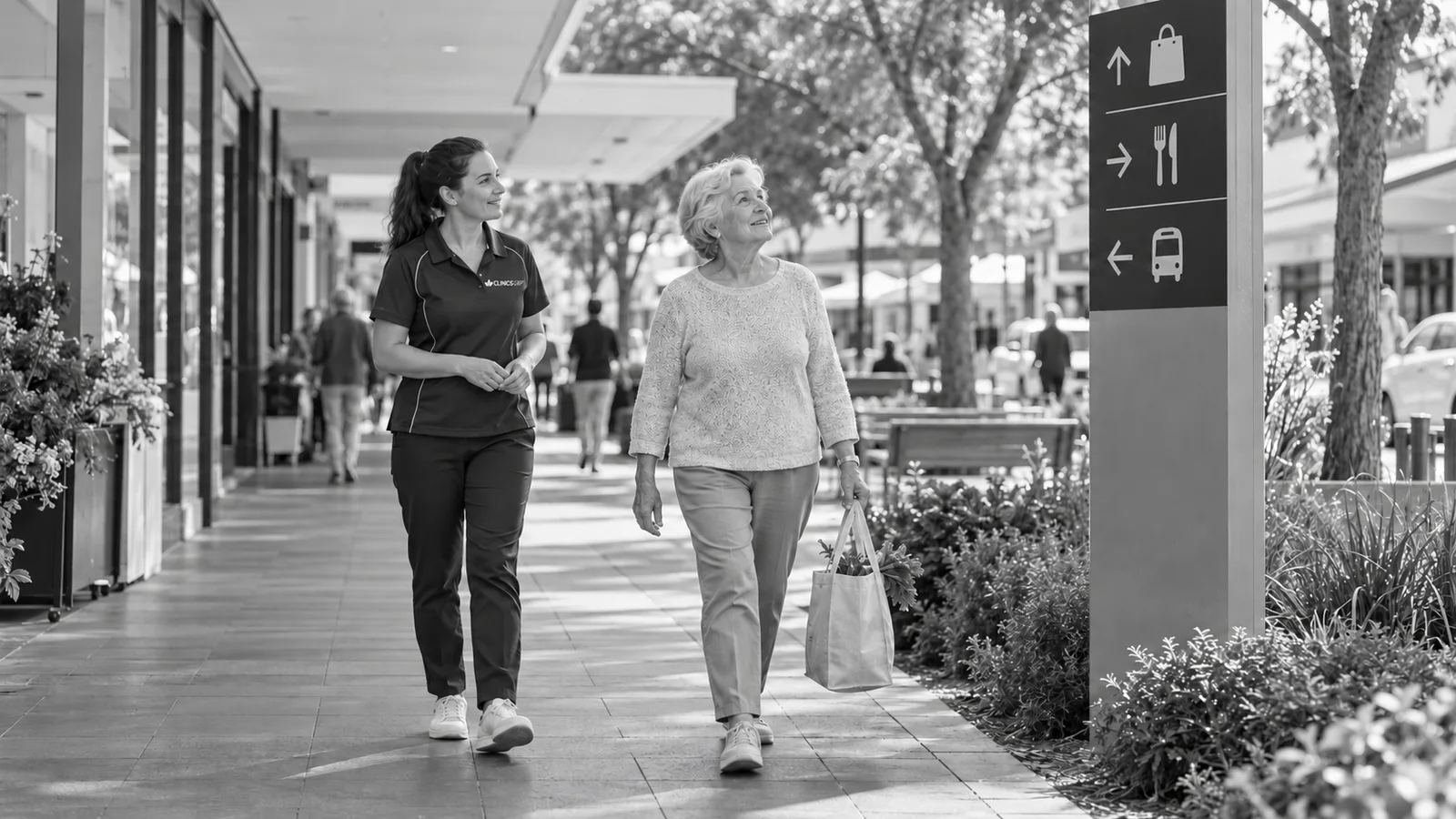
Dual-task walking means walking while doing something else. The added task might be cognitive, such as talking or remembering directions, or motor, such as carrying a cup or moving an object.
This matters because everyday walking rarely occurs in isolation. People scan for traffic, answer questions, carry bags, find a destination and make decisions while moving. A quiet straight walk can show important information, but it may not represent the combined demands of daily life.
Dual-task performance is one part of the integrated balance system described in Balance Is More Than Strength. It should be interpreted alongside sensory, physical, medical, environmental and confidence factors.
Key points
- A dual task combines walking with a second cognitive or movement task.
- The added task can change gait, the second task or both.
- Dual-task cost describes change, but methods differ and no universal cut-off predicts falls.
- Prioritising one task can be an effective strategy.
- Assessment and training should use tasks that are safe, repeatable and relevant to the person.
Two broad types of dual task
Cognitive-motor dual tasks combine walking with thinking, language or decision-making. Examples include conversation, counting, remembering a list, responding to questions or navigating.
Motor-motor dual tasks combine walking with another movement. Examples include carrying a tray, opening a door, pushing a trolley or moving an object.
Some real tasks involve both. Crossing a road may require scanning, judging vehicle speed, choosing a route and changing walking pace.
The categories are useful for description, but they do not tell us how difficult the task will be for one person. Familiarity, hearing, language, arm function and the environment all affect demand.
Why can two tasks interfere?
The nervous system has substantial capacity, but attention and response selection are not unlimited. Two tasks may need overlapping resources or require decisions at the same time.
Walking itself becomes more demanding when the surface is irregular, the person is in pain, sensory information is uncertain or physical reserve is reduced. A second task can expose this hidden demand.
Interference is not always a sign of disease. Most people alter performance when a task becomes difficult. The size, pattern and real-world consequence of the change provide the useful information.
What is dual-task cost?
Dual-task cost compares performance during the combined task with performance during a single task. If walking speed falls from the single-task condition to the dual-task condition, the percentage change can be reported as a cost.
The same idea can be applied to step time, variability or accuracy on the cognitive task. Researchers use different formulas and outcomes, so two reported costs may not be directly comparable.
Cost also needs context. A person who slows down to preserve accuracy and safety may be making a sensible choice. A person whose speed is unchanged but who repeatedly misses hazards may be prioritising differently.
Task prioritisation is part of the result
People can prioritise posture, the added task or both. The strategy may change with instructions.
If the clinician says “walk safely and answer as accurately as you can”, the person may choose a different approach from “keep walking at your usual speed”. Instructions should therefore be recorded and kept consistent when measuring change.
In everyday life, flexible prioritisation is valuable. Pausing conversation at a kerb, slowing before a turn or putting down an object can reduce demand. The goal is not to perform every task simultaneously at full speed.
What does research show?
A systematic review and meta-analysis found that cognitive tasks alter gait performance in older adults, although the effect varies with the task and measure.1 A separate review examined whether dual-task tests predict falls and found heterogeneous methods and results.4
Together, these findings support observing how a person manages two tasks, then interpreting that observation alongside their history and other findings. They do not support one universal dual-task cut-off as a stand-alone fall prediction tool.
How can a clinician assess dual-task walking?
A clear assessment compares three conditions:
- the walking task alone
- the added task alone
- both tasks together.
The clinician observes performance and strategy in both tasks. Walking measures may include speed, step timing, variability, direction and need for support. The second task may be scored for accuracy, fluency or completion.
The task should be challenging enough to create meaningful competition but not so unfamiliar that it mainly tests education or language. Hearing and vision should be considered. The person's usual aid and footwear should be used unless the assessment question requires otherwise.
Why task selection matters
Counting backwards, naming animals and holding a conversation place different demands on attention. Carrying a light empty cup is different from carrying a hot drink. A laboratory task may be repeatable but have limited relevance to the person's main difficulty.
An assessment can use a standard task for comparison and a functional task for meaning. For example, a person who wants to shop independently might walk while locating signs or carrying a light bag in a controlled setting.
Motor tasks deserve the same care. Carrying an empty cup may have little consequence, while carrying a hot drink changes attention and acceptable error. Assessment should not use a hazardous load to imitate daily life. A safe substitute can reproduce the need to carry, scan and plan without adding unnecessary injury risk.
What dual-task walking cannot tell us alone
A change during dual-task walking does not identify the cause. It could reflect cognitive demand, hearing difficulty, sensory uncertainty, pain, weakness, anxiety, unfamiliarity or a cautious strategy.
It also does not prove that the person will fall. An umbrella review of gait, balance and mobility instruments found that no single tool predicts falls with high certainty.5
Dual-task findings should lead to further questions: Does the change also occur with turning? Does a walking aid reduce demand? Does performance improve with a simpler task, better lighting or practice?
Dual-task walking and cognition
Dual-task difficulty can occur without a diagnosed cognitive condition. It may still provide information about attention and executive control. If there is a clear new cognitive change, disorientation or functional decline, appropriate medical assessment is important.
The assessment should avoid implying that a poor result diagnoses dementia. Cognitive screening and diagnosis require broader, validated processes.
Can dual-task ability be trained?
Training may practise walking with a graded second task. The programme can vary task difficulty, environment and prioritisation. Some sessions may focus on preserving walking; others may practise switching attention.
Systematic reviews published in 2024 and 2025 found improvements in balance and functional mobility after dual-task exercise in older adults. The larger review included 44 studies and 2,782 participants, with certainty across outcomes ranging from very low to moderate.23 An earlier review found that exercise can improve aspects of gait-related dual-task interference.6 Interventions and outcomes vary. The person may also benefit from strength, power, vestibular, sensory or walking-specific treatment that increases reserve for the combined task.
Functional strategies remain valuable. It may be safer to stop before answering, use a trolley, reduce the carried load or complete one task at a time when tired.
Dual-task training should not be the automatic answer to every dual-task change. If dizziness with head movement is the main limitation, vestibular assessment may take priority. If standing from a chair consumes most available effort, strength and task practice may create more reserve before a cognitive task is added.
How progress should be judged
Improvement might include:
- less slowing during a relevant task
- more consistent steps
- better accuracy without loss of walking safety
- more effective prioritisation
- reduced need to stop in low-demand situations
- greater confidence in a meaningful activity
- successful use of a walking aid or environmental strategy.
The best outcome is not necessarily a smaller percentage cost. It is safer, more adaptable participation.
When to seek assessment
Assessment may help if walking changes during conversation, carrying, route finding or busy environments, or if near-falls occur when attention is divided. Sudden confusion, weakness, speech difficulty, fainting or sudden inability to walk requires urgent medical assessment.
Understand more
- Balance Is More Than Strength
- Why Walking While Talking Can Reveal Balance Problems
- How the Brain Keeps You Balanced