
Key points
- People may avoid a falls exercise programme because of access barriers or how it is presented, even when they could benefit from support.
- In a knee osteoarthritis trial, pain improved in all three groups; a short-term advantage for a brace plus exercise was not judged clinically significant by the authors.
- A stroke trial found no clear advantage of robot-assisted walking practice over conventional physiotherapy for its main walking and daily-activity outcomes.
- A home-based stroke programme was associated with better social participation at nine months, but its several components cannot be separated by this study.
Clinics GRP Friday Research Update | 30 October 2026
Rehabilitation has to work for the person who is expected to use it. A programme may improve a test score, but participation also depends on access, acceptable options and what happens at home. Four recent studies look at different parts of that picture. They do not point to one treatment for everyone.
Falls support has to feel possible
Canadian researchers interviewed 11 adults who reported mobility, vision or hearing impairment about community falls prevention exercise. Participants described barriers that went beyond whether an exercise was physically possible: transport, cost, sensory access, how programmes were advertised and the feeling that a programme was “for someone weaker” all mattered. The interviews suggest that clinicians and programme organisers should ask about fit and access rather than assume that non-attendance means lack of interest. This small qualitative study did not test whether any programme reduced falls. Read the interview study.
More equipment does not always mean a meaningful gain
In Finland, 136 people with mild-to-moderate knee osteoarthritis were allocated to exercise alone, a knee brace plus exercise, or a biomechanical footwear device. Pain reduced in all three groups. The brace-and-exercise group had a statistically greater reduction at four months, but that between-group difference was no longer clear at 12 months and the researchers did not consider its short-term size clinically significant. Participants were about 61 years old on average, so this does not settle which option is best for a frailer older adult. A useful question is what a person can comfortably do with an option, whether it is practical to use and whether it changes a valued activity. Read the knee trial.
Stroke walking practice needs the right comparison
An Austrian inpatient trial randomly assigned 100 people with subacute or chronic stroke to four weeks of robot-assisted gait practice plus conventional physiotherapy or conventional physiotherapy alone. Walking ability and basic daily activities improved over time in both groups. The trial found no clear advantage for the robot group on those primary outcomes. Self-rated health showed a favourable secondary result for the robot group, but that does not overturn the main finding. The study tested a particular inpatient programme with follow-up to 12 weeks; it cannot decide whether every person should or should not use this technology. Read the stroke walking trial.
Participation is a different outcome
A study across five hospitals in southern China tested a three-month home-based motor relearning programme for 283 stroke survivors. It combined practice at home, digital tools and nurse-led support. The researchers tracked social participation, including involvement in life beyond a treatment session, for nine months. A between-group difference in participation emerged at the nine-month assessment, and exercise adherence also improved. A reported functional-independence pattern was less certain when individual time points were compared. Because the programme bundled several forms of support, the study cannot show which part made the difference, nor can its results be transferred directly to Australian home care. Read the home rehabilitation study.
What to bring to a rehabilitation conversation
These studies measure different things: whether a programme is accessible, how pain responds to treatment options, performance during walking practice and participation months later. Those measures matter, but they answer different questions. It helps to tell your treating clinician what you want to do and what gets in the way. Is travel difficult? Does a walking option feel safe and useful? Has pain changed what you can manage at home? Is fatigue limiting your social life? Those details can guide an individual plan and how progress is reviewed.
About this series
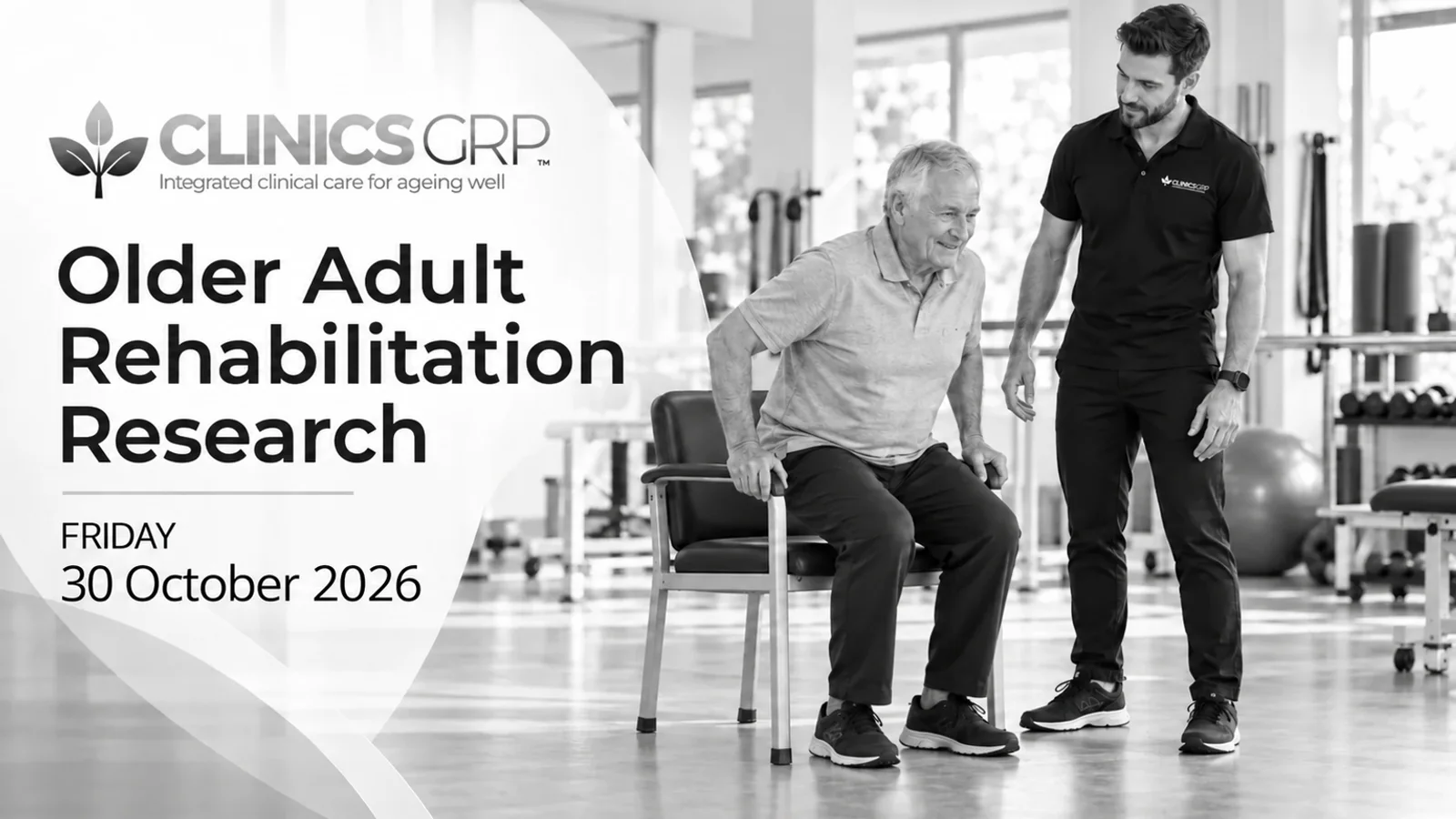
Older Adult Rehabilitation Research is a weekly Clinics GRP reading of new studies in falls and balance, musculoskeletal and neurological rehabilitation, and everyday function. Friday 30 October 2026 identifies this edition; the website records the actual publication date separately.
This article is general information, not individual medical advice. Speak with your treating health professional before changing an exercise or rehabilitation plan.
References
- Latiff A, Klicnik I, Bouchard DR, Dogra S. “It’s not for me”: community-based fall prevention exercise programs for those aging into disability. Disability and Rehabilitation. Published online 5 October 2026. doi:10.1080/09638288.2026.2740573. https://pubmed.ncbi.nlm.nih.gov/42831317/
- Kivistö H, et al. The effects of knee brace, biomechanical footwear device, and exercise in knee osteoarthritis: a randomized clinical trial. Annals of Physical and Rehabilitation Medicine. Published online 18 September 2026;69(8):102170. doi:10.1016/j.rehab.2026.102170. https://pubmed.ncbi.nlm.nih.gov/42759360/
- Stampfer-Kountchev M, et al. Robot-assisted gait training in people with subacute and chronic stroke: a randomized controlled trial. Frontiers in Neurology. Published 3 September 2026;17:1898475. doi:10.3389/fneur.2026.1898475. https://pubmed.ncbi.nlm.nih.gov/42755508/
- Peng X, et al. Effectiveness and implementation of home-based motor relearning for social participation after stroke: a hybrid type 2 stepped-wedge trial. Annals of Physical and Rehabilitation Medicine. Published online 4 August 2026;69(7):102158. doi:10.1016/j.rehab.2026.102158. https://www.sciencedirect.com/science/article/pii/S1877065726000618