About Clinics GRP

Leadership, governance and accountability support safe, consistent care

Clinics GRP is built around clinical leadership, clear standards, and accountable systems that support safe, consistent care over time. The model is designed to strengthen continuity across clinicians, settings, and service pathways so care remains coordinated, explainable, and dependable.

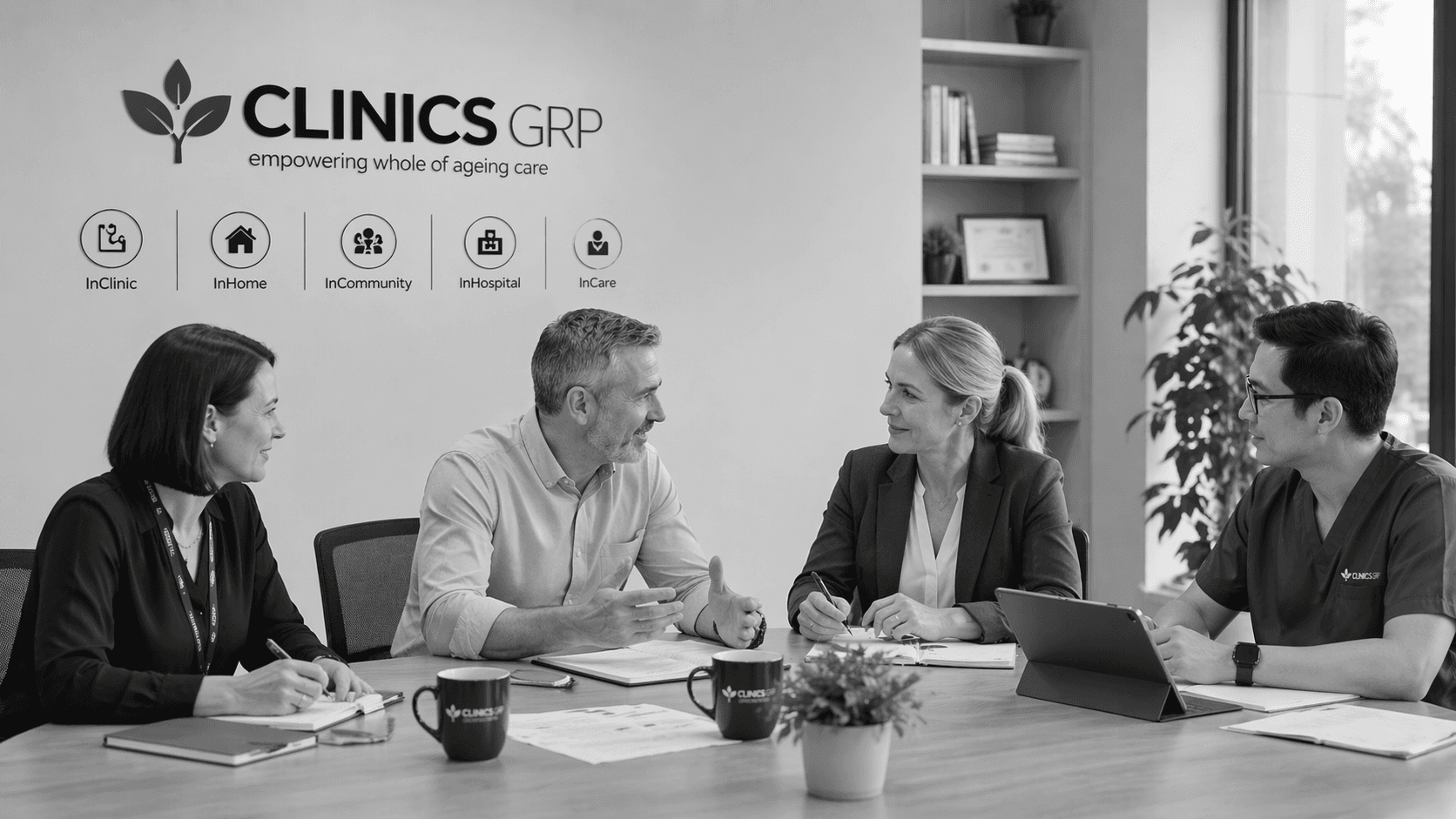
Clinics GRP leadership and clinical team meeting in a governance setting.

About section

Leadership & Governance

This page explains how Clinics GRP supports continuity through shared clinical frameworks, accountable leadership, strong communication standards, and UnityCMP, the unified client management platform being developed to support care across divisions and settings.

Care settings
  • inClinic
  • inHome
  • inCommunity
  • inHospital
  • inCare

Clinics GRPCare, governance and continuity

Core page content

What leadership and governance mean here

Leadership and governance matter because healthcare trust depends on more than branding. People need to know there are clear standards, clinical oversight, dependable communication, and a consistent approach to care quality.

At Clinics GRP, this includes shared clinical reasoning, structured communication and handover, education and workforce development, documentation standards, and a commitment to reviewing and improving care over time.

Internally, the model is designed so current and future disciplines work through the same clinical logic rather than developing separate systems or isolated habits.

Key points

Governance themes

  • Clinical standards and consistent care expectations.
  • Shared reasoning and documentation frameworks.
  • Communication, consent, and handover quality.
  • Education and workforce development.
  • Continuous improvement and dependable service standards.
  • Accountability that is durable beyond any one individual.
Integrated clinical framework

A shared clinical framework sits underneath the care model

Clinics GRP uses a shared clinical operating framework so care is guided by the same reasoning structure across settings, clinicians, and disciplines.

Internally, this framework is designed to create consistency across clinicians, locations, and disciplines, support tiered workforce use, embed escalation and de-escalation as normal governance behaviours, and provide a platform-ready model for future systems such as UnityCMP.

The current framework architecture includes the major components that govern how care is reasoned, explained, constructed, reviewed, and handed over. Within this structure, the Intent Hierarchy Framework defines the dominant clinical intent and treatment envelope, while the broader Integrated Clinical Framework governs the method used within that intent state.

The operating model also treats communication as a formal governed layer rather than an informal extra.

Framework support

How the framework works

  • Goals give direction.
  • Z3 provides the reasoning rhythm.
  • IFM identifies the main bottleneck.
  • IHF defines the governing intent and safe treatment envelope.
  • CTM constructs treatment inside that envelope.
  • OM validates whether change is real and meaningful.
  • Comms + PIIF translate reasoning into understanding, consent, alignment, and safe continuity.
Clinical communication

Communication is treated as a clinical standard

Clinics GRP does not treat communication as a soft extra. Communication is governed through its Clinical Communication and Alignment Framework, which is designed to translate clinical reasoning, treatment intent, outcome interpretation, and governance decisions into clear understanding, informed consent, aligned behaviour, safe monitoring, escalation readiness, and effective handover.

The framework applies across physiotherapy, nursing, remedial massage, rehabilitation, students, and future disciplines, and across InHome, InClinic, InCare, InHospital, and InCommunity settings.

This matters especially in older-adult care, where cognition, fatigue, confidence, medication effects, support-circle involvement, and slower adaptation can all affect whether a clinically sound plan is actually understood and implemented safely.

Communication in practice

What the standard is designed to protect

  • Plain-language explanation of the current priority.
  • Ongoing consent when care direction or risk changes.
  • Clear review timing and escalation thresholds.
  • Minimum handover content for safe continuity.
  • Communication that supports agency, not passive dependence.
UnityCMP

UnityCMP is being built to support continuity across divisions

Clinics GRP is developing UnityCMP as an in-house client and patient management platform designed to replace fragmented operational tools with one governed system.

Its purpose is to centralise client records, appointments, documentation, communication, tasks, billing, and oversight so continuity is not lost when care moves between teams, settings, or service lines.

At the centre of UnityCMP is a unified client record and a CareStream model. A CareStream is a time-bounded, goal-directed episode of care that links the client, team, funding stream, setting, outcomes, and documentation into one coherent pathway.

That allows care to move across in-clinic, in-home, in-community, residential, and hospital-linked environments without duplicating records or breaking accountability. The design intent is governance by design, with role-based access, consent enforcement, audit trails, and operational visibility built into the system rather than left to policy alone.

Platform support

Why UnityCMP matters

  • One centralised client record.
  • One workflow model across divisions.
  • Governance built into the platform.
  • Better continuity across settings and teams.
  • Stronger visibility, auditability, and handover quality.
Continuity in practice

How continuity is protected in practice

Continuity at Clinics GRP is intended to be more than a good intention. It is supported through shared clinical reasoning, documented intent, standardised communication, measurable review points, escalation rules, and systems that make it easier for the next clinician or team to continue safely.

Internally, the Intent Hierarchy Framework requires each client to be assigned one dominant intent, with higher-order safety priorities constraining lower-order goals. The framework also defines minimum assessment outputs, treatment planning rules, escalation triggers, review timeframes, and handover elements.

  • Shared clinical reasoning and one dominant governing intent.
  • Documented treatment intent and defined treatment envelopes.
  • Standardised communication, consent, and handover expectations.
  • Review timeframes, escalation rules, and measurable checkpoints.
  • Systems that help the next clinician or team continue safely.
Leadership & improvement

Leadership is not only operational. It is educational and review-based

Clinics GRP's direction treats leadership as more than management structure. Leadership includes protecting clinical standards, building workforce capability, teaching shared frameworks, reviewing documentation quality, supporting escalation, and using audit and feedback to improve care over time.

This is one reason education, student supervision, workforce development, and framework teaching sit so closely beside governance in the broader Clinics GRP model. The goal is to build a system that remains clinically coherent as the business grows across disciplines and settings.

  • Protecting clinical standards as the organisation grows.
  • Teaching shared frameworks across current and future disciplines.
  • Reviewing documentation quality, escalation quality, and handover quality.
  • Using audit and feedback to improve care over time.
  • Building a clinically coherent system rather than isolated pockets of practice.
Why it matters

Why this matters for clients, families, and referrers

For clients and families, good governance means care is more consistent, better explained, and less dependent on one person holding everything together. For referrers, it means clearer communication, safer escalation, and better continuity across settings. For the organisation, it means growth can happen without losing standards.

This is particularly important in older-adult care, where treatment often needs to move between clinic, home, community, facility-based, and post-hospital contexts. Publicly, Fizzio already reflects this multi-setting care model through in-clinic physiotherapy, home-based care, and selected residential support.

Internally, Clinics GRP is building the leadership, framework, and system layers needed to make that continuity stronger over time.

FAQ

Common questions

What does governance mean at Clinics GRP?

It means care is supported by clear clinical standards, structured communication, defined review and escalation rules, accountable documentation, and systems designed to protect continuity across the group.

What is the Integrated Clinical Framework?

It is the shared clinical logic that helps Clinics GRP reason, govern, deliver, document, and review care consistently across clinicians, settings, and disciplines.

What is UnityCMP?

UnityCMP is the in-house client and patient management platform Clinics GRP is building to support unified records, CareStreams, communication, tasks, oversight, and continuity across divisions.

Why is communication part of governance?

Because safe care depends on more than correct reasoning. The person, carer, clinician, and wider team need to understand the current priority, the plan, the expected response, and the thresholds for review or escalation.

Next step

Learn more about how Clinics GRP fits together

Clinics GRP is building a model where care, communication, education, and continuity work together through shared standards and accountable systems.