
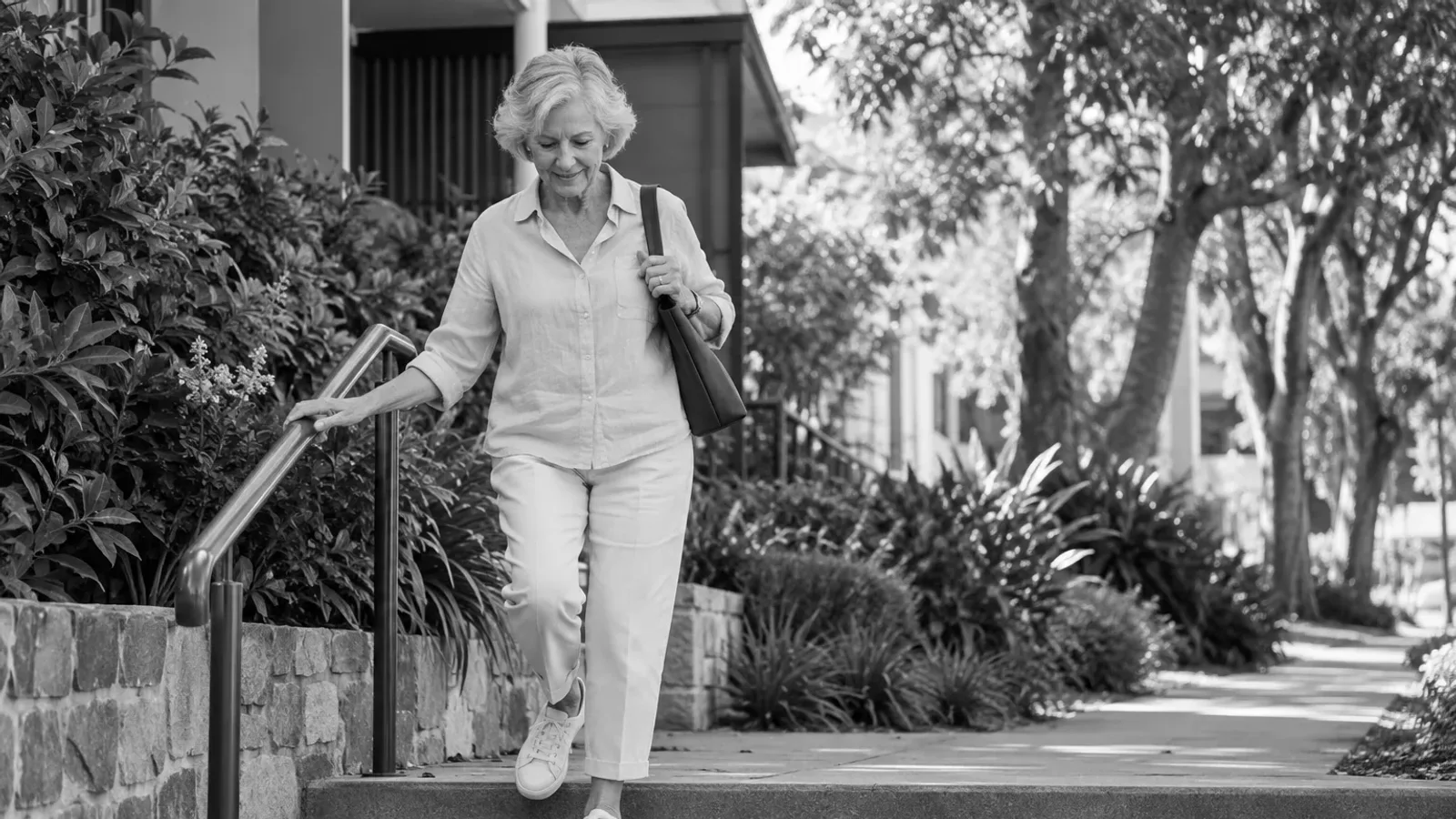
Falls become more common as people grow older.
That does not make falling an inevitable or meaningless part of ageing.
The difference matters.
If a fall is dismissed as “just getting old”, potentially useful questions may never be asked.
At the other extreme, if every fall is treated as evidence that somebody is becoming incapable, the person may be encouraged to withdraw from activities long before that is necessary.
Age is relevant.
It is not the whole explanation.
Key points
- Falls become more common with increasing age, but they are not inevitable for every older person.
- Chronological age does not tell us why a particular person has fallen.
- Health, movement, sensation, medicines, confidence, environment and activity can all affect risk.
- Some contributors can be changed; others may need to be accommodated.
- Falls management should support a meaningful life, not create the expectation that successful ageing means never needing help.
Common does not mean inevitable
Fall-related injury becomes more common with age.
That tells us age is relevant to risk.
It does not tell us that every older person will fall, that every fall has the same cause or that nothing can be done.
There is enormous variation among older people.
Some people in their eighties maintain high levels of physical and mental capacity.
Others require substantial assistance.
Health conditions, past experiences, resources and environments all contribute to that diversity.
There is no single ageing trajectory.
There is therefore no single falls trajectory either.
“It’s just your age” can close the conversation too early
Imagine somebody says they have started falling when turning in the kitchen.
A response such as “that’s normal at your age” may sound reassuring, but clinically it explains very little.
Did the change begin suddenly or gradually?
Is there dizziness?
Has medication changed?
Is the person catching one foot?
Has their vision changed?
Are they experiencing pain?
Do they lose balance only when attention is divided?
Are they becoming more hesitant because of an earlier fall?
Does the difficulty happen in one environment or everywhere?
Those questions matter because different patterns suggest different next steps.
Chronological age belongs in the assessment.
It should not substitute for it.
Age is also a poor treatment plan. Two people of the same age may need entirely different responses to a fall. One may need review of a recent medicine change. Another may need progressive balance and strength work. A third may need better lighting, a rail or a walking aid that is fitted and practised properly. The useful question is not what is usually expected at a certain birthday. It is what has changed for this person, what the change means in daily life and which parts of the situation can be improved or managed.
Ageing can change the ingredients of balance
It would be equally misleading to pretend age has no effect.
Ageing can influence muscle strength and power, sensory function, reaction time, bone health and the likelihood of living with several health conditions.
Older adults are also more likely to use medicines that may interact with blood pressure, alertness or other aspects of function.
But those changes occur to different degrees in different people.
Their effect also depends on what the person is trying to do.
A modest reduction in physical reserve might make little difference on a flat indoor surface but become important on a steep driveway, while carrying something or when responding quickly to a trip.
The environment can either expose difficulty or help compensate for it.
Some factors are modifiable. Others are manageable.
Falls risk management is sometimes described as though every risk factor can be removed.
That is unrealistic.
We cannot make somebody younger.
We cannot reverse every health condition.
We cannot guarantee that a person will never encounter an unexpected obstacle.
But many contributors can be influenced.
Depending on the person, care may address:
- balance and functional mobility
- lower-limb strength and power
- walking and turning
- medicines
- dizziness
- vision
- feet and footwear
- home hazards
- blood pressure
- confidence
- continence
- osteoporosis and injury risk
- use of walking aids
- the way a meaningful activity is organised.
Some factors can be improved.
Some can be compensated for.
Some need ongoing monitoring.
Some need to be accepted and planned around.
All of those can be legitimate parts of good care.
This distinction helps prevent care from becoming a search for a perfect, younger version of the person. The aim is not to remove every sign of ageing. It is to identify the difference between an expected change that can be accommodated and a new problem that warrants attention. A person can live with several long-term conditions and still gain useful capacity, confidence or access through a well-targeted plan.
Falls management is not a promise
Evidence-based interventions can reduce fall rates and falls risk across populations.
They cannot guarantee that one particular person will never fall again.
This distinction matters because unrealistic promises create blame.
If we imply that every fall is preventable, the person may feel they have failed when another fall occurs.
A family may believe they did not supervise closely enough.
A clinician may become overly restrictive in an attempt to remove all uncertainty.
Human movement always involves some uncertainty.
The goal is not to promise control over every future event.
It is to understand known risks, address what can reasonably be changed and make considered decisions about what matters enough to keep doing.
Falling is not a moral failure
Older adults often hear messages about what they “should” be doing:
Exercise more.
Be stronger.
Use the rail.
Slow down.
Take fewer risks.
Some of that advice may be useful in the right context.
It becomes unhelpful when a fall is treated as evidence that the person was careless, stubborn or insufficiently committed to staying healthy.
Falls can occur in people who exercise regularly.
They can occur in people who follow medical advice.
They can occur during entirely ordinary activities.
Understanding risk is different from assigning fault.
A good falls conversation asks what happened and what might help next.
It does not turn the event into a judgement about the person’s character.
We should also be careful about the word “independence”
After a fall, the stated goal often becomes “maintain independence”.
That can be meaningful, but independence has different meanings.
For one person it may mean continuing to live at home.
For another it may mean deciding how and when assistance is provided.
For someone else it might mean attending a weekly activity using a walking aid and transport support.
Doing everything alone is not the only valid outcome.
Support can expand what a person is able to choose.
A rail can preserve access to a staircase.
A walking aid can extend the distance someone can comfortably cover.
Help from another person may allow a community outing to continue.
Needing support should not be confused with failing to age well.
What should prompt assessment?
A single unexplained fall may justify discussion with a health professional.
Repeated falls, near-falls, a new need to hold furniture, increasing hesitation or reduced participation deserve attention even when no major injury has occurred.
Assessment should be particularly prompt when there is:
- sudden or marked change
- fainting or near-fainting
- new dizziness
- new weakness or neurological symptoms
- repeated falls
- injury
- medication changes
- significant loss of mobility or confidence.
The purpose is not to search for a problem because somebody is old.
It is to take a change seriously because it matters.
Ageing is real. Fatalism is optional.
A good approach to falls holds two ideas together.
Ageing changes the body and can alter risk.
And older people remain individuals with different capacities, health histories, environments, priorities and possibilities.
We do not need to deny ageing to reject the assumption that decline is the only explanation.
Nor do we need to promise that every limitation can be reversed.
Sometimes the right outcome is improvement.
Sometimes it is maintaining what matters.
Sometimes it is adapting the task.
Sometimes it is accepting help.
Falls management should help the person understand their situation and make better-informed choices about what comes next.
Those choices should remain open to review. A person’s capacity, health and environment can change, and a strategy that was appropriate after an illness may no longer be necessary months later. Equally, a new symptom or repeated near-falls may mean that an older plan no longer provides enough support. Ageing is dynamic, so falls management should be dynamic too.
That is very different from simply being told to expect falling because of age.
Understand more
- Balance Is More Than Strength: The Clinics GRP Approach to Balance in Older Adults
- Why Do Older Adults Fall? There Is Rarely One Cause
- Why Clinics GRP Talks About Falls Management — Not Just Falls Prevention
Relevant care
References
- Australian Institute of Health and Welfare. Injury in Australia: Falls. https://www.aihw.gov.au/reports/injury/falls
- World Health Organization. Healthy ageing and functional ability. https://www.who.int/news-room/questions-and-answers/item/healthy-ageing-and-functional-ability
- Australian Commission on Safety and Quality in Health Care. Falls Guidelines for Community Care. 2025. https://www.safetyandquality.gov.au/resources/falls-guidelines-community-care
- Montero-Odasso M, et al. World guidelines for falls prevention and management for older adults. 2022. https://pmc.ncbi.nlm.nih.gov/articles/PMC9523684/
- Queensland Health. Falls prevention. https://www.health.qld.gov.au/public-health/groups/seniors/falls-prevention