
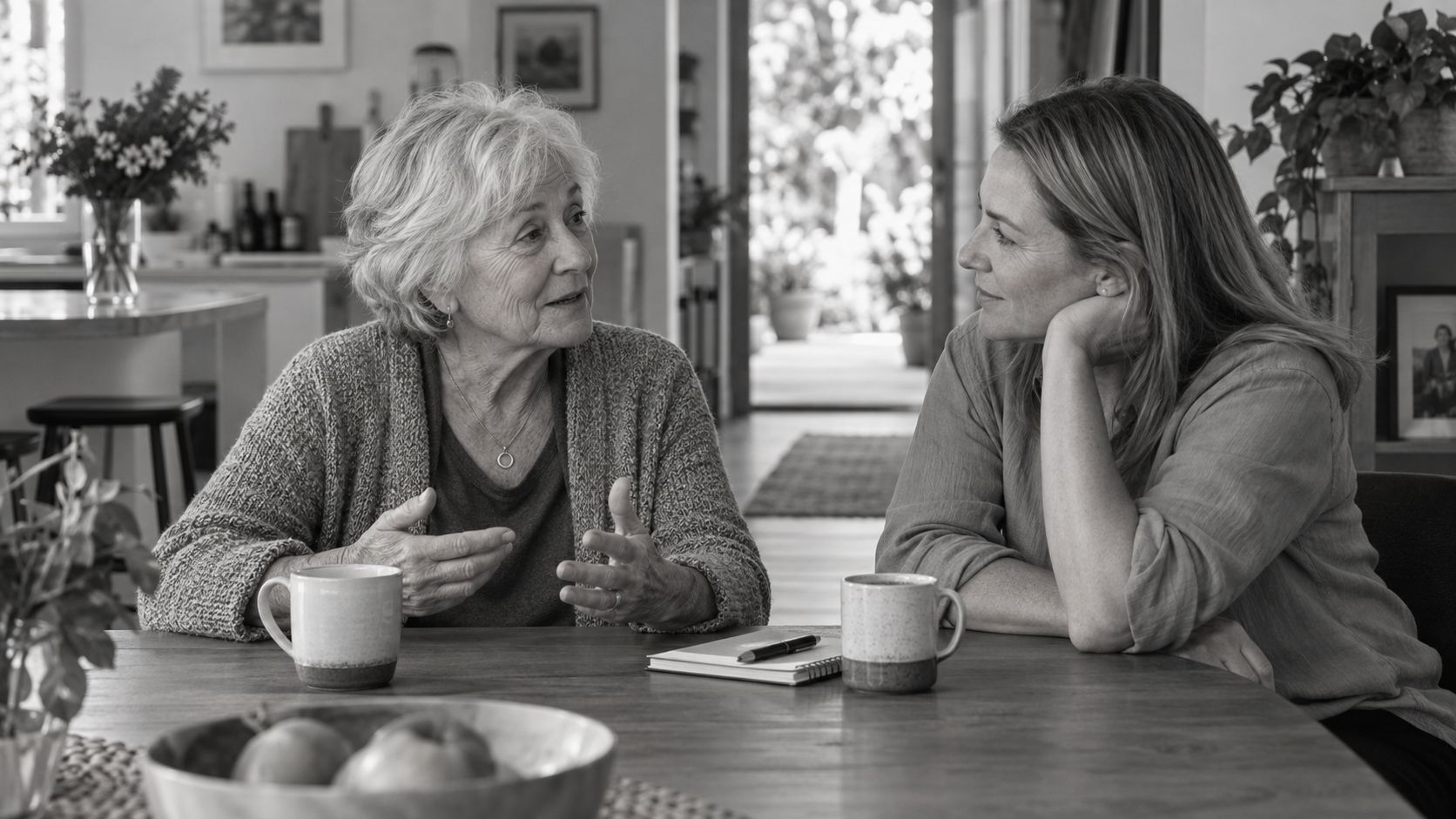
“Mum is getting older” may be true. It may also leave an important question unanswered: what has actually changed?
Perhaps a familiar outing has stopped, walking feels less steady, or someone has begun asking for help with a task they previously managed. These are hypothetical examples. They do not identify a diagnosis, but they can provide a reason to start a conversation.
Key points
- A change in everyday life deserves attention rather than an automatic explanation of “getting older”.
- Describe what is different and how it affects familiar activities.
- Avoid assuming a cause before an appropriate assessment.
- Clear communication helps maintain continuity when care needs or settings change.
Notice without making assumptions
Ageing is associated with changes in health, but people's experiences vary considerably. 1 A new difficulty should not be dismissed solely because the person is older.
Equally, noticing a change does not mean something serious is necessarily wrong or that it can always be reversed. The purpose of seeking advice is to understand what support or further assessment may be appropriate.
Try asking the person what they have noticed before deciding what the change means for them.
Describe the everyday difference
A concrete description can be easier to discuss than a broad label such as “slowing down”.
For example: “Over the past few weeks, the walk to the shops has felt harder,” or “I have started holding the furniture when moving around the room.”
You do not need to know why this is happening. Avoid deliberately recreating a near-fall or removing support to demonstrate the problem.
If there has been a fall, near-fall or increasing concern about falling, tell a health professional. Australian guidance supports care that considers the individual's fall-related needs and circumstances. 2
When a familiar description becomes too broad
“Slowing down” can describe many different observations. Someone might take longer to get ready, choose shorter outings, need more help after an illness or avoid a situation that now feels difficult. Grouping all of these under ageing may make the conversation sound settled before the individual change has been understood.
Try to identify the activity behind the phrase. Has the person stopped something they still want to do? Have they changed how they do it? Is someone else now providing help that was not previously needed? These are ways to describe daily life, not a checklist for diagnosing decline.
The person's own explanation is important. They may have made a deliberate choice that others have misinterpreted. They may also have a concern they have found difficult to describe. A conversation should allow either possibility, rather than assuming that every difference means loss of ability or that every reassurance means there is nothing to discuss.
Changes after illness need their own story
An illness or hospital stay can become the turning point in a family's account: “Before that, things were different.” It is useful to tell a health professional which parts of the routine have changed and what advice was provided during recovery. The timing helps describe the history; it does not by itself establish the cause.
For example, the immediate issue may be managing the morning at home rather than repeating an activity completed in hospital. The person may need clarification about the next appointment, the intended plan or who to contact with a concern. Those practical questions deserve attention alongside the clinical questions.
Avoid setting a recovery deadline based on someone else's experience. A neighbour's return to usual activities cannot establish what should happen for this person. Ask the treating professional what is relevant in their case, what uncertainty remains and when the plan should be reviewed. No article can replace that individual advice.
When the person and family notice different things
Different accounts do not have to become a contest. A relative may notice that an outing has stopped, while the older person may be more concerned about fatigue during another part of the day. Both observations can be brought to an appointment, with the person's agreement, without forcing them into a single explanation.
The same applies when someone says they feel capable but a family member is worried. Describe the concern respectfully and ask for appropriate advice. Do not create an informal home test to decide who is right. Professional assessment can address the relevant question without making the relationship revolve around proving or disproving ability.
At Clinics GRP, the intended starting point is the person and the change they want help understanding. That allows the discussion to consider relevant expertise, setting and escalation. The family does not need to nominate a discipline or a treatment before making an enquiry, although new or unexplained symptoms may need medical attention first.
Recognising a change is therefore an invitation to a clearer conversation. It can lead to assessment, explanation, practical support or reconsideration of a plan. It should not lead automatically to a promise of recovery or a decision to take over the person's life.
Research shows why events deserve attention
Gill and colleagues followed 754 community-dwelling adults aged 70 and older who initially needed no personal assistance with four basic daily activities. Hospitalisation and episodes of restricted activity were associated with the subsequent development of disability. 4 This was an observational study, so it does not establish that hospital care itself caused the disability or that a particular rehabilitation programme would prevent it. It supports taking the history of illness, injury and disrupted activity seriously when discussing a change.
The distinction matters for families. “Things have been different since the illness” is useful information to share, but it is not a diagnosis. It gives a health professional something to explore alongside the person's account and medical history. The study cannot tell a family what an individual's recovery will look like.
It also does not justify blaming the person for being less active during an illness. People may have needed rest or medical treatment. The appropriate question is what care is needed now, rather than what they should supposedly have done differently in the past.
Begin with permission to talk
Concern can easily sound like criticism when it arrives as a conclusion: “You cannot manage this any more.” A more open beginning is to describe what you noticed and ask how the person sees it. For example, “I noticed you have not been going to the group lately. Is that something you want to talk about?”
The person may share the concern, disagree with your interpretation or have a reason you had not considered. They may also prefer to discuss it privately with a professional. A respectful conversation leaves room for those responses. Being concerned about someone does not mean knowing in advance which outcome they should want.
Choose an ordinary, unhurried moment where possible. Try to address the person directly, including when other relatives are present. If they want help arranging an appointment, ask what kind of help would be useful. Making a phone call, organising transport and attending a consultation are different forms of involvement.
Separate observations from interpretations
“Dad is becoming dependent” is an interpretation. “Dad has asked me to carry the washing basket upstairs this month” is an observation. The second gives a clearer starting point and avoids turning a particular change into a judgement about the whole person.
You can describe what happened, roughly when it began and whether the person has mentioned a concern. If you are unsure, say so. There is no need to keep an exhaustive diary or monitor every movement. A few relevant examples may be enough to help the person explain the issue at an appointment.
Avoid staging a demonstration that removes usual assistance or encourages an unsafe task. The purpose is to communicate a concern, not to test the person at home. A clinician can advise on what assessment is appropriate. Photographs or recordings should not be taken or shared without the person's agreement.
Support does not have to mean taking over
An older person may welcome help with one part of life while wanting to keep responsibility for other parts. Ask which assistance they want rather than assuming that one difficult task settles every decision. Someone might want transport to an appointment but prefer to speak with the clinician alone.
Where the person wants a relative involved, agree on the relative's role. They might help recall dates, take notes or raise a question the person has asked them to mention. Their account can add useful context while remaining distinguishable from the person's own experience.
If views differ, describe the difference honestly. “I have noticed this, and Mum sees it differently” is more accurate than presenting a shared view that does not exist. The clinician can listen to both accounts. Immediate safety concerns need appropriate professional advice; a general article cannot resolve a disagreement about a person's care or decision-making ability.
Prepare for a useful appointment
The person might choose one or two things they most want to discuss. A brief written note can help if the conversation feels overwhelming. Relevant discharge information and an up-to-date medicines list may be useful if available. Do not delay seeking advice simply because you cannot assemble every document.
At the appointment, ask what has been established, what remains uncertain and what the next step is intended to clarify. If further care is recommended, establish who will arrange it. If there are instructions for the period before review, ask for an explanation that the person can understand and use.
Afterwards, check what the person wants help remembering or organising. They may want practical assistance, or they may prefer to handle the next step themselves. A follow-up conversation can focus on their priorities rather than on whether they have done what the family expected.
Leave room for a different future
Understanding a change does not always lead back to the previous routine. Sometimes the discussion includes lasting support, a different way of doing an activity or a new priority. Those possibilities deserve the same care and respect as a goal of improvement. The person's life should not be reduced to a comparison with what they managed before.
Choose the next step according to the concern
For a new or unexplained change, your GP can help assess possible medical causes and advise on other care. Rehabilitation or home-based support may be relevant, depending on what is found.
Do not stop or change prescribed medicines on the basis of an article. If you are concerned about a medicine, speak with the prescriber or pharmacist.
Dizziness that is sudden, severe or keeps happening, or an unexplained fall, needs medical advice. Dizziness accompanied by chest pain, shortness of breath, new weakness or trouble speaking requires an ambulance: call triple zero (000). 3
Keep the person's voice central
Families can share observations, but the older person's own concerns and preferences remain important. “Would you like help talking this through?” may be a more useful opening than deciding what they can no longer do.
At Clinics GRP, our starting question is: “What is different now, and what would you like help with?”
The evidence below supports attention to individual needs and appropriate review. It does not allow us to identify the cause from these examples or promise that treatment will restore previous abilities.