
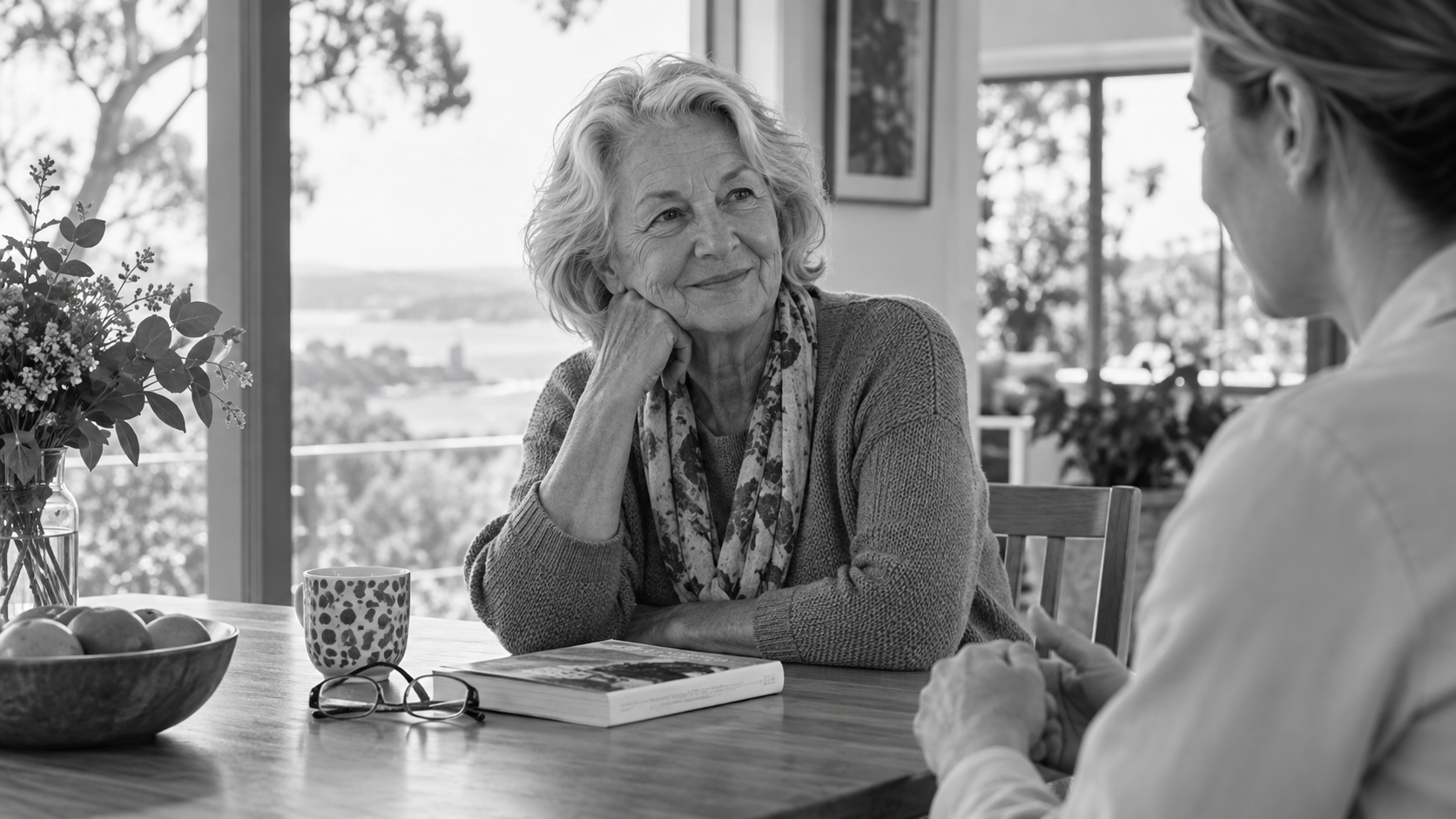
A person's age belongs in their clinical history. It should not become the entire explanation for what they are experiencing.
At Clinics GRP, “age is context” means taking ageing seriously while remaining curious about the individual. It means listening before deciding what a person needs, and being clear about what we know and what still needs assessment.
Key points
- Age is relevant to care, but it does not explain every change a person experiences.
- Start with the person’s concerns, daily activities and goals.
- Clinical evidence helps guide care; assessment determines how it applies to an individual.
- Review progress and adapt care as needs change.
Age matters, and people differ
Ageing is associated with biological change and an increased likelihood of some health conditions. Those changes do not happen uniformly. The World Health Organization describes substantial variation in health and ability among older people. 1
Knowing someone's age helps place a concern in context. It cannot, by itself, establish why a particular activity has become difficult.
That distinction matters in an ordinary conversation. “What has walking been like recently?” invites a different account from “That is expected at your age.”
Start with the person's priorities
For one person, the immediate priority may be managing their own shower. For another, it may be visiting a friend or continuing a valued community role. These are hypothetical examples, not descriptions of patients or promised results.
WHO's account of healthy ageing includes what people can do in their environment, rather than defining health only by the absence of disease. 2 This provides a useful public perspective for discussing care: what matters to this person, and what support might help?
A diagnosis remains important. So do a person's preferences, the support available to them and the realities of their home and daily routine.
Avoid replacing one assumption with another
Rejecting “just old age” does not mean every change is reversible. It does not mean a person has failed if their abilities change, or that rehabilitation can remove every limitation.
A thoughtful conversation can include improvement, adaptation, assistance and comfort. The appropriate direction depends on the individual and may require input from more than one health professional. WHO's integrated care guidance supports a person-centred approach to assessment and care planning. 3
Why older-adult care needs a wider view
Older adulthood is a clinical context in which several concerns may need to be considered together. A person can be living with more than one health condition, dealing with a recent illness and adjusting to changes in their daily support. WHO describes this diversity and the importance of the environments in which people live. 1, 2 The practical implication is that a single label may leave important parts of the person's situation unexplored.
Consider the difference between knowing that someone has arthritis and understanding why their usual shopping trip has recently become difficult. The diagnosis remains relevant, but the current problem still needs to be described. Is the concern pain, the journey, carrying groceries, access to help or something else? These are questions to clarify with the person, not a way of diagnosing them from an article.
Specialist attention to older adults therefore involves more than choosing a gentler version of a standard activity. At Clinics GRP, the intended approach is to understand the person's present circumstances, decide what needs attention and connect that need with appropriate expertise. Depending on the concern, this may include medical advice, rehabilitation, nursing or another form of support. The person should not have to identify the correct discipline before their concern can be heard.
Age informs risk without settling the explanation
Age can change the likelihood of health problems, but likelihood and explanation are different questions. WHO's description of ageing recognises biological change alongside considerable variation between individuals. 1 A clinician may appropriately take age into account while still asking why a difficulty appeared now and what else needs consideration.
This avoids two unhelpful extremes. One is dismissing a concern because the person is older. The other is assuming that age has no relevance and that enough effort must restore previous abilities. Neither gives the person an honest account of uncertainty. A responsible discussion can recognise risk, investigate a change and remain realistic about what care may achieve.
The same care is needed when using the word resilience. In everyday conversation it may express admiration, but it should not become a judgement that people with greater support needs have somehow tried less. Health history, circumstances and preferences differ. People deserve thoughtful care whether their priority is improvement, maintaining an activity, adapting a routine or comfort.
Continuity is part of the question
A person's priorities do not disappear when they move between hospital, home and clinic. At Clinics GRP, continuity means aiming to carry forward an understanding of the person, where clinically appropriate and with their consent. It is an organisational direction, not a claim that every service can be delivered in every setting.
For example, a goal discussed during rehabilitation may need to be reconsidered once the person is home. The meaningful question is whether the current arrangement serves the same daily purpose, or whether something different now needs attention. Sharing relevant information between professionals can support that conversation; the person should know who is responsible for the next step.
What research adds to this conversation
The LIFE randomised trial studied 1,635 sedentary adults aged 70–89 who had physical limitations but could initially walk 400 metres. Over an average of 2.6 years, major mobility disability occurred in 30.1% of the structured physical activity group and 35.5% of the health education group. 4 This supports a potential mobility benefit in that selected population. It does not show that ageing can be reversed, that all older adults should follow the same programme, or that exercise removes every risk. It also did not test Clinics GRP's services.
That distinction gives us a more useful form of optimism. There can be reasons to explore suitable support without claiming to know an individual's outcome in advance. The research invites a clinical conversation about relevance, suitability and preferences. It is not a ready-made prescription for someone reading at home.
When reading a study, it helps to ask who participated and what the researchers actually measured. Being able to walk a specified distance is a meaningful research outcome, but it is not identical to every person's definition of living well. A person might be more concerned about cooking, getting to the bathroom or having enough help to remain involved in family life.
The difference between context and a conclusion
Imagine an older person who says they have stopped going to the local library. Their date of birth is a fact. “They have stopped because they are old” is an explanation that has not yet been established. Perhaps the concern is physical, perhaps the trip has become difficult to organise, or perhaps the activity no longer interests them. These possibilities are illustrations of questions to explore, not a list of diagnoses.
The useful next conversation is specific: do they want to keep going, what part has become difficult, and what would they like to discuss? It leaves room for the person to disagree with the assumptions being made about them. They might want help with the walk. They might prefer a different activity. Either answer changes the purpose of the conversation.
This is also why comparisons with other people can be unhelpful. A neighbour of the same age may have different health conditions, responsibilities, resources and wishes. Their experience cannot set the standard for what someone else ought to achieve. Care should not become a competition to be the most active person in an age group.
Goals can be modest and still matter
Not everyone arrives at an appointment with a large rehabilitation ambition. “I would like mornings to feel more manageable” can be a legitimate starting point. So can wanting an explanation, reassurance about the next step, or support discussing a concern with another professional. A useful goal belongs to the person receiving care; it does not need to sound impressive.
It can help to describe the activity behind a general word such as independence. Does independence mean doing everything alone? Does it mean making your own decisions while accepting assistance? Does it mean choosing when and how support is provided? Those meanings are different, and a care conversation should make space for them.
For someone living with lasting limitations, adaptation need not be treated as a disappointing second choice. The person may value a practical arrangement that allows participation more than an ambitious plan that does not fit their life. The role of a clinician is to explain appropriate options and their trade-offs, not to decide which version of a good life the person should prefer.
Ask for an explanation you can use
A care plan should be understandable in ordinary language. You should be able to ask what a recommendation is intended to help, how it relates to your concern and what uncertainty remains. If several professionals are involved, it is reasonable to ask who will coordinate the next step and how information will be shared with your consent.
You can also explain the practical limits of a plan. Transport, appointment timing, language, available help and other commitments may affect what is manageable. Raising these issues is not a failure to take care seriously. It gives the conversation a more accurate picture of your circumstances.
Consider asking for the important points in writing, particularly if there is a lot to take in. A family member or trusted support person can join the discussion if you want them there. They can help remember information while leaving your own priorities at the centre. You should not need to use technical terms to explain what matters to you.
Review the purpose as well as the activity
Once a plan begins, the original question should remain visible. If the concern was getting ready for a weekly outing, a review should include a conversation about that outing. Completing an activity in an appointment can be useful information, but the person also needs room to describe what is happening in everyday life.
Sometimes the goal changes. A new responsibility, illness or personal preference may alter what is most important. A review is an opportunity to discuss that openly, including whether a recommendation remains suitable and what further advice is needed. It should not require the person to defend a previous goal simply because it was written down.
A useful question to bring to care
You might ask: “How does my age affect your advice, and what else do we need to understand?”
At Clinics GRP, our care philosophy is to connect that discussion with the person's everyday priorities. This is an organisational commitment, not a claim that our approach has been independently proven superior.
What the evidence does and does not say
The sources below support recognising diversity, everyday function and person-centred care. They do not predict an individual's recovery or validate a proprietary Clinics GRP clinical model. New symptoms still need appropriate clinical advice.