
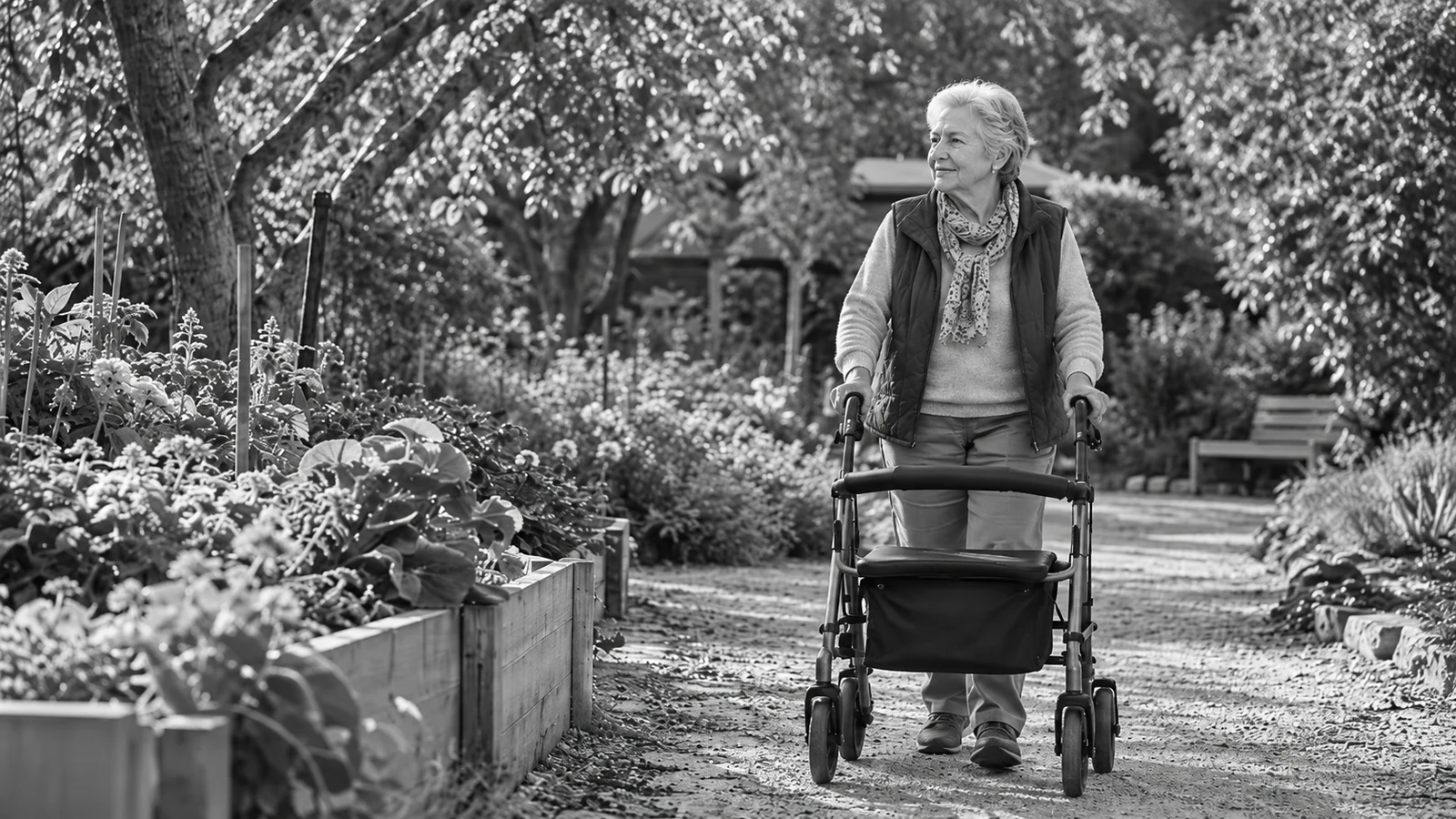
A walking stick or frame is often introduced with an apology.
“I know you don’t want one.”
“It’s only temporary.”
“Hopefully we can get you off it.”
Those statements reveal an assumption: needing a walking aid represents decline, and the best outcome is to stop using it.
Sometimes that is true.
Sometimes it is exactly backwards.
The right walking aid can allow a person to walk further, feel more secure and remain involved in activities that would otherwise become inaccessible.
Key points
- A suitable walking aid can increase practical independence, confidence and participation.
- The best device depends on the person, task, environment, fatigue and what they will actually use.
- Fit and technique matter; a poorly configured or incorrectly used aid can create problems.
- A walking aid does not guarantee that somebody will not fall and may form part of a broader assessment.
- Needing equipment is not failure when it preserves meaningful activity.
What does a walking aid actually do?
Different walking aids change the task in different ways.
A stick can provide a point of contact and some external support.
A four-wheeled walker can increase the available base of support, offer upper-limb contact and allow the person to pause using a seat where appropriate.
A forearm support frame may change how body weight is distributed.
The device can also provide additional sensory information through the hands.
But these potential benefits depend on the person using the aid correctly and on whether the device suits the task.
A walking aid can create more independence, not less
Independence is often equated with doing something without equipment.
That is a narrow definition.
Imagine two people.
One refuses a walking aid and limits walking to a few metres inside the home because they feel unsafe.
The other uses a rollator and continues going to the shops, meeting friends and walking in the community.
Which person has more practical independence?
The device may increase dependence on equipment while reducing dependence on other people.
The point is not to label one outcome superior.
It is to stop assuming that “no aid” is automatically the best one.
Start with the activity the aid needs to support
The same device will not suit every person or every setting. A person who needs support for short transfers inside a compact home faces a different task from someone who wants to walk several kilometres outdoors. Steps, narrow doorways, carpet, slopes, transport, storage and the need to carry items can all affect the choice.
Assessment should ask where the person walks, how far, what happens when they tire and whether the aid can be transported or stored. It should also consider what the person will realistically use. A technically appropriate device left in a cupboard provides no practical support.
A walking aid does not guarantee that somebody will not fall
A walking aid can improve function and steadiness for an appropriately selected person.
It should not be treated as a fall-prevention guarantee.
Falls risk still depends on the person, environment, task, device setup and the way the aid is used.
That is why prescription and training matter.
The person may also have more than one reason for falling. A walking aid will not correct fainting, a serious medicine effect, acute neurological change or every problem with vision and attention. It can be one useful part of a broader plan without carrying responsibility for risks it cannot address.
Fit matters
A walking aid set at the wrong height can make movement awkward.
Brakes that are difficult to operate can make a rollator unsafe.
A device that is too heavy may be hard to manage.
The person’s grip, upper-limb strength, cognition, vision and ability to learn a new movement pattern all matter.
“Just buy a frame” is not ideal clinical advice.
Assessment should consider what the person needs the aid to do.
Fit should be checked in the footwear normally worn and in the postures the person uses. The setup may need to account for pain, joint limitation or asymmetry. For wheeled devices, the person must be able to control direction and brakes while still organising the movements needed for sitting, standing and turning.
An aid that was suitable during early recovery may not remain the best option. Improvement, decline, a new environment or a change in upper-limb function can alter what is manageable. Prescription is a starting point, not a permanent conclusion that should never be reviewed.
Technique matters too
People often develop their own method of using a device.
They may place a stick too far forward.
Leave the frame behind when turning.
Walk too far behind a rollator.
Forget to apply brakes.
Carry objects in ways that interfere with control.
Practice should occur in the situations where the aid will actually be used.
That may include doorways, tight turns, ramps, kerbs, lifts, public transport or moving towards a chair. The person may also need a safe method for carrying everyday items. A basket or bag designed for the device is different from hanging a heavy load where it changes control.
Practice should include the moments when people commonly abandon the aid: a few steps to the bathroom, a turn around furniture or the final approach to a seat. If the device is consistently left out of reach, the plan needs to address the routine and environment rather than merely repeating an instruction to use it.
Stigma can be a genuine barrier
Some older adults reject walking aids because of what the aid symbolises.
“I’ll look old.”
“People will think I’m disabled.”
“Once I start using that I’ll never stop.”
Those concerns should not be mocked.
The conversation can be reframed.
What does the device make possible?
Can it extend the distance you can walk?
Can it help you go somewhere you have stopped going?
Can it reduce how much you need another person to hold you?
Would you prefer to use it only in some settings?
Choice of appearance can matter too. Size, colour, noise and the way a device fits into a car or social setting may influence acceptance. These concerns are not superficial if they determine whether the person uses the aid. The clinical conversation should explain the functional trade-offs while allowing the person genuine input into the choice.
A walking aid can be situational
Using a device does not have to be all or nothing.
Somebody may use no aid around a familiar home but use a rollator outside.
They may use a stick when tired.
They may use a frame during recovery after hospitalisation and later transition to another device.
Or they may continue using the same aid long term because it remains useful.
A permanent aid is not proof that rehabilitation failed.
Situational use should still be clear. “Use it when needed” may leave the person guessing. A more practical plan describes the circumstances: outside the home, when fatigued, for longer distances or during a period of recovery. The plan can then be reviewed against what actually happens rather than against a vague expectation that use will naturally reduce.
Support can preserve agency
Somebody can rely on a device and still make their own decisions.
They can use a frame and choose where they want to go.
They can require assistance and still decide how that assistance is provided.
Physical independence and personal agency are not the same thing.
This distinction is important when family members are involved. A relative may prefer to hold the person instead of encouraging use of a frame, believing that personal assistance is safer or kinder. In some situations that is appropriate. In others, the device gives the older person more control over pace, direction and timing. The preferred support should be decided with the person, not simply around them.
The best walking aid is not the smallest one
People sometimes progress through devices as though they are grades:
frame → stick → nothing.
That sequence may be appropriate for some recoveries.
It should not become an automatic hierarchy.
A person who is much more active with a rollator may have a better functional outcome than somebody who is less stable with a stick simply because the stick looks more independent.
Progress can occur while the same aid remains in use. The person may walk further, negotiate more varied environments, require less supervision or recover more effectively when distracted. Those gains should not be overlooked because the visible equipment has not changed.
Judge the aid by the life it enables
Can you get where you want to go?
Do you feel more stable?
Can you manage the device confidently?
Does it fit the environment?
Does it reduce or increase the need for another person’s assistance?
Has it opened activities that had started disappearing?
Those answers tell us more than whether the person can walk ten metres without it.
A walking aid is equipment.
What matters is what the person can do with it.
That judgement should include safety, effort and sustainability. If the aid makes walking exhausting, cannot be managed through the person’s doorway or increases pain, the apparent support may not translate into daily use. If it enables regular outings with manageable effort and acceptable risk, dependence on the device may represent greater freedom in practice.
Understand more
- Balance Is More Than Strength: The Clinics GRP Approach to Balance in Older Adults
- Why Do Older Adults Fall? There Is Rarely One Cause
- Managing Falls Risk Should Protect Participation, Not Restrict It
- Adaptation Is Not Giving Up: Rethinking Balance and Ageing
Relevant care
References
- Australian Commission on Safety and Quality in Health Care. Falls Guidelines for Community Care. 2025. https://www.safetyandquality.gov.au/resources/falls-guidelines-community-care
- Montero-Odasso M, et al. World guidelines for falls prevention and management for older adults. 2022. https://pmc.ncbi.nlm.nih.gov/articles/PMC9523684/
- World Health Organization and UNICEF. Global report on assistive technology. 2022. https://www.who.int/publications/i/item/9789240049451