
Rehabilitation often begins with restoration.
Can strength improve?
Can balance become more adaptable?
Can walking become easier?
Can confidence return?
Those are worthwhile questions.
But another question belongs beside them:
What if changing the task would help the person live better now?
Adaptation is sometimes treated as what happens after rehabilitation has failed.
That misunderstands what adaptation can do.
Key points
- Adaptation changes the task or environment so a valued activity remains possible.
- Equipment, timing, technique, route choice and support can all be useful adaptations.
- Rehabilitation and adaptation are not opposites; they can be used together.
- The right adaptation begins with the purpose that matters to the person.
- Adaptation is not giving up when it protects participation and expands practical options.
What do we mean by adaptation?
Adaptation can be simple.
Using the rail.
Turning on more lights.
Sitting to dress.
Carrying fewer items at once.
Choosing a flatter walking route.
Using a rollator outdoors.
Taking a rest before fatigue substantially affects balance.
These changes alter the demand of the activity.
The person’s physical capacity may be exactly the same before and after the adaptation.
What changes is the fit between capacity and task.
Adaptation can involve equipment, the environment, timing, technique or support from another person. It can be temporary during recovery or remain useful long term. The common feature is not the object used. It is the decision to change a demand so that the purpose of the activity remains achievable.
Adaptation begins with the purpose
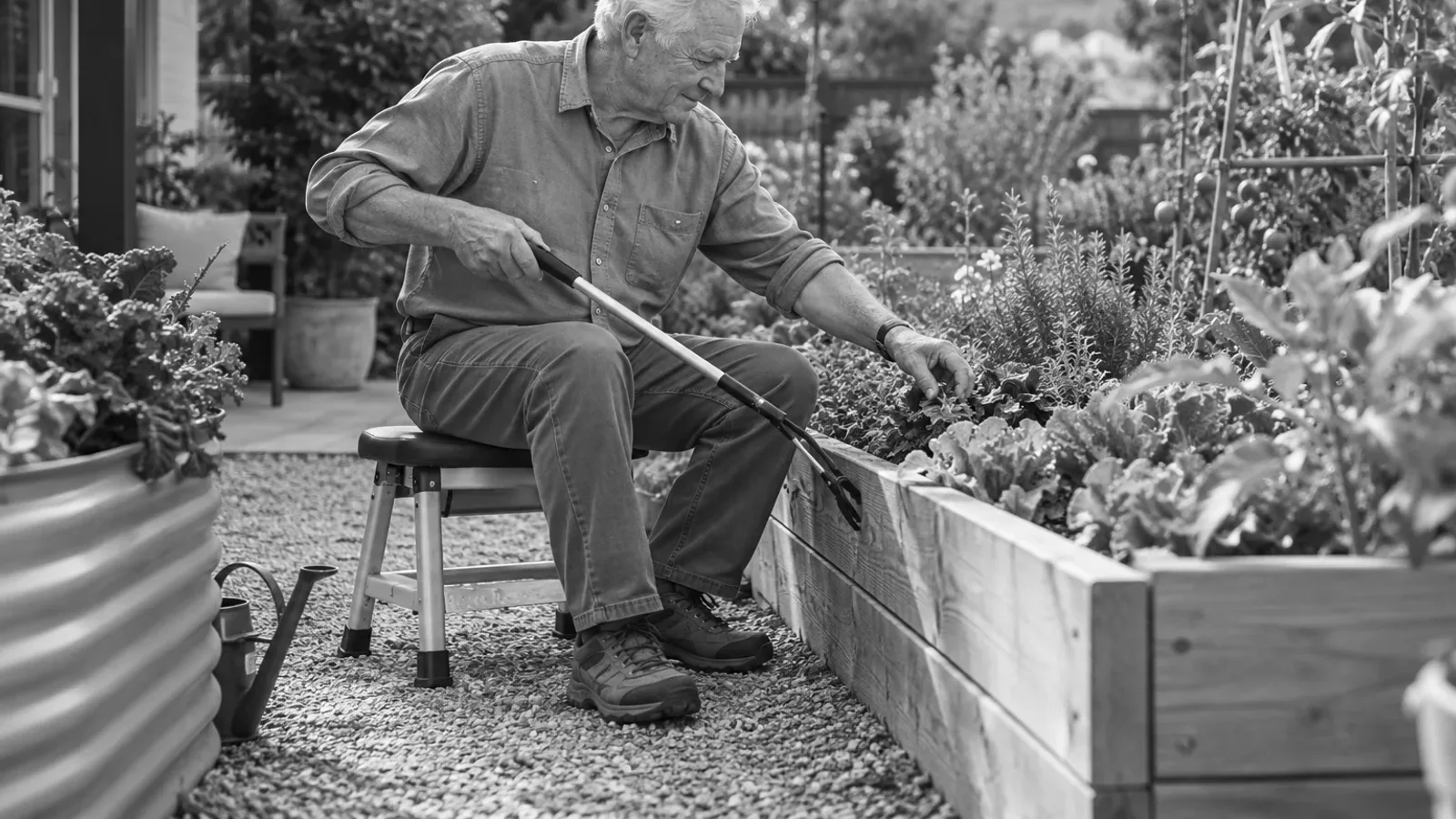
Two activities that look similar may serve different purposes. One person gardens because they value growing food. Another values time outdoors. Another values the identity and routine associated with caring for a particular garden.
The right adaptation depends on which part matters. Raised beds may preserve hands-on gardening. Help with heavier tasks may protect the person’s role in planning and tending plants. A comfortable outdoor seat may preserve time in the garden even when prolonged bending is no longer realistic.
If the purpose is not understood, an adaptation can solve the physical problem while removing the reason the person wanted the activity.
Rehabilitation and adaptation are not opposites
A common pattern in healthcare is:
Try to restore normal function.
If that fails, adapt.
That sequence may make sense in some situations, but it should not become a rule.
Suppose somebody is recovering after hospitalisation and currently needs a shower chair.
Using the chair can make bathing possible today.
At the same time, rehabilitation may work on standing tolerance, strength and mobility.
The adaptation has not blocked rehabilitation.
It has preserved an activity while rehabilitation occurs.
Early adaptation may also prevent a long interruption in routine. Waiting months for physical capacity to improve before resuming any version of an activity can make return harder. A manageable version allows the person to continue practising relevant skills and remain connected with the role the activity plays in daily life.
Environmental change can reduce falls risk for selected people
Home hazard interventions can reduce falls in appropriately selected community-dwelling older people.
The point is not to eliminate every object that could theoretically create a fall.
It is to identify environmental features that meaningfully interact with that person’s risk.
A good adaptation preserves the character and function of the home while removing unnecessary difficulty.
This requires selectivity. A home is not merely a collection of hazards. It contains familiar routes, valued objects and routines that support identity. Removing furniture or changing layouts without the person’s involvement can make the environment less usable or less recognisable. The strongest environmental changes respond to an observed problem and are agreed with the person who lives there.
Timing is an adaptation too
Capacity varies across the day. Fatigue, medication timing, pain, meals, temperature and busy environments can change how demanding an activity feels. A person may manage shopping well in the morning and struggle later in the day. They may walk confidently in a quiet centre but find the same route difficult when crowded.
Changing when an activity occurs can reduce unnecessary demand without abandoning it. This is not avoidance when the person is making a deliberate choice about the conditions in which they function best. The strategy should still be reviewed if the available window becomes progressively narrower or if new symptoms appear.
Changing the method can preserve the purpose
A person may no longer be able to garden exactly as they once did.
That does not immediately answer whether gardening remains possible.
Raised beds.
A stable seat.
Help with heavier tasks.
Shorter sessions.
Different tools.
A change in layout.
The method changes.
The purpose remains.
The same reasoning can apply to cooking, travel, personal care and social activity. A perching stool may allow someone to prepare food with less fatigue. Delivery of heavy groceries may preserve the ability to choose meals and cook. Accessible transport may make a weekly group possible after driving has stopped. Adaptation protects the part of the activity that holds meaning.
Adaptation can involve grief
It would be too easy to describe adaptation as endlessly positive.
Some changes are unwanted.
Using a walking aid for the first time can feel like visible evidence that life has changed.
Giving up driving may affect identity and freedom.
Needing another person’s help can bring frustration or sadness.
A person can dislike the change and still decide that the adaptation is useful.
Acceptance is not approval.
People may need time to decide. Introducing several pieces of equipment immediately after a fall or hospital admission can feel like a sudden redefinition of the home and the person’s identity. Trial, explanation and choice can make adaptation more collaborative. Where options exist, the person should be able to compare their practical benefits and burdens rather than being told that there is only one acceptable solution.
The alternative may be less agency, not more
Rejecting support is sometimes framed as preserving independence.
But if the result is that the person can no longer participate, the practical effect may be less freedom.
A walking aid might feel like dependence.
It may also make independent community mobility possible.
A rail is external support.
It may allow somebody to use their own stairs without another person.
Support and agency can coexist.
Agency also includes the right to reject an adaptation after understanding the implications. A clinician may strongly recommend a change where risk is substantial, but the reasoning and alternatives should be discussed openly. Shared decision-making is not the absence of professional advice. It is advice delivered in a way that recognises the person as the decision-maker in their own life.
Adaptation should not become unnecessary restriction
Not every change labelled “for safety” is helpful.
Removing every challenging activity may reduce opportunities to maintain ability.
Family members may take over tasks that the person remains capable of doing.
Good adaptation needs the same clinical reasoning as exercise.
What problem are we solving?
Does the change actually help?
What does it cost?
Does the person want it?
Can the solution be less restrictive?
Should it be reviewed later?
Adaptation should create options rather than automatically close them.
Adaptations should be tested in real use
A rail may look well positioned but prove awkward during the actual transfer. A chair may be the correct height yet block the route through a room. A rollator may work in a clinic corridor but be difficult to manoeuvre through the person’s doorway.
Where possible, the change should be evaluated during the task it is intended to support. Does it reduce effort? Does the person use it consistently? Does it introduce another problem? Is the support located where it is needed? Observation can distinguish an attractive idea from a practical solution.
Adaptations also need maintenance. Brakes wear, rubber tips lose grip, lighting changes and furniture moves. A solution that once worked should not be assumed to remain effective indefinitely.
Rehabilitation can expand the range of adaptations available
A stronger person may be able to use a lighter walking aid.
Better turning ability may make a rollator easier to manage in tight spaces.
Improved endurance may allow longer outings even if the aid remains necessary.
Greater confidence may reduce how much supervision is needed.
Rehabilitation does not always remove adaptations.
Sometimes it makes them more effective.
The relationship can work in the other direction as well. A useful adaptation can create more opportunity for rehabilitation. A person who can safely reach the garden using a rail has a reason to walk that route. Someone who uses a rollator to access the community gains regular walking exposure. Participation can become part of how capacity is maintained.
Ageing well does not require resisting every change
There is a cultural story that successful ageing means remaining completely independent and physically unchanged for as long as possible.
Real life is more varied.
People improve.
People maintain.
People adapt.
People accept help.
People change priorities.
None of those outcomes determines their worth.
Balance care should preserve capability where possible while making room for intelligent adaptation when life changes.
Adaptation is not giving up.
It is one of the ways human beings continue.
It acknowledges that bodies, environments and priorities change, while refusing to assume that every change must lead to withdrawal. The most useful adaptation does not ask the person to become somebody else. It helps them preserve a valued part of life in a form that works now.
Understand more
- Balance Is More Than Strength: The Clinics GRP Approach to Balance in Older Adults
- Why Do Older Adults Fall? There Is Rarely One Cause
- A Walking Aid Can Increase Independence, Confidence and Participation
- The Goal Is Not Perfect Balance — It Is More Options
Relevant care
References
- Clemson L, et al. Environmental interventions for preventing falls in older people living in the community. Cochrane Database of Systematic Reviews. 2023. https://doi.org/10.1002/14651858.CD013258.pub2
- Australian Commission on Safety and Quality in Health Care. Falls Guidelines for Community Care. 2025. https://www.safetyandquality.gov.au/resources/falls-guidelines-community-care
- World Health Organization. Healthy ageing and functional ability. https://www.who.int/news-room/questions-and-answers/item/healthy-ageing-and-functional-ability
- World Health Organization and UNICEF. Global report on assistive technology. 2022. https://www.who.int/publications/i/item/9789240049451