
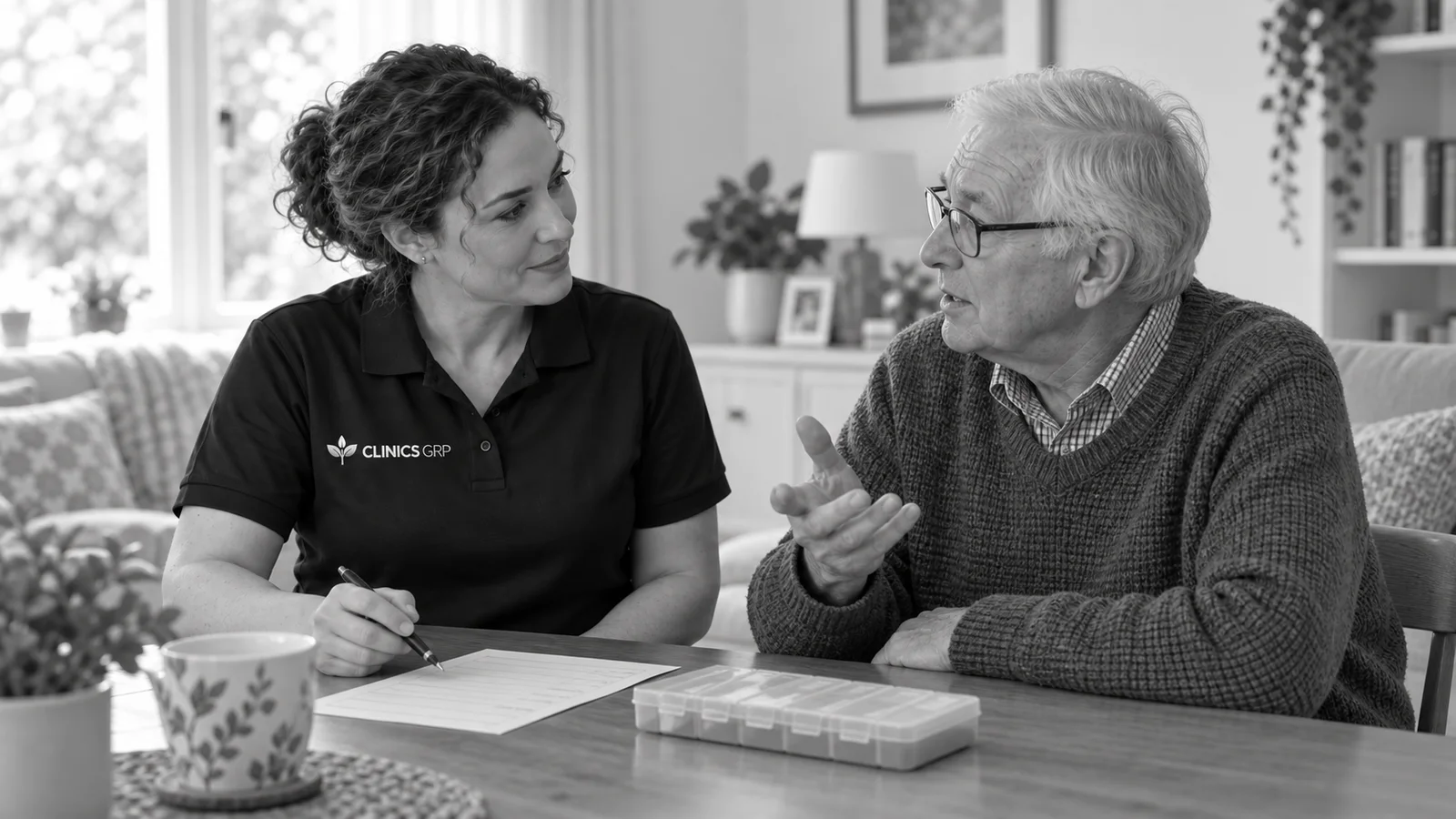
A new prescription can look like the end of a clinical decision. For the person taking the medicine at home, it may be the beginning of a new set of questions. Which instructions are current? Has an older supply been replaced? What should they do if they feel different? Who is expecting to review the response?
These questions deserve clear answers. Nursing can contribute to authorised medicine support, relevant observation and communication, while prescribing and medicine-review responsibilities remain with the appropriate practitioners. The presence of a nurse does not remove the need to clarify a prescription with its prescriber or pharmacist.
At Clinics GRP, medication support and clinical monitoring sits within an assessed nursing plan. This article explains the role of observation and communication after a prescription changes. It does not advise which medicine to take, recommend doses or suggest changes to treatment.
Key points
- A current, understandable medicines plan is important when prescriptions change.
- Nursing observations can inform communication but do not establish the cause of a symptom by themselves.
- Prescription changes and specialist medicine review require the appropriate prescriber or pharmacist.
- Serious or rapidly worsening symptoms need urgent help, not a routine follow-up message.
Why the period after a change deserves attention
The practical details of a medicine change can be easy to underestimate. A person may receive new instructions while tired after a hospital stay. Different documents may arrive at different times. A family member may be helping with a routine they have never managed before.
In a November 2025 release, the Australian Commission on Safety and Quality in Health Care reported an estimate of 250,000 medication-related hospital admissions each year in Australia.1 That is a population-level estimate, not a measure of an individual person’s risk or a result from Clinics GRP. It does not show that a particular nursing programme will prevent a set proportion of admissions.
The practical message is more modest: medicine information and communication deserve careful attention, especially when care moves between settings. A small uncertainty in the instructions should not be allowed to persist simply because several people are involved.
Confirm which information is current
If instructions differ between a medicine label, discharge document and an older list, the discrepancy needs clarification. The person should not have to decide which version to follow by comparing dates or guessing what the hospital intended.
The nursing team can identify and communicate concerns within its role. Questions about the prescription should be directed to the responsible prescriber or pharmacist. The urgency depends on the situation and the person’s condition; some questions cannot wait until a later appointment.
A current plan should also make follow-up understandable. Who will review the response? Has an appointment been arranged? Is another clinician expecting information? These are ordinary organisational questions with clinical importance.
What can nursing observation contribute?
Observation is useful when it is connected to an agreed purpose. A nurse may be asked to observe a relevant aspect of the person’s condition, support an authorised administration plan or communicate a change that needs review. The task and the limits of the role should be clear.
A change noticed after a prescription is not automatically caused by that medicine. New symptoms can have several explanations, and a medical assessment may be needed. The timing of the observation is useful information; it is not a diagnosis.
Describe what happened in plain terms. “She has seemed different since yesterday” may lead to questions about what “different” means. A clear account of the change, its timing and its effect on everyday function can help the receiving clinician decide what needs attention.
Support is not the same as prescribing
Clinics GRP’s nursing medication pathway does not present itself as a prescribing service or a pharmacist-led medication reconciliation service. It provides nursing support within assessed needs, current instructions, professional scope and the agreed care arrangement.
Do not stop, restart, share or alter a medicine on the basis of this article. Do not change a dose because you are waiting for a nurse or because an observation seems to fit something you have read. Obtain advice from the appropriate prescriber or pharmacist, and seek urgent care when required.
This distinction protects the usefulness of nursing input. The nurse can contribute observations and identify concerns without being expected to make a decision that belongs elsewhere.
A hypothetical example: two lists and an uncertain next step
Imagine an older man returning home with a discharge summary that differs from the medicines list kept in his kitchen. His daughter has arranged a nursing enquiry because she is unsure which instructions are current. He also says he feels less steady than usual.
The response needs to address both the conflicting information and the change in his condition. The prescription needs appropriate clarification. The new symptom needs assessment at a level and urgency suited to the situation. A routine nursing appointment should not be used to postpone necessary medical advice.
This example does not establish that a medicine caused the unsteadiness. It illustrates why information problems and clinical changes need to be communicated clearly rather than folded into one assumption.
Ask whether the routine is workable
A person may understand what has been prescribed but still find the routine difficult. Instructions may be hard to read, the organisation of care may be confusing, or the person may feel uncomfortable asking the same question again.
These concerns should be discussed without blame. The next step may involve the prescriber, pharmacist, nursing team or another appropriate support. Any proposed arrangement needs to respect the person’s choices, consent and ability to participate.
The aim is not to assume that every older adult needs someone else to manage their medicines. It is to understand what assistance, if any, is useful for this person. Independence and support are not fixed categories; the appropriate arrangement can change.
Communication should identify who will act
“The GP has been informed” can mean several things. Was a message sent? Was it received? Was advice provided? Is someone expecting a response? Where a concern requires action, those distinctions matter.
The Commission’s medication-transition framework supports clear responsibilities and reliable information when people move between care settings.2 In home care, a practical application is to make the next step explicit: which clinician is being contacted, what question needs answering and how the outcome will be communicated.
Clinical information should be shared through agreed secure processes and with appropriate consent. A family group chat is not automatically an appropriate place for medication records or clinical instructions.
Review the person, not just completion of the task
An authorised administration task may have been completed correctly while another concern still needs attention. The person might report difficulty participating in their usual routine or uncertainty about the plan. Those observations deserve a place in the review.
The nursing assessment and care review pathway can help clarify broader nursing priorities when needs are changing. It does not replace a medicine review by the appropriate practitioner.
After a hospital stay, recovery-at-home nursing may help connect the relevant follow-up arrangements. The value lies in coordinated responsibilities and a considered response, rather than simply adding appointments.
When to obtain urgent help
If someone has severe difficulty breathing, chest pain, signs of a stroke, becomes unresponsive or is seriously unwell, call Triple Zero (000).5 New sudden confusion can also require emergency medical attention.3 Do not wait for an online enquiry, a planned visit or a routine call-back.
For suspected poisoning or a medicine overdose, the Poisons Information Centre can provide advice on 13 11 26; call 000 for an emergency.4 This article cannot determine the seriousness of a particular event. Clinics GRP is not an emergency or 24-hour service.
Keep the evidence in perspective
National safety guidance explains why medicine transitions need attention. It does not establish that every change causes harm, that all symptoms are medicine-related or that home nursing can remove every risk. The right plan depends on the person, the prescription and the clinical context.
For non-emergency enquiries, Clinics GRP nursing can clarify whether nursing support is suitable and what information is required. Care remains subject to assessment, authorisation and availability. The aim is a plan in which the person knows what is agreed, professionals know their responsibilities and concerns reach the right clinician.