
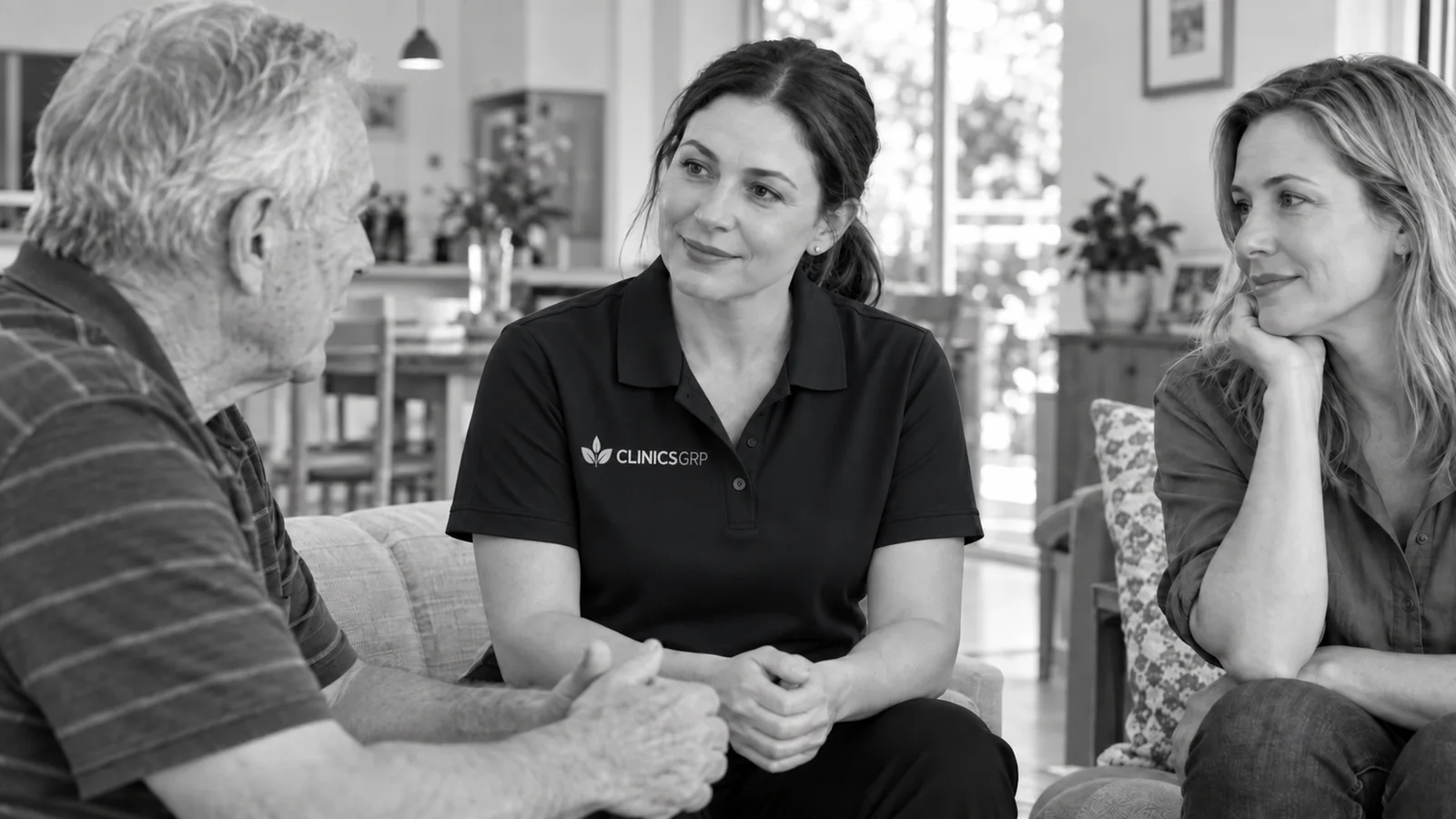
An older person who usually prepares breakfast has stopped coming into the kitchen. Someone who manages their own medicines seems uncertain about a recently changed prescription. A family member notices that a small wound is becoming more uncomfortable. The first question is often whether to arrange a nurse.
That can be a useful next step, but it is not the only possible answer. A change may need nursing assessment, a GP or pharmacist, a specialist already involved in care, or urgent medical attention. Understanding the concern and its urgency comes before choosing an appointment.
At Clinics GRP, the starting point is the change in the person’s health or everyday function. Nursing for older adults connects that concern with assessment, clinical priorities and an appropriate plan. Age provides context; it does not explain every new difficulty.
Key points
- Describe what has changed, when it started and how it affects ordinary life.
- Nursing assessment can help identify care priorities and the need for other clinical input.
- Sudden or severe changes can require urgent medical assessment rather than a routine visit.
- A useful plan explains responsibilities, follow-up and what to do if the situation changes.
First consider whether the situation is urgent
If someone has severe difficulty breathing, chest pain, signs of a stroke, becomes unresponsive or is seriously unwell, call Triple Zero (000).4 Do not wait for a home-nursing appointment or an online enquiry response. Healthdirect identifies sudden confusion associated with delirium as a medical emergency.1 A new change in alertness or behaviour should not simply be attributed to ageing or an existing memory problem.
These examples are not a complete list of emergencies. If you are unsure what level of care is needed, seek prompt advice from an appropriate medical service. Healthdirect’s telephone service is available on 1800 022 222 for health advice. Clinics GRP is not an emergency or 24-hour service.
Once urgent needs have been addressed, nursing may still contribute to follow-up. The distinction concerns timing and responsibility, rather than a choice between professions that never work together.
Describe the change before naming the service
“Dad needs more help” conveys concern but leaves important questions unanswered. “Dad has needed help getting washed since returning home, and his dressing is causing discomfort” gives the receiving team a clearer starting point. It identifies a change, a setting and a practical consequence.
Useful information includes when the concern began, whether it is new or recurring, and whether it is getting worse. Explain what the person could usually do and what is different now. If another clinician has already assessed the issue, mention the advice and follow-up arrangements.
You do not need to establish a diagnosis before asking for help. Nor should you delay urgent care while trying to gather a perfect history. The purpose of these observations is to support the conversation, not to make families responsible for clinical triage.
What can a nursing assessment contribute?
A registered nurse can assess relevant nursing needs, consider existing care instructions, identify priorities and communicate concerns within their scope. The Nursing and Midwifery Board of Australia describes registered nursing practice as including assessment, planning, delivery and evaluation of care.2
In practical terms, an assessment may connect several concerns that arrived as separate requests. Discomfort from a wound could be affecting sleep. Difficulty managing a routine might relate to unclear discharge instructions. The appropriate response depends on the findings and the care arrangements already in place.
The nursing assessment and care review pathway provides a starting point when the main need is to clarify priorities. Assessment should produce a useful next step, even when that next step is referral to another professional rather than ongoing nursing visits.
Where do medical and pharmacy responsibilities fit?
Nursing observation does not replace medical assessment when a condition needs diagnosis, investigation or treatment decisions outside the nurse’s role. A GP or relevant specialist may need to review a new or worsening concern. A pharmacist can help with medicine-related questions within their professional role.
Clinics GRP nursing support does not represent a prescribing service. A family should not interpret an article, a changed observation or an upcoming nursing visit as permission to alter a medicine. Questions about a prescription need the appropriate prescriber or pharmacist, with the urgency determined by the situation.
Clear boundaries help people get the right help sooner. They also prevent a common communication gap: everyone assumes somebody else has contacted the GP, while no one has confirmed that the concern was received.
A hypothetical example: a change after hospital
Imagine an older woman who has returned home after surgery. She has a planned wound review, a changed medicines list and less confidence moving around the bathroom. Her daughter asks whether an extra nursing visit would solve the problem.
The team would first need to clarify the concerns and urgency. Nursing could contribute to the authorised wound plan and relevant follow-up. Prescription questions may need pharmacy or medical input. Mobility difficulties may warrant physiotherapy when clinically appropriate. New serious symptoms could change the immediate destination altogether.
This is an illustration, not a diagnosis or a recommended package of visits. Its point is that one person’s concerns can cross professional boundaries. The useful outcome is a shared understanding of what needs attention and who will take responsibility.
The person’s account remains central
A family member may notice changes that the person has not mentioned. The person may also have priorities that are missing from the referral. Both perspectives can be useful, with consent and appropriate involvement of a representative where needed.
Ask what is most difficult from the person’s point of view. It might be pain, interrupted sleep, embarrassment about needing assistance or uncertainty about what happens next. These concerns can affect participation in care even when they are not the original reason for referral.
Communication should suit the person. Hearing, language and other communication needs should be considered when arranging the conversation. A plan is more useful when the person can explain what has been agreed in their own words.
What should happen after the assessment?
The next step should be understandable. What is nursing addressing? What needs another clinician? What information will be shared, with whom and through which agreed channel? When will the response be reviewed?
A plan should also explain how concerns can be raised between appointments and what to do if the person becomes unwell. Routine contact arrangements are not a substitute for emergency services. Families should know the difference before they need to use either.
Some people need a short period of support. Others need ongoing nursing with defined goals. The number of visits alone cannot show whether the care is appropriate; the reason for continuing and the response to care matter.
Evidence, interpretation and uncertainty
Australian guidance supports involving people in decisions and relating care to their needs and goals.3 These principles provide a basis for a considered assessment process. They do not prove that every change will be explained, that every problem is reversible or that a particular Clinics GRP pathway will produce a guaranteed result.
Sometimes uncertainty remains after an initial assessment. A responsible plan makes that uncertainty visible and identifies the next step. Observation may need review alongside information from other clinicians. Further investigation may be appropriate. “We need more information” can be a useful clinical conclusion when it leads to clear action.
Starting with the right information
For a non-emergency enquiry, describe the concern, timing, usual function, existing clinicians and any relevant discharge instructions. Share clinical records through the agreed secure referral process. Provider authorisation, service location and availability also need confirmation.
You can begin with Clinics GRP nursing. If care is being arranged through a funded home-care plan, the Support at Home pathway explains the service coordination process. Funding approval and clinical suitability remain separate questions.
The aim is not to turn every change into a nursing appointment. It is to recognise that something is different, take the concern seriously and connect the person with a clinically appropriate next step.