
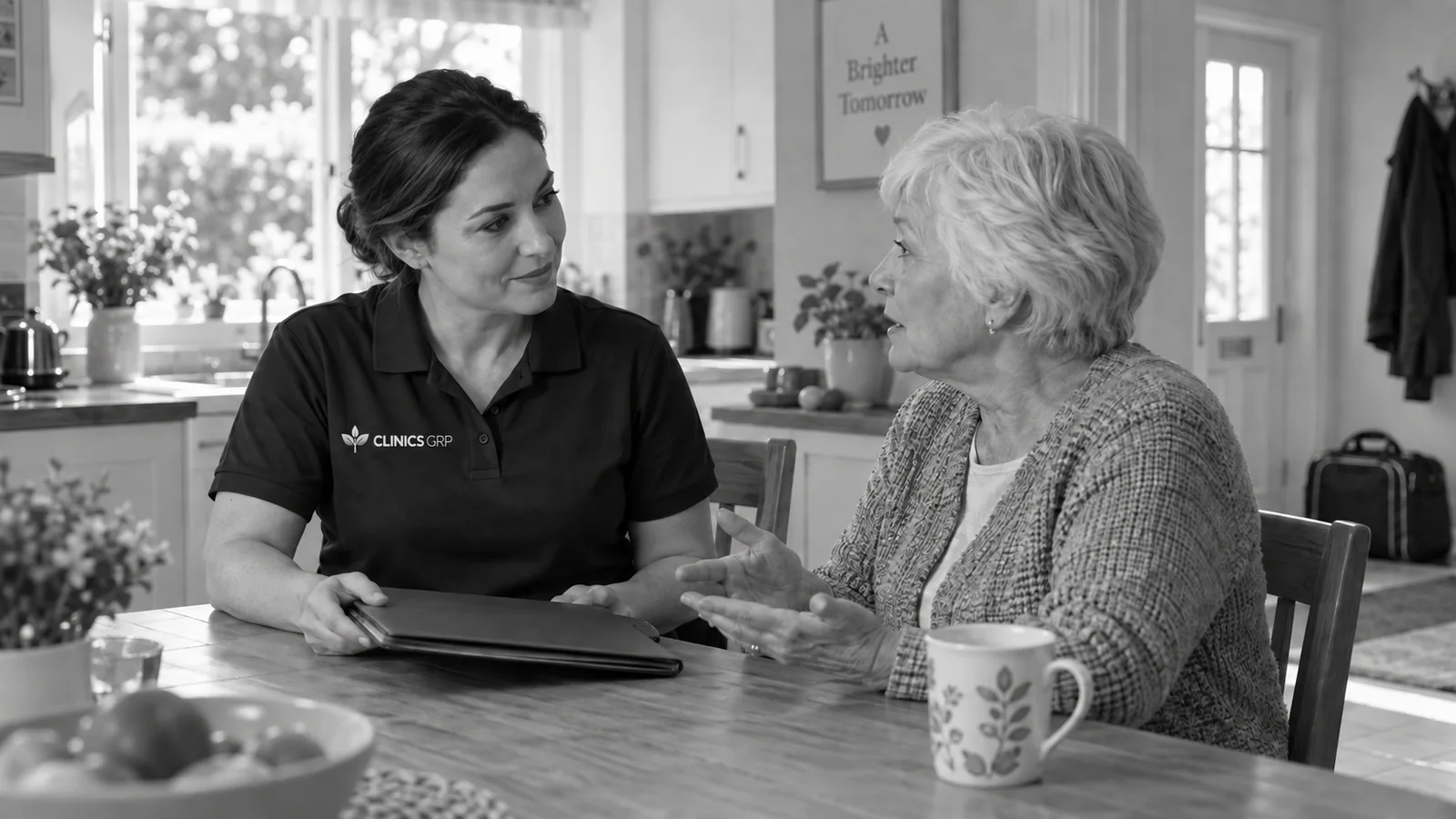
Coming home from hospital is an important transition. It can also be the moment when a person discovers how different everyday life has become. Instructions that sounded manageable on the ward may be harder to follow at home. A familiar bathroom may feel difficult to use. Several follow-up arrangements may be waiting to be confirmed.
For an older person, nursing after discharge should connect the hospital plan with what is actually happening at home. The purpose is not simply to repeat observations or complete a list of tasks. It is to understand the relevant nursing needs, notice changes and help keep the next steps clear.
Clinics GRP provides recovery-at-home nursing after hospital, subject to clinical suitability and agreed arrangements. This article explains what a useful follow-up conversation can address. It does not replace discharge instructions or determine whether home is the appropriate setting for an individual.
Key points
- Nursing follow-up should connect discharge information with the person’s current situation.
- Medicines, wounds, everyday function and communication can interact during recovery.
- Unclear instructions need clarification from the responsible clinician, not guesswork.
- New serious symptoms require urgent medical care rather than waiting for a planned visit.
Start with the discharge plan and the person
A discharge summary helps explain the hospital admission, treatment and intended follow-up. It should be considered alongside the person’s account and the current clinical picture. An important question is whether the arrangements described in the paperwork have actually been put in place.
The Australian Commission on Safety and Quality in Health Care identifies transitions between care settings as a period of increased risk and emphasises the role of information transfer.1 For a family, this makes seemingly simple questions valuable: who is expecting the referral, who has the current instructions, and when is the next review?
An incomplete document is not an invitation to reconstruct the medical plan from memory. Relevant gaps need clarification. The nursing team should identify which questions can be addressed within its role and which require the hospital, GP, pharmacist or treating specialist.
What has changed since the person arrived home?
Recovery does not happen in a standard room with identical support for everyone. The person’s usual chair, steps, bathroom and household routine influence what feels manageable. Someone may be medically discharged but still uncertain about how to organise the next few days.
Ask what is different from the person’s usual life and from the situation described at discharge. Which tasks now require assistance? Are the agreed arrangements practical? What concerns the person most? These questions help relate clinical follow-up to actual experience.
They are not a substitute for medical assessment. If the person is deteriorating, obtaining appropriate help takes priority over completing an ordinary home-care review. The timing and seriousness of the change matter.
Medicines deserve a clear handover
A hospital stay can involve medicines being started, stopped or changed. The person may also have supplies at home from before the admission. Conflicting instructions or uncertainty about the current list should be raised with the appropriate prescriber or pharmacist.
The Commission’s medication-transition framework focuses on safer medicine management as people move between settings.2 It supports the importance of reliable information and defined responsibilities. It does not mean a home-nursing service automatically provides prescribing or a pharmacist-led medication review.
Medication support and clinical monitoring may form part of an authorised nursing plan. Questions about changing a dose or restarting an old medicine need appropriate professional advice. Do not alter the prescription because a symptom appears after discharge or because a nursing appointment is scheduled.
Wound follow-up should fit the wider recovery plan
A postoperative wound may have specific instructions and a planned review. Nursing needs access to relevant information, including who is responsible for decisions if the wound or the person’s condition changes.
The person’s account matters alongside the planned task. Is discomfort affecting sleep? Is it becoming harder to manage ordinary activities? Has something changed since the last assessment? These concerns should be brought to the treating team rather than treated as inevitable features of recovery.
Where needed, the wound and skin care pathway connects nursing follow-up with documented review and escalation. It does not promise healing or replace the surgeon’s or treating practitioner’s instructions.
Nursing and rehabilitation may need to connect
An older person can have nursing needs and movement difficulties at the same time. A plan may therefore need communication between nursing, physiotherapy and medical clinicians. That is particularly relevant when different instructions affect the same everyday activity.
For example, an authorised wound plan and a rehabilitation plan should not leave the person receiving incompatible advice about movement. Each clinician contributes within their scope, and uncertainty should be clarified with the responsible professional.
The Hospital-to-Home pathway helps connect appropriate clinical inputs around the transition. Rehabilitation should be individually considered. More exercise is not automatically the right response to every difficulty after hospital, and additional disciplines should be included because they address identified needs.
A hypothetical example: the appointments exist, but the plan is unclear
Imagine an older woman with a nursing visit, a GP appointment and a physiotherapy referral following discharge. Her son knows the dates but cannot explain which team is reviewing her medicines or whom to contact about an unexpected change.
The presence of several appointments does not resolve that uncertainty. A useful review would clarify responsibilities and communication. The person should know which instructions are current, what each appointment is intended to address and what requires attention sooner.
This example does not prescribe a combination of services. It illustrates that coordination is a practical part of care. A shorter, clearer plan may be more useful than a longer list of appointments that do not connect.
Check understanding without making the family the care coordinator
The person and their supporters should have an opportunity to ask questions in language they understand. Written information can help, but a document is not proof that the plan is understood or workable.
Ask the person to describe the next step in their own words. Listen for uncertainty about appointments, responsibilities or the purpose of an intervention. With consent, the team can include a family member or representative in the discussion and address relevant communication needs.
Families should not be expected to resolve clinical disagreements between services. When information conflicts, the professional teams need to communicate. The family’s observations are valuable, but they do not replace professional responsibility for clinical decisions.
Decide what follow-up is trying to achieve
Useful nursing goals are more specific than “support recovery”. The plan might aim to address an identified nursing need, monitor an agreed concern or help clarify the next stage of care. The purpose should be visible enough to review.
Some needs resolve after a short period. Others change or require longer support. A planned review provides an opportunity to decide whether the current arrangement should continue, be modified or finish. Appointment frequency alone cannot determine what an individual needs.
Comprehensive-care guidance emphasises goals and the impact of health concerns on the person’s life.3 Those principles inform the questions asked during follow-up. They do not guarantee recovery, prevent every readmission or establish that every person can remain at home.
Know when to seek help sooner
Follow the discharge team’s individual advice about warning signs and escalation. If someone has severe difficulty breathing, chest pain, stroke symptoms, becomes unresponsive or is seriously unwell, call Triple Zero (000).5 Sudden confusion can be a medical emergency and should not be dismissed as tiredness or ageing.4
Do not wait for a planned nursing visit when urgent medical attention is needed. Clinics GRP is not an emergency or 24-hour service. For non-emergency uncertainty about the level of care needed, seek appropriate medical advice; healthdirect is available on 1800 022 222.
Arranging the next step
For planned care, have the discharge information, relevant instructions, existing follow-up details and provider contacts available. Share records securely. Clinics GRP nursing can help clarify whether nursing is an appropriate part of the next step, within scope and availability.
Where ongoing services may be funded through Support at Home, provider authorisation and funding arrangements need separate confirmation. A hospital discharge does not automatically establish eligibility for a particular programme.
The aim is a transition in which the person understands the plan, the clinical teams understand their responsibilities, and changes receive the attention they need.