
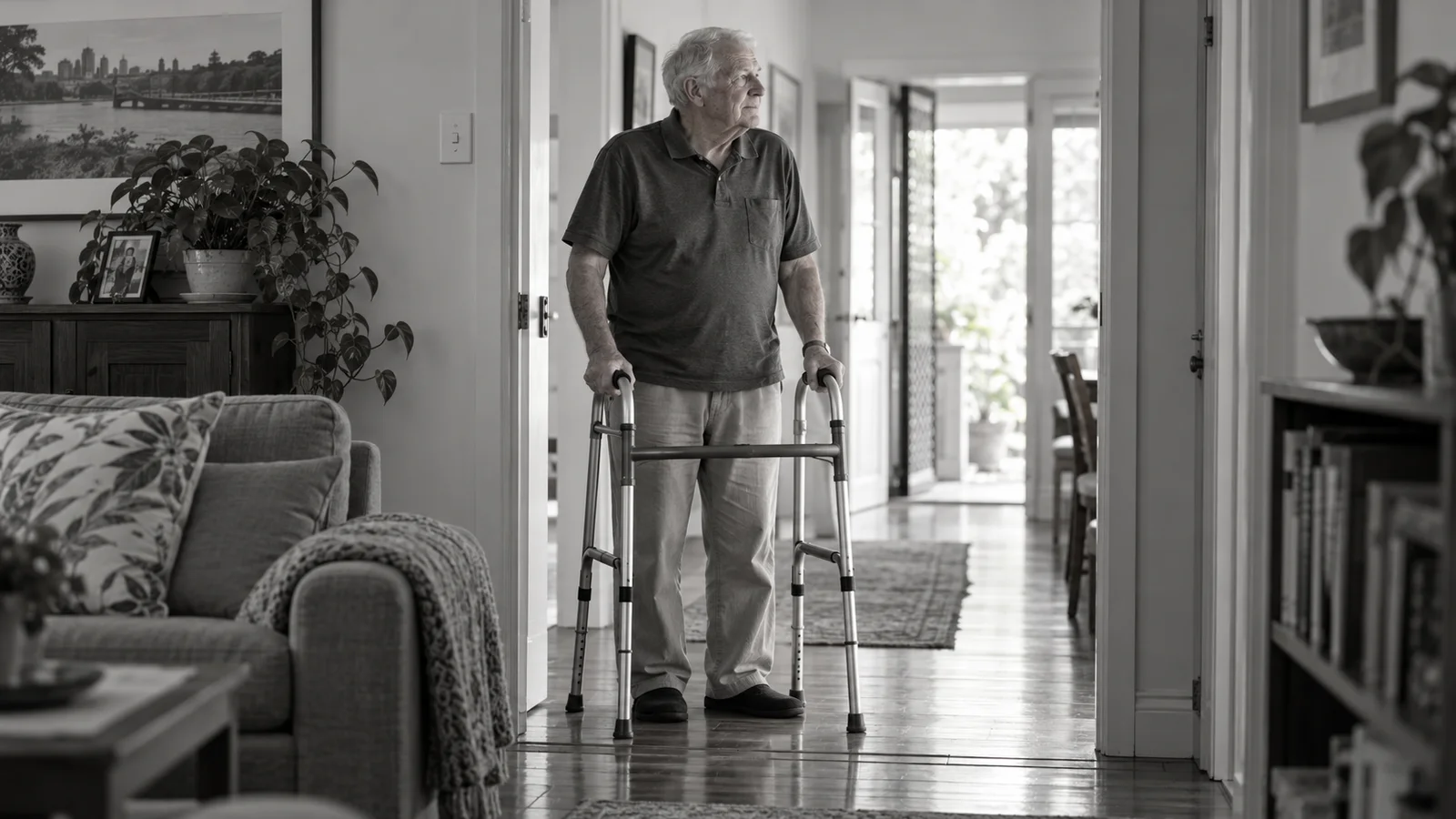
A movement can become difficult in one part of the house while remaining manageable elsewhere. Starting to walk from a chair, turning near the bathroom or moving through a doorway may create a particular problem for someone living with Parkinson’s disease. A home physiotherapy assessment can examine that situation in context.
The purpose is to understand what happens and choose an appropriate response with the person. Parkinson’s affects people differently, and movement can vary through the day. An individual plan needs relevant clinical expertise, a connection with the treating team and a clear account of the activities the person wants to protect or regain.
Key points
- Describe the specific movement, location and pattern of difficulty.
- Parkinson-specific physiotherapy may include assessed work on walking, balance, strength and relevant tasks.
- Cueing and movement strategies need individual assessment and teaching.
- Medicines questions belong with the prescriber; do not change treatment to fit an exercise session.
- Home care should remain coordinated with the person’s neurological and other clinical follow-up.
Begin with what happens in the room
Saying that walking is worse is a useful beginning. More detail can clarify the next question: is starting difficult, are turns becoming awkward, or does movement change when approaching a chair? Does the person hesitate at a doorway or find it harder when another activity is happening at the same time?
Explain when the difficulty appears and what happens next. A person may have found a way to manage that is not obvious to someone watching briefly. Their description matters, including occasions when an activity is avoided. The visit should not require a demonstration of a situation that feels unsafe.
A physiotherapist can use the actual layout to discuss the task and consider a safe assessment. That may reveal a need for movement practice, equipment review, occupational therapy or medical input. Our article on what a home assessment can show explains how home information contributes without becoming the sole explanation.
Ask for the right clinical experience
A service being mobile does not establish expertise in every neurological condition. When arranging care, explain that the person has Parkinson’s disease and describe the movement concern. Ask whether the proposed clinician has relevant experience and how they will communicate with the existing treating team.
The American Physical Therapy Association guideline supports several physiotherapy approaches for typical Parkinson’s disease, including gait, balance, resistance and task-specific training.1 Much of the underlying research concerns people in earlier or middle disease stages. Recommendations need careful interpretation for advanced disease, significant cognitive impairment or a different parkinsonian disorder.
That limitation does not remove the person’s right to care. It means assessment, suitable expertise and realistic discussion are especially important. The plan may focus on adaptation, maintaining a valued activity or making assistance more sustainable. It should not promise that a standard exercise method suits every presentation.
Turning and starting deserve their own assessment
A straight walk along an open route does not represent every movement required at home. Turning into a room, approaching a seat and restarting after a pause can create different demands. The clinician needs to understand where the difficulty occurs and what support is currently used.
Some people experience freezing, in which initiating or continuing steps becomes difficult. If this is part of the concern, explain its pattern and any associated near-falls or falls. The response should be assessed rather than reduced to an instruction to try harder, take bigger steps or follow a technique found online.
Practice may be selected around a relevant movement, but its setup and assistance need to be clear. Do not deliberately recreate a freezing episode or a rushed turn to test a strategy. The clinician can decide how to gather useful information without making the person prove the seriousness of the problem.
Why cueing needs individual teaching
An external cue can provide information that helps organise a movement, such as a selected rhythm or visual reference. The Parkinson physiotherapy guideline supports external cueing for appropriate movement outcomes.1 It does not establish that one cue works for every person, every room or every stage of disease.
A clinician may trial a strategy and examine the response. The person needs to understand when it is intended to be used, what support is required and when it should be reviewed. The effect during one supervised attempt should not be treated as proof that independent practice is safe in every circumstance.
Family and support workers should receive any relevant instruction directly, with the person’s consent. Adding several prompts at once or repeatedly changing the technique can make an already demanding task harder to follow. Agree what the plan actually asks the helper to do, and report when it is not working as intended.
Describe variation without changing medicines yourself
Tell the clinician when movement is easier or harder and whether this appears to follow a pattern. Include the timing of prescribed medicines as information for the assessment, without assuming that timing explains every change. Other symptoms and the demands of the day may also need attention.
Questions about medicine effects, missed doses or changes in symptoms need the prescriber, pharmacist or relevant Parkinson’s clinician. Physiotherapy can share observations about movement but should not replace the prescribing plan with an informal dosing suggestion. The person should know who will receive a concern and how it will be followed up.
If the appointment occurs during a better period, describe what happens at other times. A brief note can identify the activity, the time and the help needed. There is no need to provoke a problem or alter medicines so that the clinician can see a worse performance.
Consider exercise within the whole day
An appropriate programme may include different kinds of practice because walking, balance, muscle function and a particular household task are not identical goals. Ask what each part is intended to support and which priorities matter most now. More activities on a sheet do not necessarily make the plan more usable.
The plan also needs to consider fatigue, other health conditions, cognition and available help. An activity suitable during a supervised appointment may need modification between visits. Do not copy exercise intensity or complexity from a programme designed for someone with a different presentation.
Home practice can be reviewed alongside the person’s ordinary demands. A morning routine, appointments and social activity may compete for time and energy. The clinician should understand what is feasible rather than attribute an unfinished programme automatically to motivation. Our article on meaningful exercise goals offers a wider discussion.
Balance care should protect participation
Falls and near-falls deserve assessment, including the circumstances, symptoms and movement involved. Australian community guidance supports an individual approach to relevant contributors.2 A single technique or aid cannot guarantee that another fall will not occur, and the response may require more than physiotherapy.
The person’s account of confidence matters too. Avoid assuming that caution is either unnecessary fear or proof that an activity must be abandoned. Discuss what the person values, what risks need attention and what support may make participation possible. Decisions should be made with the person, with communication support where required.
An aid may be useful in some situations, but its selection and use need assessment. Limited space, turning and the person’s movement pattern can all affect suitability. The existing walking-aid article explains why the decision should be connected with the activity the aid is intended to support.
Keep the wider team involved
Movement may be only one part of the care question. Occupational therapy, speech pathology, nursing and medical services may have relevant roles, depending on the person’s needs. A physiotherapist should identify when another professional’s assessment is needed and explain how that handover will occur.
Review should return to the chosen activity. Is it more manageable? Does the strategy still make sense to the person? Can the agreed assistance be provided? If circumstances have changed, the plan may need to change too. Maintaining an ability can remain a meaningful outcome when recovery of a previous ability is uncertain.
Ask who will review a strategy if it becomes less useful before the next scheduled visit. Clear contact arrangements are particularly helpful when several professionals are involved. They prevent a movement concern from being passed between services without anyone confirming the next step.
How Clinics GRP can support you
Clinics GRP provides home and mobile physiotherapy in Brisbane. Intake checks the address, clinical fit and relevant clinician availability. Explain the Parkinson’s diagnosis, current treating team and specific movement concern so the service can consider an appropriate referral rather than assume a routine visit is sufficient.
When to seek urgent help
Seek urgent medical assessment for an abrupt, unexplained deterioration or an acute change in alertness. New facial weakness, arm weakness or speech difficulty can indicate stroke and requires 000, even in someone with an established neurological diagnosis.3 A serious fall or medical emergency should not wait for physiotherapy.
Next steps
Describe one difficult movement and when it occurs. Bring current care information and ask how assessment, practice and review will connect with the existing Parkinson’s team. Make sure the person and any authorised helper understand the agreed strategy before using it between visits.
References
- Osborne JA, Botkin R, Colon-Semenza C, et al. Physical therapist management of Parkinson disease: a clinical practice guideline from the American Physical Therapy Association. Physical Therapy. 2022;102:pzab302. https://pmc.ncbi.nlm.nih.gov/articles/PMC9046970/
- Australian Commission on Safety and Quality in Health Care. Preventing Falls and Harm from Falls in Older People: Best Practice Guidelines for Community Care in Australia. 2025. https://www.safetyandquality.gov.au/resources/falls-guidelines-community-care
- Stroke Foundation. Signs of stroke. https://strokefoundation.org.au/About-Stroke/Learn/signs-of-stroke
Disclaimer
This article provides general information only and does not replace individual medical, nursing, allied health, or emergency care advice. Health needs vary from person to person. If you are concerned about symptoms, falls risk, medication issues, mobility, pain, wounds, dizziness, or a change in health or function, speak with your GP or an appropriately qualified health professional. In an emergency, call 000 in Australia.