
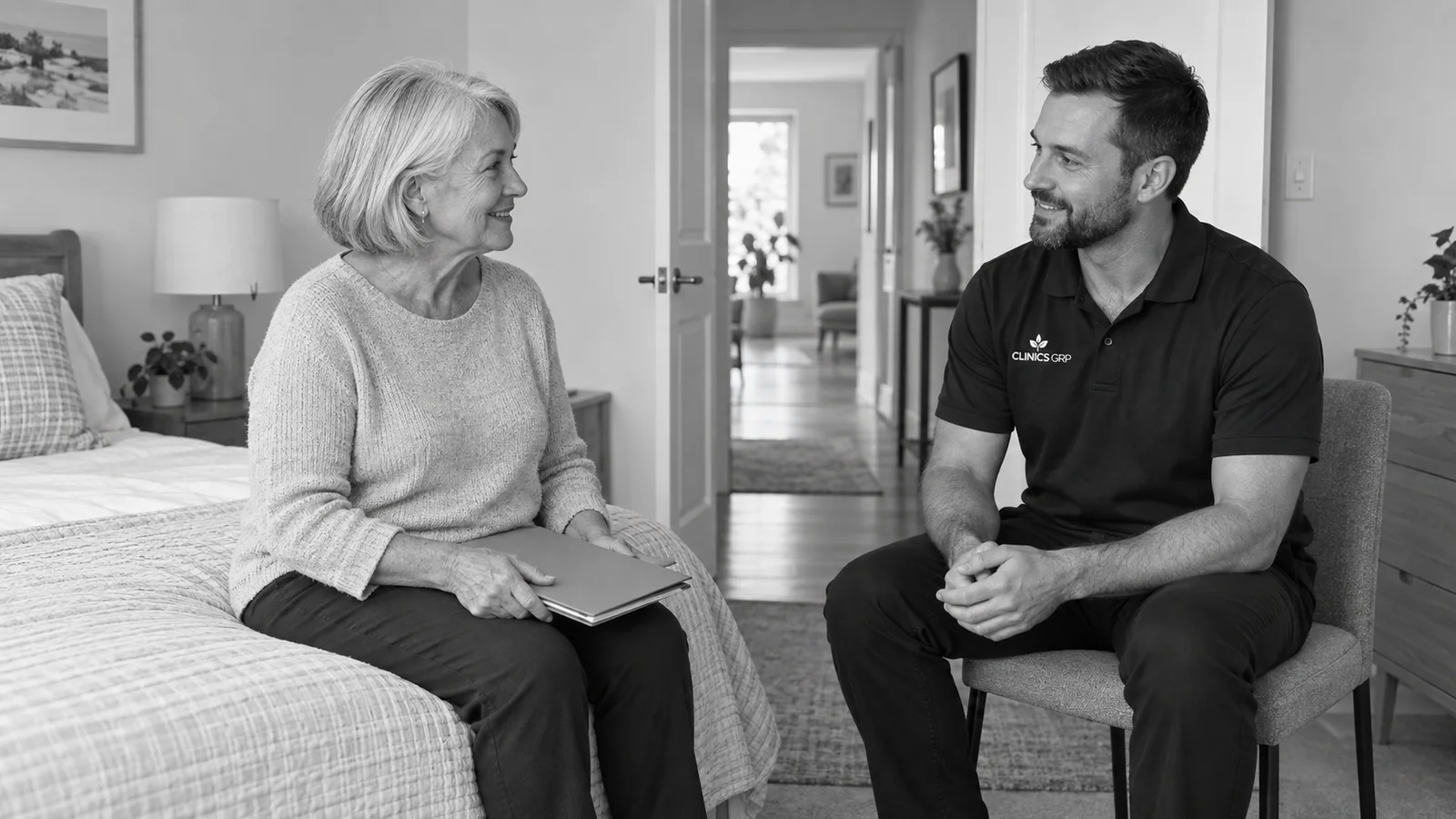
Leaving hospital is a change of setting, not necessarily the end of recovery. Tasks that were manageable with a hospital bed, nearby staff and a clear corridor may feel different in a familiar home. The person may also be adjusting to symptoms, changed medicines, equipment or new help.
At Clinics GRP, the starting point is what has changed and what matters now. A home physiotherapy assessment can help connect the discharge plan with everyday movement. It should build on the hospital team's advice and identify questions that need clarification, rather than replace the medical plan.
Key points
- Assessment after discharge should consider the reason for admission, current instructions and the person's usual level of function.
- Moving around the actual home may reveal practical difficulties that need attention or coordination with other clinicians.
- Recovery goals should reflect the person's priorities, available support and current circumstances.
- New deterioration needs appropriate medical advice. A planned physiotherapy appointment is not an emergency service.
Begin with the discharge information
A useful first step is to bring together the discharge summary, relevant follow-up instructions and any movement or equipment advice. Healthdirect advises people leaving hospital to understand their discharge plan, medicines and follow-up arrangements.1
The physiotherapist needs to know what the person was admitted for and whether the treating team has set restrictions. After some procedures, advice may limit particular movements or how much weight can be placed through a limb. These instructions should be clarified with the treating team when missing or unclear.
The person should not have to act as the sole messenger between services. With appropriate consent, communication may be needed to resolve uncertainty. If essential instructions cannot be confirmed, parts of the assessment or treatment may need to wait. Guessing is not a useful way to fill a gap in the discharge plan.
Compare with life before the admission
Someone who needed help before hospital has a different starting point from someone who previously managed the same task without assistance. Asking about the usual routine helps avoid setting expectations based only on what a person can do on the day of the visit.
The discussion may include walking indoors, getting out of bed, using the bathroom, leaving the house and the support that was already in place. It can also identify activities the person has stopped attempting since returning home.
Information from family or support workers may help, if the person agrees. Their observations should add to the person's account rather than replace it. Priorities can differ: a family member may focus on distance walked, while the person wants enough comfort and energy to sit with a visitor.
Check how the plan fits the actual home
Home assessment can examine the relationship between current movement ability and the tasks now required. A route may include a narrow turn, a doorstep or a chair that is lower than the hospital seating. These details can help explain why advice feels difficult to use.
The aim is not to prove that someone can complete every task in one appointment. The clinician should decide with the person what is relevant and safe to observe, taking current instructions into account. Some questions may be better addressed through discussion, another assessment or joint work with another discipline.
Home physiotherapy may be useful for these movement questions. Occupational therapy may be needed for equipment, adaptations or a broader assessment of daily activities and the environment. Where falls risk is relevant, Australian guidance supports an individual approach, including tailored occupational therapy home-safety assessment for older people at increased risk.2
Symptoms can change the next step
Pain, fatigue, dizziness or breathlessness can affect what a person can manage, but a physiotherapist should not automatically attribute every new symptom to reduced fitness after hospital. The history, severity and pattern matter, and some concerns require medical assessment.
Follow the discharge team's instructions about symptoms that need urgent attention. For a life-threatening emergency, call triple zero (000). Do not wait for a scheduled home visit. If unsure about a non-emergency concern, contact the treating service, GP or Healthdirect on 1800 022 222 for advice.1
Physiotherapy also does not replace medicine reconciliation or prescribing review. If someone reports a problem after a medicine change, the concern may need communication with their GP or pharmacist. Nursing care may be relevant where clinical monitoring, wounds or other nursing needs form part of the recovery plan.
Make support specific
A discharge plan may say that help is available, but home life can reveal gaps. Someone might be present in the morning but absent when an important task usually occurs. Equipment may not yet have arrived, or the person assisting may not understand the advice.
Assessment should make these practical details visible. With consent, the discussion can establish who is involved, what help is feasible and which questions need to go back to the treating team or coordinator.
The purpose is not to assume that relatives can provide unlimited care. A plan needs to work for the person receiving care and those offering support. If it depends on assistance that is unavailable or unsafe, that is a problem to address in the plan.
A hypothetical example: home, but not back to routine
Imagine a fictional person who has returned home after an admission and can walk along the lounge room with the prescribed aid. They are nevertheless avoiding the bathroom because the route feels difficult and they are exhausted afterwards.
A physiotherapist might explore the actual route, symptoms, movement, discharge instructions and help available. Depending on the findings, the next step could include individual rehabilitation, occupational therapy input, coordination of support or medical review.
The review question would be whether the essential routine is becoming more manageable and whether the plan remains appropriate. Simply increasing the distance walked in another room would not necessarily resolve the person's concern. This example describes possible assessment questions, not a real patient or a recommended programme.
Agree goals that can change with recovery
An early goal might be managing a necessary task with agreed help. Later priorities may include going outdoors or resuming an activity the person values. For some people, maintaining comfort or establishing sustainable assistance will be more appropriate than pursuing independence.
NICE reablement guidance supports agreeing meaningful goals with the person and reviewing care around those goals.3 It does not establish that every person will recover their previous ability, and its UK service recommendations do not determine Australian funding.
Review should consider the person's experience as well as clinical findings. Is the activity more manageable? Are symptoms changing? Is the support workable? If the answer is no, the plan may need revision or further assessment. Recovery should not become a test of the person's willingness or character.
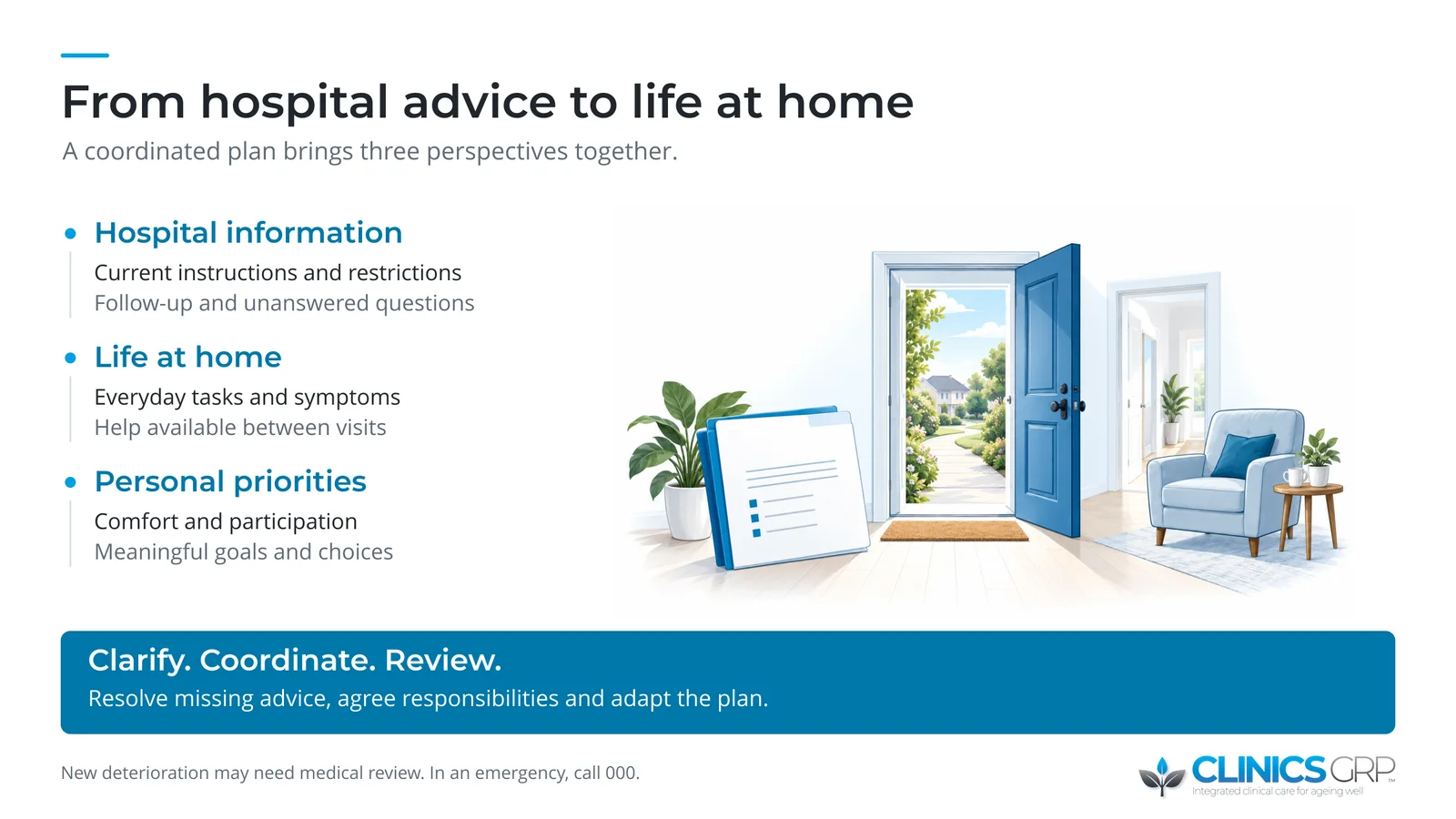
Bring these perspectives together, clarify missing advice and agree who will follow up. View diagram at full size.
Keep the next steps connected
Post-hospital rehabilitation should have a clear connection to the discharge plan and ongoing care. The person should know what has been agreed, who will follow up and whom to contact about a change.
The broader hospital-to-home pathway can help explain how services may fit together. Availability and funding need to be checked separately from clinical suitability.
A home assessment is one contribution to recovery, not a guarantee against readmission or further difficulty. Its value lies in making the next plan relevant to the person, their surroundings and their changing needs, consistent with our approach to care.