
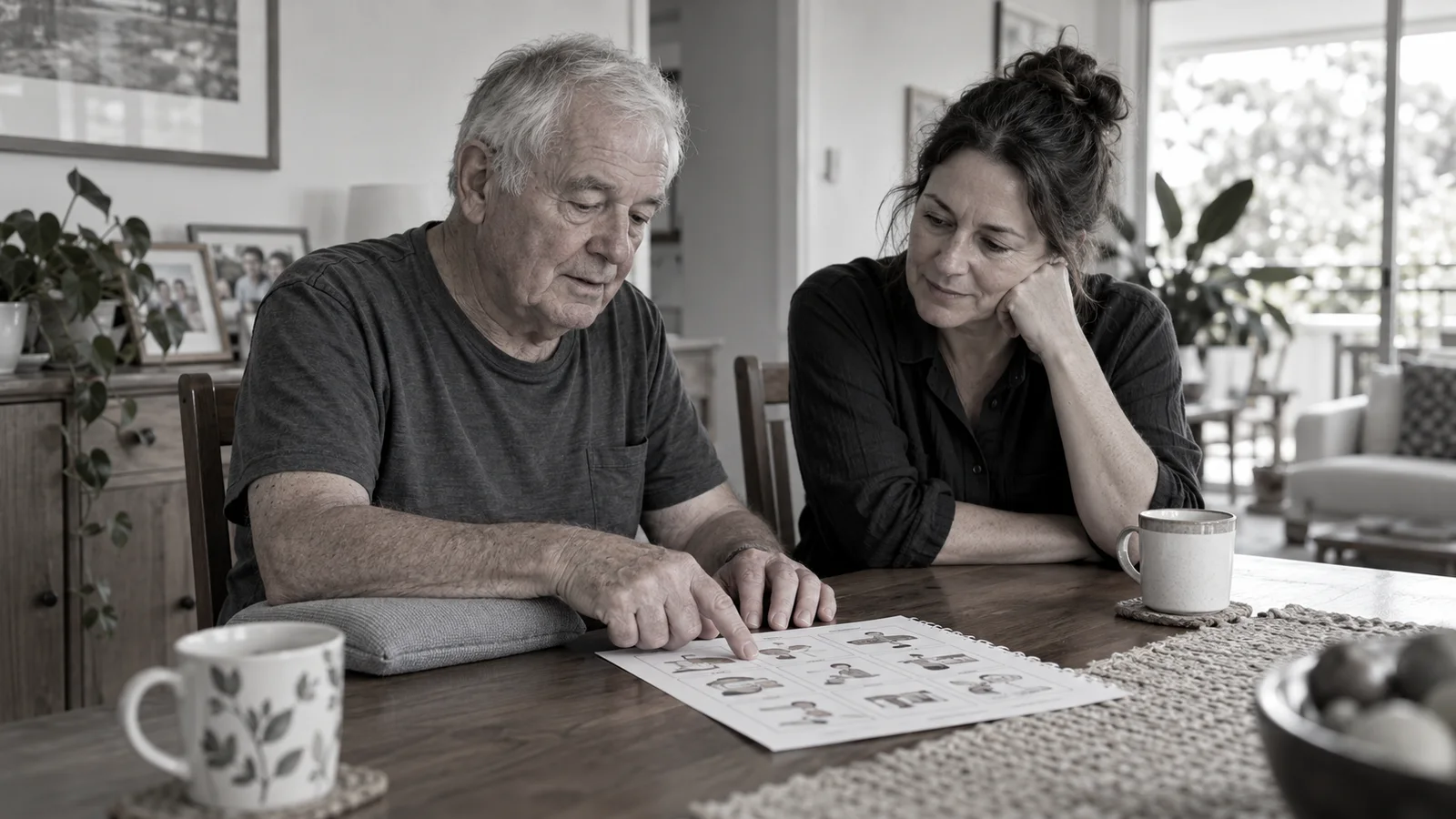
After a stroke, returning home can reveal movement problems that were less obvious in hospital. A familiar task may now require a different approach, more concentration or another person’s help. Home physiotherapy can contribute to rehabilitation by working on relevant movement within the wider stroke-care plan.
The home visit should begin with the person’s goals and the information from the treating team. Stroke can affect communication, sensation, vision, thinking and fatigue as well as movement. A coordinated plan needs to account for those needs rather than treat difficulty with a household task as a muscle-strength problem alone.
Key points
- Home physiotherapy is one part of stroke rehabilitation, with other disciplines involved as needed.
- Practice should relate to meaningful tasks and be matched to the person’s current ability.
- Communication support and appropriate assistance are part of making rehabilitation accessible.
- A short supervised success does not establish that an activity is safe to repeat alone.
- New stroke symptoms are an emergency, even if they improve.
Keep the stroke team’s plan connected
Bring the discharge summary, current rehabilitation programme and any instructions about assistance or equipment. The receiving clinician needs to understand what has already been assessed, what remains uncertain and which services are continuing. Clarify whether a referral has been accepted and who is coordinating follow-up.
The Stroke Foundation describes rehabilitation across hospital, centre-based and visiting services, with input from different professionals according to need.1 A routine physiotherapy home visit should not be represented as equivalent to a specialist multidisciplinary early supported discharge service. Ask what the particular service includes and what remains with the existing team.
You should know whom to contact about each issue. Walking practice, swallowing, medicines and communication may require different expertise. Clear responsibilities help avoid both duplication and gaps. Our article on why more than one clinical discipline may be needed explains how a shared goal can connect those contributions.
Choose a task that gives practice a purpose
Useful goals can begin with an ordinary part of home life: getting to the table, standing for part of a household activity or moving between two particular seats. The person’s preferences should guide which task is considered. A family member’s priority may be relevant, but it should not automatically replace the person’s own choice.
The clinician can then examine the movements and conditions involved. A chair transfer may include positioning, standing, turning, managing an aid and judging where to sit. Difficulty at one stage does not establish that every stage needs the same intervention.
NICE stroke guidance recommends repetitive practice of relevant tasks, including sit-to-stand, walking and upper-limb activities where indicated.2 This supports purposeful practice selected through assessment. It is not an instruction to repeat a task beyond safe limits or to assume that a general exercise sheet represents a complete stroke rehabilitation programme.
Understand movement in the actual surroundings
A walking route may involve a doorway, a turn and a change of surface. Furniture positions and the available space can affect how an aid or another person fits into the task. The home setting allows these demands to be discussed directly, where assessment can proceed safely.
A physiotherapist may assess movement, relevant muscle function, balance and symptoms. Occupational therapy may be needed for equipment, self-care or environmental adaptations. Visual, sensory or attention-related concerns may require further assessment. The presence of an obstacle should not become the explanation for every difficulty on the route.
The person does not need to demonstrate an unsafe task. Describe what usually happens, what support is provided and when the difficulty is worse. Our guide to walking changes at home offers questions that can help make that account specific without attempting a diagnosis.
Make communication accessible
A person may understand an activity but need extra time to communicate, or may need instructions presented differently. Allow time for a response and check understanding without treating speech difficulty as proof that the person cannot take part in decisions. Ask what communication approach the stroke team has recommended.
The physiotherapist may use demonstration, a suitable visual cue or a shorter instruction as part of an individual approach. Speech pathology advice can help when communication needs affect teaching and participation. The useful question is whether the person understands what is being proposed and can express agreement, uncertainty or discomfort.
With consent, family or support workers can contribute observations. Their account should complement the person’s voice. If communication is difficult, the team needs to create a way to hear that voice rather than move the whole conversation to the people sitting nearby.
Treat fatigue as information
Fatigue after stroke can affect how much activity feels manageable and how well someone can participate in practice. NICE guidance includes assessment of post-stroke fatigue.2 It should not be dismissed as lack of motivation or treated with an automatic instruction to push through.
Describe when fatigue appears and what it changes. Does a demanding morning leave little capacity for the appointment? Does an activity remain manageable on its own but become difficult after several other tasks? The plan may need to consider timing, rests and the total demand of the day. An appointment may be manageable on its own while leaving too little capacity for a valued later activity. That consequence belongs in the review, alongside what happened during the supervised practice.
New or unexpectedly worsening tiredness can also require clinical review. The team should decide whether the programme needs adjustment or whether another health issue should be assessed. Information about the response after a visit is relevant, even when the person completed the activities comfortably while the clinician was present.
Agree what support practice actually requires
The programme should distinguish activities that can be done independently from those needing specified assistance or direct supervision. A safe attempt with a physiotherapist does not establish that the task can be repeated with any available helper. The person’s ability and the helper’s training both matter.
Ask the clinician to demonstrate any agreed assistance and check that the helper understands it. Do not pull on an affected arm, improvise a lift or copy a handling technique from a public video. If the required help is unavailable, the rehabilitation team needs to reconsider the arrangement rather than leave an unworkable instruction.
Equipment must also be appropriate to the task. An aid or support used in hospital may need review in the home layout. Clarifying that need is different from independently changing equipment. The article on transfers at home explains why furniture, space and assistance need to be considered together.
Review useful change across several measures
Clinical tests can help describe movement, but review should also ask whether the chosen activity is becoming more manageable. Is the agreed assistance available? Is the person participating as intended? Are fatigue, discomfort or confidence changing the experience? These questions give a test result practical meaning.
Someone may improve one part of a task while still needing help with another. The plan should identify that difference and explain the next decision. It should not promise that enough repetitions will necessarily restore a previous level of independence. Recovery, maintenance, adaptation and supported participation can each provide a legitimate purpose for care.
Our article on function beyond a test score provides a wider discussion. If the expected response does not occur, reassessment may involve a different task, intervention, setting or clinical opinion. The person should understand the reason for continuing or changing the programme.
Consider the next setting and longer-term goal
The house may be the most useful place for a particular early question. Later goals might involve outdoor access, community activity or facilities available elsewhere. A change in setting should follow the person’s needs and preferences, not a rule that everybody must move through the same sequence.
Before a transition, ask what the next service will provide and how information will be handed over. It should receive the relevant stroke history, current abilities, assistance requirements and unfinished goals. Continuing rehabilitation needs a clear purpose and communication, whichever location is used.
How Clinics GRP can support you
Clinics GRP provides home and mobile physiotherapy in Brisbane. Intake confirms the clinical fit, relevant clinician availability and address before arranging care. Explain that the referral follows a stroke and provide current rehabilitation and assistance instructions so the appropriate next step can be considered.
The service should clarify its contribution and any need for specialist or multidisciplinary input. A home booking does not replace the person’s stroke follow-up or establish that every rehabilitation need can be addressed by one clinician.
When to seek urgent help
Call 000 immediately for new facial drooping, arm weakness or speech difficulty, even if symptoms settle. Other sudden neurological changes, including new severe balance or vision problems, also need urgent assessment. Do not wait for a routine physiotherapy appointment or drive yourself to hospital with suspected stroke.3
Next steps
Confirm the receiving services and contact arrangements, then identify a meaningful home activity to discuss. Ask what practice is appropriate, what support it needs and how the response will be reviewed. Keep the plan accessible to the person and the people authorised to assist.
References
- Stroke Foundation. Stroke rehabilitation. https://strokefoundation.org.au/About-Stroke/Learn/Treatment-for-stroke/Stroke-rehabilitation
- NICE. Stroke rehabilitation in adults. NG236. 2023, current online version accessed 17 October 2026. https://www.nice.org.uk/guidance/ng236/resources/stroke-rehabilitation-in-adults-pdf-66143899492549
- Stroke Foundation. Signs of stroke. https://strokefoundation.org.au/About-Stroke/Learn/signs-of-stroke
Disclaimer
This article provides general information only and does not replace individual medical, nursing, allied health, or emergency care advice. Health needs vary from person to person. If you are concerned about symptoms, falls risk, medication issues, mobility, pain, wounds, dizziness, or a change in health or function, speak with your GP or an appropriately qualified health professional. In an emergency, call 000 in Australia.