
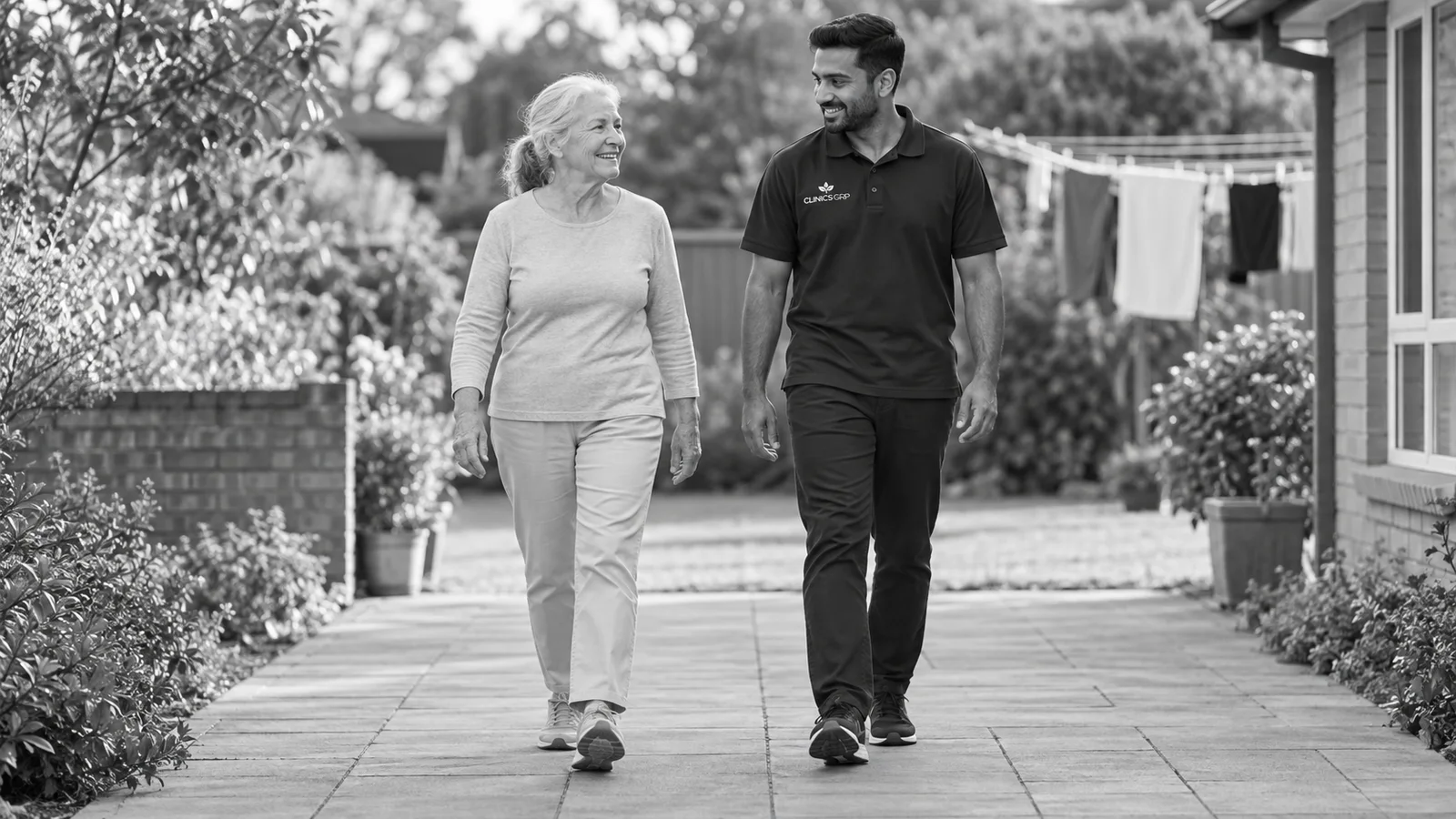
A change in walking can first appear in an ordinary moment. Someone starts holding the furniture, pauses at a doorway, avoids the path outside or asks for company on a route they previously managed. Sometimes the person notices it first. Sometimes a family member notices that familiar activities are happening less often.
The change deserves attention, but it does not explain itself. Walking differently can have several possible contributors, and a physiotherapy assessment is only one part of the response when other health concerns are present. The starting point is to describe what has changed and establish what kind of help is appropriate.
Key points
- Describe the change in a particular activity rather than assuming a cause from age or appearance.
- Physiotherapy may consider movement, symptoms, confidence, the environment and the help available.
- A new walking problem is not automatically a problem to solve by walking farther or exercising harder.
- Sudden weakness, speech difficulty or other possible stroke symptoms need emergency help, not a routine appointment.
- Goals should reflect what walking makes possible in the person's life, including appropriate support where needed.
First decide whether it can wait
Sudden trouble walking may accompany a medical emergency. If there is sudden facial weakness, arm weakness or speech difficulty, call 000 for an ambulance, even if symptoms improve. Stroke can also involve other sudden changes, including balance or vision problems.1
Severe breathlessness, chest pain, collapse or a serious injury also require urgent medical attention. This article is not a triage checklist, and a physiotherapy booking should not delay help when someone is acutely unwell. If a change is new or unexplained and you are unsure how urgently it needs review, seek health advice promptly.
Once immediate medical needs have been addressed, physiotherapy may help assess the movement difficulty and the appropriate rehabilitation or support. The timing and scope should fit the person's condition and the advice of their treating team.
Make the change specific
“Not walking as well” can mean many things. Is the person covering less distance, walking more slowly, avoiding a turn, needing a hand or taking longer to recover afterwards? Is there pain, dizziness, hesitation or a change in confidence? Is it present throughout the day or mostly during a particular routine?
You do not need to collect a formal set of measurements. A few concrete observations can be more useful than a general label. For example, “They now stop halfway from the bedroom to the kitchen” identifies a question the clinician can explore.
Also describe what the change has interrupted. Perhaps the person is missing breakfast with others, no longer answering the door or avoiding the garden. The clinical importance of a walking problem includes the choices and activities that have become harder to access. This aligns with the World Health Organization’s broader account of functional ability.3
Compare with the person's usual pattern
The relevant comparison is often with the person's own recent experience. Someone who has long used a walking aid may have developed a new difficulty that needs assessment. Someone who can still walk without an aid may nevertheless be avoiding important activities or experiencing symptoms.
Ask what was usual before the change, whether it appeared suddenly or gradually, and whether illness, a fall, hospitalisation or a change in routine occurred around the same time. These details can guide the conversation without proving a connection.
Avoid filling gaps with an explanation such as “just getting older”. Age and health history provide context, but they do not identify why this particular activity has changed. Equally, not every change can be reversed. Assessment should clarify what is known, what remains uncertain and which next step is reasonable.
Look at walking within its surroundings
At home, the relevant task may involve a doorway, a corner, a threshold or a surface change. The person may need to reach a seat, use an aid in limited space or manage an essential route when assistance is not immediately available.
A physiotherapist can consider these circumstances alongside movement assessment. They may ask which routes are most important and which are being avoided. Assessment should be planned around safety; the person does not need to demonstrate an activity that feels unsafe merely to establish that a problem exists.
The environment can help explain the demands of a task, but it should not become a convenient explanation for everything. A visible obstacle does not rule out a health problem. A clear room does not rule out a meaningful walking difficulty. The person and the setting both deserve attention.
Symptoms and health changes belong in the discussion
Tell the clinician about symptoms that accompany walking and about relevant changes in health or care. These may affect whether physiotherapy can proceed, what it can assess and whether another professional needs to be involved.
Medicines can be relevant to some mobility and falls concerns, but the physiotherapist should not independently alter prescribed treatment outside their scope. Questions about medicines may require the prescriber or pharmacist. Nursing may be relevant when observation, monitoring or another nursing need is part of the situation.
Australian community falls guidance considers balance and mobility within a broader assessment of potential contributors.2 It does not support assuming that one exercise, one aid or one discipline will resolve every walking problem. The appropriate response depends on the individual findings and risks.
Confidence is information, not an inconvenience
People may change how they walk because they feel uncertain after a fall or difficult experience. They may also feel uncertain because something has changed physically. These possibilities should not be collapsed into “it is only confidence”.
Ask what the person expects might happen and what support would make participation more manageable. An agreed plan might include carefully supported practice, different arrangements or further assessment. The person should understand the purpose and have a say in the pace.
Participation matters even when full independence is not a realistic immediate goal. Walking to join a conversation with appropriate assistance may be worthwhile. The need for help should be acknowledged honestly, without making the person feel that accepting support has undermined rehabilitation.
A hypothetical example: the garden is becoming out of reach
Imagine someone who still moves around their living room but has stopped going outside to tend a favourite plant. They say the trip has become tiring and the doorway makes them hesitate. Their family wonders whether they simply need more encouragement.
Assessment might explore the change, symptoms, route, current support and the person's priorities. It might also identify a need for medical review or another discipline. It would not begin by assuming that the solution is a longer walk or a different attitude.
The example is hypothetical. It illustrates why the task and the person's experience matter; it does not describe a diagnosis, treatment prescription or likely outcome.
Agree an outcome beyond “walk better”
A useful goal gives the plan a practical reference point. What destination matters? What assistance is expected? What would make the activity worthwhile and manageable? The clinician can help turn that discussion into an appropriate goal without asking the person to set a technical target alone.
The plan should also describe what will be reviewed. Changes in symptoms, confidence, help required and participation may matter alongside clinical measures. An improved test score is useful information, but it should be considered in relation to the original concern.
If the expected response does not occur, the next step may be reassessment rather than automatic repetition. The clinician may need to reconsider the goal, the treatment, the environment or the contribution of another health issue. Clear review is part of care, not a judgement about whether the person has tried hard enough.
Bringing the concern to care
Prepare a short description of what changed and which activity matters most. Share relevant discharge or care instructions securely. Do not deliberately increase walking, stop medicines or change prescribed aid use to test a theory before assessment.
Clinics GRP provides physiotherapy and home physiotherapy, with balance and falls care where relevant. The broader approach to care connects the person's concern with assessment, practical goals and review.