
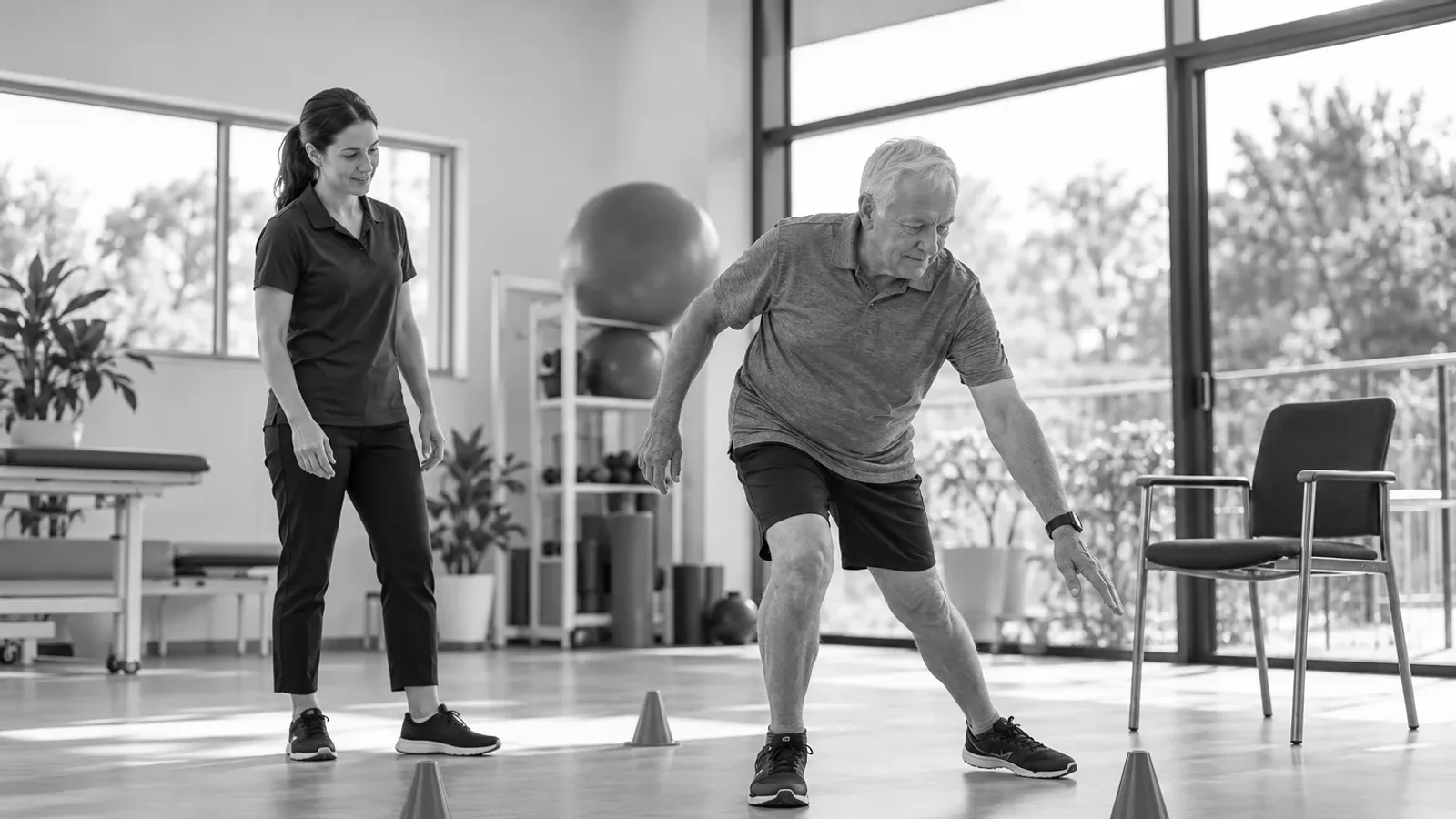
If you search for exercise to reduce falls risk, you will find almost everything.
Strength training.
Balance exercises.
Tai Chi.
Walking.
Pilates.
Stepping drills.
Classes.
Home programmes.
Reactive balance.
The useful question is not which exercise has the best marketing.
It is what the research consistently tells us about the ingredients of effective exercise, and how those ingredients should be matched to the person.
Key points
- Exercise can reduce fall rates in community-dwelling older adults.
- Programmes that challenge balance and functional movement have strong established evidence.
- Strength training is important, but strength alone does not address every component of balance.
- Exercise needs sufficient challenge, progression and ongoing practice.
- The right programme depends on the person’s abilities, health, goals and safety needs.
Exercise works — but “exercise” is too broad a word
Large reviews have found that exercise programmes can reduce falls among community-dwelling older adults.
Programmes centred on balance and functional exercise are particularly important.
Multicomponent programmes may combine balance, functional and resistance training.
The message is not that one specific exercise prevents falls.
It is that effective programmes tend to share particular characteristics.
Exercise should follow an appropriate health review
Not every fall is primarily an exercise problem. New fainting, sudden weakness, acute dizziness, chest symptoms, a recent major medicine change or a rapid decline in walking may require medical assessment. Pain, joint limitation, neurological conditions, cardiovascular responses and cognition can also affect how exercise should be selected and supervised.
This does not mean that a person must complete an endless list of investigations before moving. It means that exercise should sit inside a plausible explanation of the problem. A well-designed programme targets what can be trained while recognising concerns that need another type of care.
Balance needs to be challenged
Standing comfortably with two hands on a bench may be a useful starting point.
If it never becomes more demanding, it may stop creating enough stimulus for adaptation.
Balance exercise can be progressed by changing:
- base of support
- direction of movement
- reaching
- stepping
- turning
- speed
- surface
- visual information
- head movement
- obstacle negotiation
- cognitive demand
- external support.
Progression does not mean making exercises recklessly difficult.
The person should be challenged enough to learn while the activity remains appropriately managed.
Functional exercise matters
Falls happen during movement.
Walking.
Turning.
Stepping backwards.
Getting out of a chair.
Negotiating a kerb.
Responding to a trip.
Carrying something.
Exercise therefore needs to connect with functional movement.
A person may have excellent gym strength but still struggle to change direction quickly.
Another may be able to stand on one leg but become unsteady while walking and talking.
Functional exercise gives the nervous system opportunities to coordinate strength, sensation, attention and movement in combinations that resemble everyday tasks.
Strength still matters
Balance is more than strength.
That does not make strength unimportant.
Adequate lower-limb force is required for standing, stepping, controlling descent and recovering from perturbations.
Power — producing force quickly — may become particularly relevant when a person needs to respond after a trip or sudden loss of balance.
Falls-risk exercise often includes resistance training because greater physical reserve can support movement.
The mistake is assuming that stronger legs automatically solve sensory, vestibular, cognitive, cardiovascular or task-specific problems.
Walking is valuable, but walking alone is not the whole answer
Walking has major health benefits.
It supports cardiovascular health, endurance, community access and participation.
But ordinary walking on a predictable surface may not provide enough balance challenge to address an established balance deficit.
That does not mean people should stop walking.
It means a programme to reduce falls risk may need additional balance and functional challenges.
What about Tai Chi?
Tai Chi has evidence supporting reduction of falls in some community-dwelling populations.
Its slow weight shifts, controlled movement and changing base of support may provide useful balance challenges.
It will not suit everybody.
Someone with a particular neurological, vestibular or musculoskeletal problem may require more specific rehabilitation.
Likewise, a person who enjoys Tai Chi and attends consistently may gain more from it than from a theoretically perfect programme they dislike and rarely perform.
Preference matters across all exercise choices. A programme can be evidence-informed and still fail if it is inaccessible, confusing, unaffordable or incompatible with the person’s routine. Some people prefer a group because the social commitment helps them attend. Others need home-based practice because transport or fatigue makes classes impractical. The programme has to be performed often enough to matter.
Reactive balance deserves consideration
Many falls involve an unexpected disturbance.
A trip.
A slip.
A bump.
A surface changing under the foot.
Reactive balance training aims to improve how the person responds after stability has already been disturbed.
This area is increasingly represented in balance research.
Reactive training also requires careful safety systems and appropriate selection.
It is not something to reproduce unsupervised by deliberately tripping yourself.
The same principle applies to any exercise that creates a meaningful chance of losing balance. Challenge and danger are not synonyms. Stable supports, appropriate guarding, a clear space and professional supervision may allow a person to practise demanding responses without exposing them to unnecessary harm. The safety system should become more deliberate as the task becomes less predictable.
Dual-task training can be useful for the right person
Real-world walking often involves another task.
Conversation.
Navigation.
Carrying.
Looking for traffic.
Making decisions.
Dual-task training may help when assessment shows that divided attention significantly changes walking.
Again, this is not a reason to add cognitive tasks to every person’s programme.
Training should address the difficulty that actually matters.
Exercise dose matters
A brilliant programme done once every few weeks is unlikely to create much adaptation.
Exercise intended to reduce falls risk needs repeated exposure over time.
The exact frequency, intensity and supervision should be individualised.
Someone starting after hospitalisation may require a different programme from an active older adult who mainly struggles on uneven outdoor surfaces.
Consistency should not be confused with performing exactly the same task forever. Regular practice can contain planned variation in direction, speed, support and setting. The recurring feature is exposure to an appropriate challenge, not loyalty to one exercise sheet after it has stopped asking the person to adapt.
Progression matters too
The exercise that was challenging in week one may be easy by week eight.
That is good news.
It also means the programme may need to change.
Progression can involve more repetitions or resistance, but balance training often progresses by changing the task itself.
Less hand support.
More movement.
Greater speed.
Different directions.
More variable sensory conditions.
A relevant secondary task.
A more demanding functional activity.
The best programme is the one that addresses the person’s problem
There is no single “best balance exercise” for every older adult.
One person may primarily need strength and stepping capacity.
Another may need vestibular rehabilitation.
Another may need sensory challenges.
Another may need help learning to use a walking aid effectively.
Another may need confidence rebuilding after a fall.
Another may have a medical issue that exercise cannot address.
Assessment comes first because exercise has to solve a problem, not merely fill a timetable.
Look for transfer beyond the exercise session
Improvement should eventually become visible outside the programme. The person may turn with fewer extra steps, rise from a chair more easily, recover after a small loss of balance or feel able to return to a valued route. If exercise performance improves but the original activity remains unchanged, the programme deserves review.
The missing link may be task-specific practice, confidence, endurance, an unsuitable aid or an environmental demand that exercise alone cannot remove. This is not evidence that the exercise was useless. It is evidence that rehabilitation needs another step between improved capacity and real-world participation.
What should a good programme achieve?
Useful questions include:
- Is balance being genuinely challenged?
- Is functional movement included?
- Is strength addressed where relevant?
- Is the programme progressive?
- Is it performed often enough?
- Is the level of support appropriate?
- Does the person understand why they are doing it?
- Does improvement transfer into everyday life?
The review should also ask what the person experiences during and after exercise. New chest pain, faintness, marked breathlessness, sudden neurological symptoms or a rapid deterioration in function require a different response from ordinary muscular effort. Pain, fatigue and confidence may call for adjustment even when they do not represent an emergency.
The aim is not to become excellent at balance exercises.
The aim is to become better able to manage the activities that matter.
Understand more
- Balance Is More Than Strength: The Clinics GRP Approach to Balance in Older Adults
- Why Do Older Adults Fall? There Is Rarely One Cause
- Balance Training Should Help You Do Something That Matters
- The Goal Is Not Perfect Balance — It Is More Options
Relevant care
References
- Sherrington C, et al. Exercise for preventing falls in older people living in the community. Cochrane Database of Systematic Reviews. 2019. https://www.cochrane.org/evidence/CD012424_exercise-preventing-falls-older-people-living-community
- Australian Commission on Safety and Quality in Health Care. Falls Guidelines for Community Care. 2025. https://www.safetyandquality.gov.au/resources/falls-guidelines-community-care
- Khan MJ, et al. Effectiveness of dual-task exercise in improving balance and preventing falls among older adults. 2025. https://pubmed.ncbi.nlm.nih.gov/41152559/