
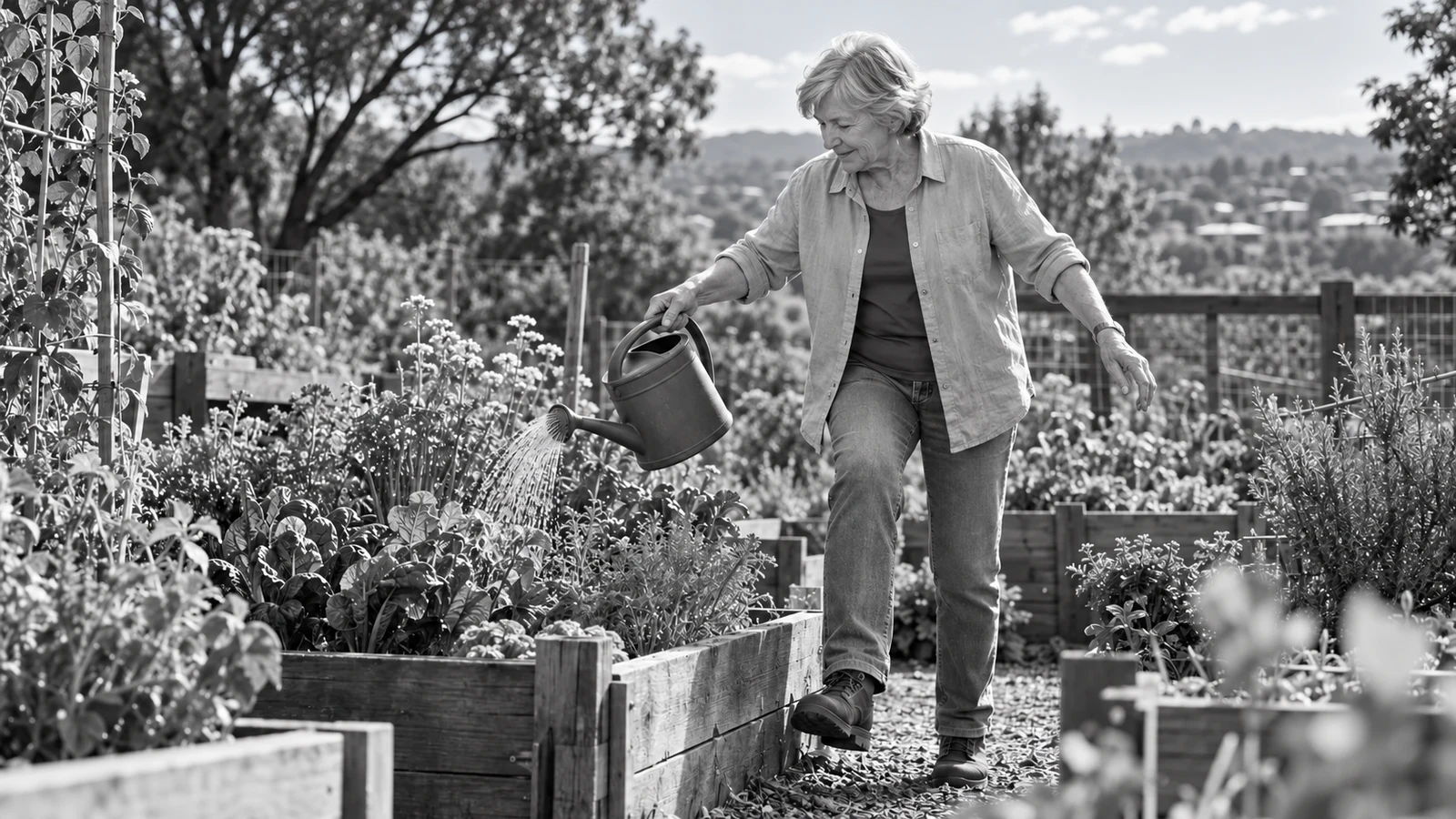
A person rarely seeks balance rehabilitation because they want to become better at balance tests.
They want to walk to the letterbox.
Use the garden.
Take a shower without feeling unsafe.
Visit family.
Go shopping.
Travel.
Keep doing something that has become harder.
Balance training is most useful when those activities remain visible throughout the programme.
Key points
- Balance exercises are tools, not the final purpose of rehabilitation.
- The meaningful activity should help shape what is assessed and trained.
- Good rehabilitation connects physical capacity, task demands, environment and support.
- Clinical measures remain useful when they help answer a real question.
- Improvement, maintenance, adaptation and appropriate support can all be worthwhile outcomes.
Begin with the activity, not the exercise list
Two people may both be described as having “poor balance”.
One wants to return to walking a dog on uneven paths.
The other wants to transfer safely in and out of the shower.
Giving them identical programmes may miss the reason each person sought care.
The physical contributors may overlap.
Both may need leg strength.
Both may need stepping practice.
But the actual tasks place different demands on the person.
The goal changes the clinical question.
It also changes what success looks like. The dog walker may need to manage slopes, distractions, an unpredictable lead and enough endurance to return home. The person using the shower may need to step over a lip, turn in a confined space, reach for controls and manage a wet surface. A general balance score may contribute to both plans, but it cannot describe either task completely.
Break the activity into its demands
A meaningful goal can feel too large when treated as one single ability. Task analysis makes it more workable. The clinician can ask:
- Where does the activity happen?
- How far and how long does it take?
- Does the person need to turn, reach, bend or carry?
- What surfaces, steps or obstacles are involved?
- Is vision reduced or attention divided?
- What happens if the person becomes tired?
- Which aids, rails or people are available?
- At what point does the person currently stop or feel unsafe?
This analysis links the goal with assessment. It also prevents rehabilitation from training the easiest visible component while ignoring the demand that actually limits participation.
Meaningful goals improve clinical reasoning
Meaningful goals are sometimes discussed only as a way to motivate people.
They do more than that.
A specific goal helps the clinician decide:
- which movements matter
- what environment should be considered
- what physical capacity is required
- what support may be acceptable
- what type of practice is relevant
- what progress should look like.
The real activity belongs inside rehabilitation.
The exercise should have a reason
A sit-to-stand exercise may be chosen because the person needs greater lower-limb capacity to rise from their usual chair.
Turning practice may be chosen because they lose stability when changing direction in the kitchen.
Head movement during walking may be relevant because they become unsteady when scanning shelves.
Reactive stepping may be useful because they struggle to recover from unexpected disturbances.
The person should be able to ask:
Why am I doing this?
and receive an understandable answer.
Training does not have to imitate the activity exactly
Task relevance does not mean recreating every real-world risk.
A person who wants to walk on a crowded railway platform should not be trained by creating an unsafe crowd in the clinic.
Instead, the clinician can identify the components of the task.
Walking while scanning.
Changing direction.
Managing another cognitive demand.
Stepping around obstacles.
Maintaining balance while people move nearby.
Those components can be practised in controlled conditions and gradually integrated.
The order matters. A person may first practise scanning while standing securely, then while walking in a clear space, then while changing direction and finally in a busier but still controlled environment. Another person may need physical capacity work before additional cognitive demand is introduced. Progression follows the person’s response, not a fixed exercise ladder.
Practice should become recognisable
Rehabilitation often begins with simplified movements because they are easier to teach and dose. Over time, the connection with the goal should become increasingly recognisable. Chair-rise strength can progress into getting up from the person’s own lounge. Stepping practice can become negotiating the front threshold. Turning drills can move into the kitchen route where instability occurs.
This does not mean every session must take place at home or in the community. It means the programme should eventually test whether the newly developed capacity can be organised in the setting that matters. Transfer should be planned rather than assumed.
Test scores are still useful
Meaningful care does not mean abandoning measurement.
A Timed Up and Go, Five Times Sit-to-Stand, Mini-BESTest or another measure may provide useful information.
The problem is treating the score as the entire outcome.
A person might improve a test while still avoiding the front steps.
Another person may show only a modest change in a score but become much more capable of managing a valued routine because they have learned an effective strategy or started using suitable support.
The test provides information.
The person’s life tells us what that information means.
Measures can also help explain why an activity remains difficult. A change in sit-to-stand performance may support the impression that lower-limb capacity is improving. Observation of turning may show whether the person is using a more adaptable strategy. Confidence or participation measures can reveal progress that is not visible in a strength result.
No single measure needs to carry the whole outcome. A useful review combines clinical findings, the person’s report and observation of the relevant task.
The environment is part of balance
Balance ability is not contained entirely within the person.
A well-lit flat hallway asks different questions from a dark garden path.
A chair with arms is different from a low lounge.
A supermarket is different from a quiet clinic.
Balance rehabilitation should therefore consider whether the environment needs to change as well as the person.
Improved lighting.
A rail.
A different chair.
A suitable walking aid.
A safer route.
A more manageable way to carry something.
These can be legitimate parts of the plan.
Environmental adaptation should be specific. Removing every object from a home is not the same as making it safer. A rail on the route the person actually uses, lighting at the place where vision is limited or a stable surface beside the garden bed may have more value than broad restrictions. The best change reduces an important demand without unnecessarily erasing the activity.
Training and adaptation can happen together
Rehabilitation is sometimes imagined as:
First improve the person.
Only adapt if rehabilitation fails.
That is too rigid.
An adaptation can allow meaningful activity to continue while physical capacity is being rebuilt.
A walking aid may allow somebody to resume community walking while they also work on strength and stepping.
A rail may make stairs safer while the person practises lower-limb control.
The adaptation does not prevent rehabilitation.
It may create more opportunity to participate in it.
Support from another person can work in the same way. Someone may initially walk to the shops with a family member, then complete part of the route independently, or continue to prefer company because that arrangement makes the outing enjoyable and sustainable. Rehabilitation does not have to prove that assistance can be removed. It should determine what combination of ability and support gives the person acceptable choices.
Maintenance can be a meaningful outcome
Not every rehabilitation episode produces dramatic improvement.
Some people live with progressive conditions.
Some have long-standing limitations.
Some are recovering from repeated health events.
In those situations, maintaining an activity can be a valuable achievement.
Care should not treat maintenance as failure simply because the graph did not move upward.
Maintenance still deserves active review. The programme may need to change as health, fatigue, seasons or environments change. An activity that is stable today may require a new strategy after illness or a change in living arrangements. Conversely, a person assumed to need permanent assistance may gain capacity and want to try a less supported version of the task.
Review the goal, not only the programme
Goals can change. A person may discover that returning to the exact former activity is no longer their priority. They may choose a shorter route, a different garden task or another way to see friends. That is not automatically a compromise imposed by failure. It may be an informed decision about where effort and risk are worth investing.
Review should ask whether the goal remains meaningful, whether the current plan is moving towards it and whether the person accepts the supports involved. If the answer is no, adding more of the same exercise is unlikely to solve the problem.
Balance training should lead somewhere
Exercises can be technically excellent and still become disconnected from the person.
The programme should keep returning to the question that started care:
What are we trying to make more possible?
Balance training should build capacity.
But capacity matters because of what it allows the person to do.
Understand more
- Balance Is More Than Strength: The Clinics GRP Approach to Balance in Older Adults
- Why Do Older Adults Fall? There Is Rarely One Cause
- What Type of Exercise Helps Reduce Falls Risk?
- From Balance Scores to Real Life: What Does Successful Rehabilitation Look Like?
Relevant care
References
- Sherrington C, et al. Exercise for preventing falls in older people living in the community. Cochrane Database of Systematic Reviews. 2019. https://www.cochrane.org/evidence/CD012424_exercise-preventing-falls-older-people-living-community
- Australian Commission on Safety and Quality in Health Care. Falls Guidelines for Community Care. 2025. https://www.safetyandquality.gov.au/resources/falls-guidelines-community-care
- World Health Organization. Healthy ageing and functional ability. https://www.who.int/news-room/questions-and-answers/item/healthy-ageing-and-functional-ability