
Key points
- A changed prescription needs a clear source, an updated record and communication to those who actually support the person.
- Conflicting labels, lists or discharge instructions should be clarified with the prescriber or pharmacist, not resolved by guessing.
- The person should understand what changed, why, and whom to contact with a question or new symptom.
- Nursing can observe, document, communicate and deliver authorised support within its scope; it does not replace prescribing or pharmacist-led review.
- A completed task is not the end of follow-up if an unresolved question remains.
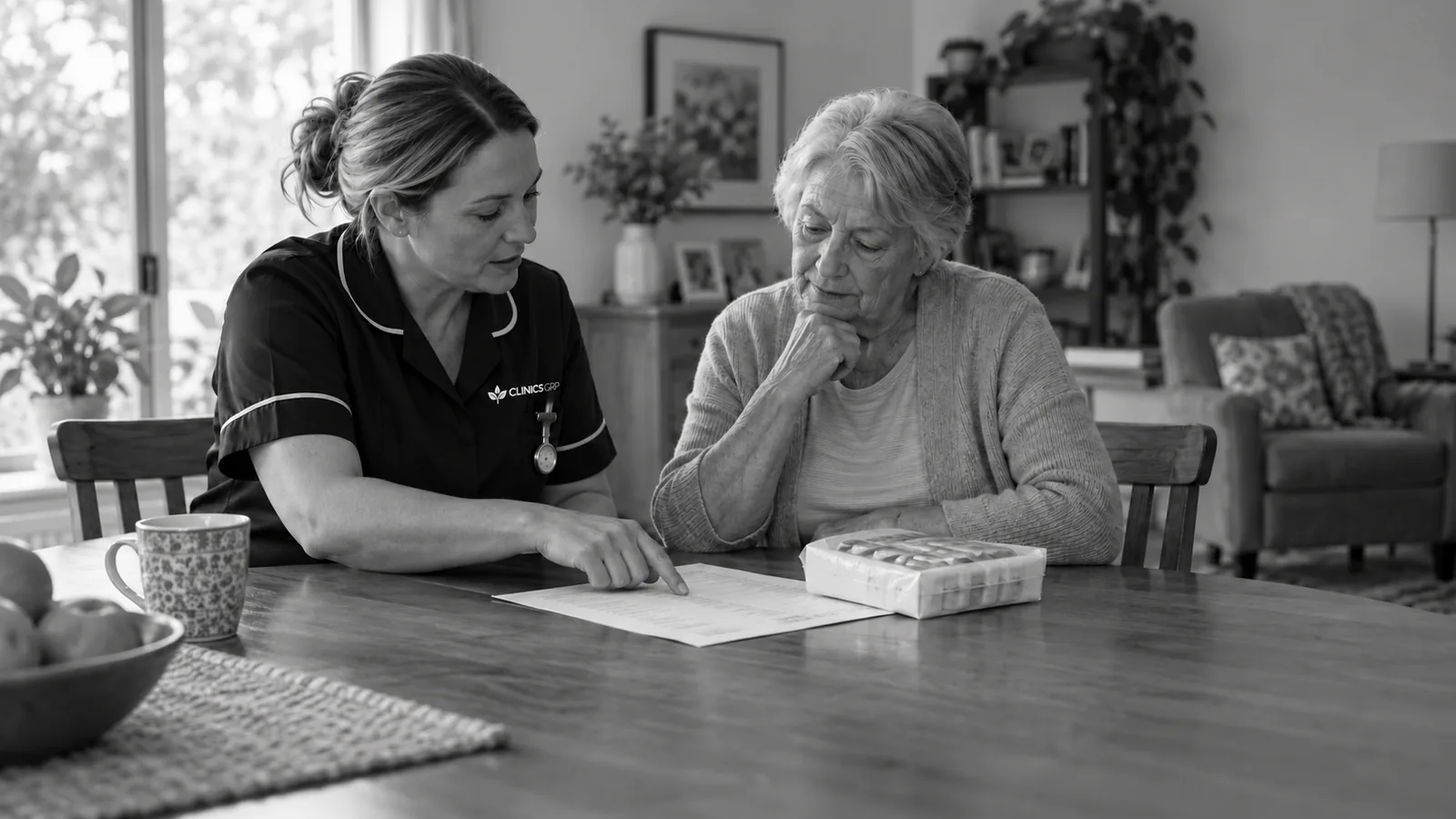
A prescription can change in a single consultation. The home routine rarely changes that neatly. An older adult may have a new discharge summary, a familiar medicine pack, an older list on the fridge and several people helping at different times. Each document can look official. If they disagree, the person should not have to work out which one wins.
Our earlier article, Medication Changed? Why Observation and Communication Matter After the Prescription, explains how nursing observations may be shared after a change. This article answers a different operational question: how does the changed instruction become one current, understood care plan at home? It is about information, responsibility and follow-up, not about choosing a medicine or interpreting a dose.
Start with the authoritative instruction
Sometimes the change is a new medicine. Sometimes a medicine has been stopped, its timing has changed or a short course has ended. The detail matters, but the first task for the care team is not to infer a new regimen from a box or a memory of a conversation. It is to identify the current authorised instruction and the practitioner responsible for it.
The Australian Commission on Safety and Quality in Health Care describes medicine reconciliation at transitions as a structured process that checks current orders against the best possible medication history and resolves discrepancies.1 Its standard asks how the reasons for changes are documented and communicated at discharge. An older adult at home may see only the results of that process: a list, a label and advice from a clinician. If those results conflict, the discrepancy needs to return to the appropriate professional for resolution.
This is particularly important after hospital, where medicines may be started temporarily, changed during admission or recommenced at discharge. A discharge document is useful evidence, but it may not tell the whole story if the person has seen another prescriber since leaving hospital. A nurse can identify the mismatch and help the person contact the relevant prescriber or pharmacist. This article cannot identify which instruction is current for an individual.
Make one record usable by the people who need it
An up-to-date medicines list is useful only if it can be found and understood when care is delivered. The Aged Care Quality and Safety Commission's strengthened standards call for current medicines information to be accessible to the older person, workers and health professionals involved in care, including at transitions.2 That does not mean publishing a private list broadly. Sharing should follow consent, role and secure-record arrangements.
At home, the practical questions are simple. Has the record been updated? Does it include medicines taken only when needed, where relevant? Are known allergies recorded? Has an old instruction been identified as superseded rather than left beside the new one without explanation? Does the person know where the current version is kept? If a family member or provider helps, has that person received the information they are authorised to receive?
The answer may differ by situation. Some people manage their own medicines independently and need only a clear explanation. Others have an authorised worker, family member or nurse involved. A useful plan respects the person's capability and preference rather than assuming that age alone means they cannot manage. It also recognises that the arrangement can change after illness, fatigue or a new health concern.
Clarify who does which part
A medicine change often crosses professional boundaries. The prescriber decides and changes treatment. A pharmacist may review medicines, clarify supply and advise on medicine use. Nursing may provide assessment, authorised administration or support, observation and communication within the agreed plan. A care coordinator may need to update service instructions and make sure the right people know there is a change. Those roles overlap in communication, but they are not interchangeable clinical authorities.
If nobody owns the handoff, the same uncertainty can appear at every visit. A useful follow-up note names the outstanding question, who has been contacted, whether advice has been received, who will update the care record and how the person will hear the answer. "The GP was informed" could mean a message was sent; it does not prove that a prescription question has been answered.
This is where the medication support and monitoring pathway may be relevant. It describes nursing support under current instructions and an assessed plan. It does not promise that a nurse will prescribe, perform a pharmacist's medication review, or independently reconcile every conflicting order. If the question is broader than one medicine, nursing assessment and care review can help organise the nursing part of the response while the responsible medical and pharmacy practitioners address their own decisions.
Ask what follow-up was intended
Not every change requires the same observation or appointment. The relevant follow-up depends on the medicine, the reason for change, the person's health and the prescriber's plan. What can be asked safely, without inventing a monitoring schedule, is whether someone has explained the purpose and next contact point. Is a review booked? Is there a symptom or concern the person was told to report? If a test has been ordered, who will review its result? Does the older adult know what to do if the new routine cannot be followed?
The Aged Care Quality and Safety Commission identifies medicine changes and new symptoms among circumstances that should prompt a medication review through appropriate processes.2 It also emphasises a current record and monitoring of adverse events. This is a service-level standard, not a direction for families to change treatment independently. The person should be supported to ask the prescriber or pharmacist for the follow-up that fits their circumstances.
Imagine a woman who returns home with a changed prescription. Her support worker has an older care instruction, and her daughter has a photograph of a previous medicines list. The nurse sees the mismatch at a planned visit. The safe response is to document what is conflicting, identify who can authoritatively clarify the prescription, and make sure the answer reaches the woman and those authorised to act on it. It would be unsafe to decide from the age of the documents alone or to leave the discrepancy for the next visit.
Notice the person as well as the paperwork
A tidy list cannot show how someone feels. A person may report dizziness, nausea, unusual tiredness or difficulty managing the new routine. The timing is worth documenting, but it does not establish that the medicine caused the change. Another illness or urgent condition may be involved. The nurse's role may include observing, describing and escalating the concern to the appropriate clinician, not diagnosing a reaction from timing alone.
Invite the person to explain what they understood about the change. A question such as "Which part of the new plan is hardest to follow?" can reveal practical problems that a medication list will not. If the response is uncertain, use plain language and check understanding without blame. A family member can be involved when the person wants that and consent permits it.
When not to wait
Do not wait for a routine nursing visit or online enquiry if the person becomes acutely unwell, develops severe breathing difficulty, chest pain, stroke symptoms or sudden serious confusion. Call Triple Zero (000) for a medical emergency. If overdose or poisoning is suspected, seek immediate advice through the Poisons Information Centre on 13 11 26, and call 000 for an emergency. For other new or worsening symptoms, contact an appropriate medical professional promptly.
Do not stop, restart, share or alter a medicine on the basis of this article. The useful end point is a care plan in which the current instruction is clear, the right people have it, and unresolved questions have an owner. Clinics GRP is not an emergency or 24-hour service.
Understand more
- Medication Changed? Why Observation and Communication Matter After the Prescription
- After-Hospital Nursing: Recovery at Home
Relevant care
References
- Australian Commission on Safety and Quality in Health Care. *Medication Safety Standard*, continuity of medication management. https://www.safetyandquality.gov.au/national-standards/nsqhs-standards/medication-safety-standard
- Aged Care Quality and Safety Commission. *Safe and quality use of medicines*, strengthened Aged Care Quality Standards, Outcome 5.3. https://www.agedcarequality.gov.au/strengthened-quality-standards/clinical-care/safe-and-quality-use-medicines