
Key points
- Uneven ground changes foot contact, body movement and the decisions needed for walking.
- Sensation, joint movement, strength, reactions and attention all contribute.
- Slowing down or using support can be appropriate adaptations.
- Care should connect with the actual outdoor activities you want to retain.
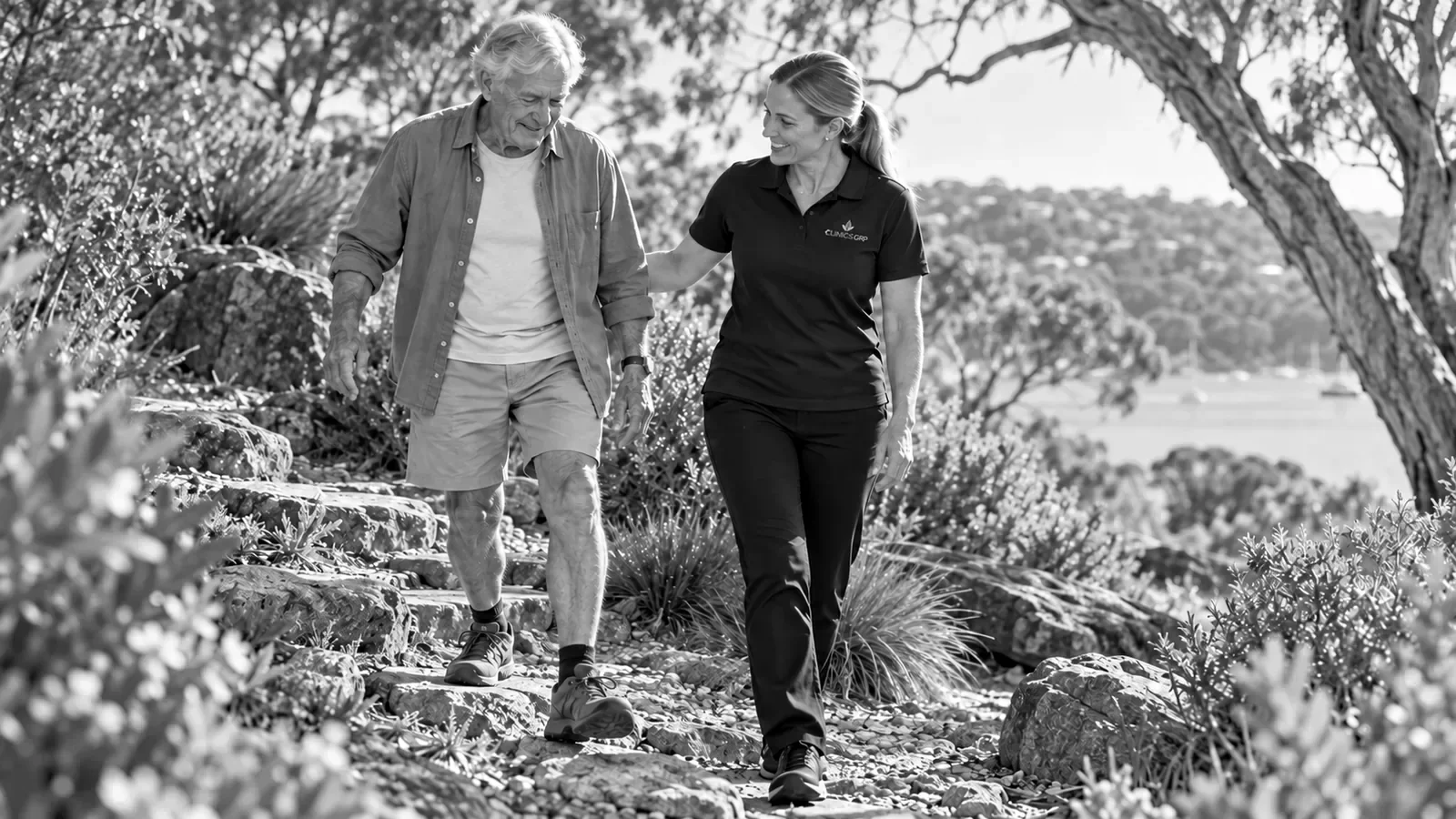
A level corridor may feel straightforward while the garden path demands your full attention. Grass, gravel, slopes and broken paving all ask more of walking than a predictable indoor floor. If these surfaces have become difficult, the difference is worth describing.
It does not necessarily mean your legs are simply too weak. The task involves sensing the surface, placing the foot, controlling movement and responding when the contact differs from what you expected. Several contributors can change with age or illness, and the surroundings can make those changes more noticeable.
Our cornerstone, Balance Is More Than Strength, explains the larger model. This article applies it to an everyday outdoor challenge.
The surface is part of the task
“Uneven ground” covers different conditions. Grass may conceal a hole. Gravel can move under the foot. A cross-slope places the two feet at different heights. A path may combine narrow sections, loose material and changing light.
These differences matter because a successful step depends partly on the contact available. The body has to manage the relationship between its movement and the supporting surface. Research comparing flat and uneven walkways found changes in lower-limb coordination; this is not identical to level walking. The study involved a small group of healthy adults, so it cannot explain every older person's outdoor difficulty. 1
An assessment conversation is more useful when it names the actual setting rather than treating every outdoor surface as the same problem.
Information from the feet and legs matters
Body sensation includes contact pressure, touch and proprioception, the sense of body position and movement. These signals help the nervous system interpret what is happening as weight transfers between the feet. They work alongside vision and vestibular information. 2, 3
Age-related sensory changes are variable, and other conditions may affect sensation. If information from the feet is less clear, an unfamiliar surface may become more demanding. However, difficulty on grass does not diagnose a sensory deficit.
It may also reflect pain, footwear, reduced movement, confidence or several factors together. Numbness or a new sensory change should be described to the appropriate clinician rather than assumed to be normal ageing.
The ankle contributes, but it is not the whole answer
The ankle and foot help accommodate contact and contribute to control of the body's movement. Joint range, pain, strength and the characteristics of the surface can influence this. A rigid or painful ankle may make some adjustments more difficult.
However, walking does not depend on an isolated “ankle strategy”. Hips, knees, trunk movement, stepping and available support also contribute. A larger disturbance may require a new step rather than a small adjustment around the ankle.
This is why an ankle exercise alone may not prepare someone for all the demands of a sloping garden path. The broader task needs consideration.
Vision helps plan the next step
Seeing changes in height, texture and direction helps with foot placement. Shadows, glare, low contrast or vegetation may make a surface harder to judge. Looking down can be useful for a particular hazard, while looking ahead helps plan the route.
There is no universal instruction to keep the head in one position throughout every walk. A clinician can consider how you gather information and whether head movement itself brings on symptoms. Persistent dizziness or visual disturbance deserves assessment.
Changing the timing of an outing or choosing a better-lit path may reduce demands while other contributors are being addressed.
Strength and reactions both have roles
Strength supports movement and control. Power and timely responses become relevant if the foot slips or catches. Endurance matters because the return journey may feel different from the first few minutes.
Reactive balance is the ability to respond after a disturbance. Research on reactive balance training is encouraging for suitable populations, but programmes, safety arrangements and outcomes vary. 4 It is not a reason to practise deliberate trips or slips outdoors.
A plan may need more than one component: physical capacity, relevant movement practice, support and an environment that allows a manageable challenge.
Slower walking can be sensible
It can be reasonable to slow down, shorten a step or pause to identify the next foothold. These actions may help organise the task. A walking aid or another person's assistance can also change what is manageable.
The useful question is whether the strategy works. Are you able to reach the destination without repeated near-falls? Does the aid suit the surface? Is caution limited to the difficult section, or have you stopped going outside altogether?
If a strategy is narrowing life more than necessary, assessment can explore alternatives. The goal is not to insist on a faster or more youthful-looking walk.
What does “having enough in reserve” mean here?
In ordinary language, a task can leave more or less room to cope with an unexpected demand. A person who manages a familiar path comfortably may still struggle when carrying a bag, becoming tired or encountering wet ground.
This is a practical description, not a validated reserve score or a diagnosis. It reminds us that demonstrating an activity once does not show how it will go under every condition. Ask what else commonly happens during the real activity.
For example, getting to the washing line may involve opening a door, carrying laundry and turning on grass. Each part belongs in the discussion.
Bringing the actual problem into assessment
Describe the route, surface, distance and troublesome section. Explain whether you catch your toes, feel the foot give way, become dizzy, tire or hesitate. Include the footwear and aid you normally use, and any falls or near-falls.
Clinics GRP's Balance and Falls service can help consider relevant contributors. Home physiotherapy may be useful when the important task is in or around the home, subject to suitability and access.
Assessment should also identify when another professional needs to review pain, sensation, vision, medical symptoms or the environment.
Training and adaptation can work together
Appropriate rehabilitation may address strength, movement, stepping, confidence and task demands. Group work through the Balance Program may be one part of a plan when the format fits the person's needs.
At the same time, repairing a hazardous path, improving lighting, choosing a different route or using suitable equipment may support participation. An adaptation is not a sign that exercise has failed. It can make a valued activity possible while rehabilitation continues or when some limitations persist.
Ageing in Full asks what matters: visiting a neighbour, gardening or walking with family. Review should return to that activity, including the support needed and whether near-falls have changed. New or worsening difficulty warrants assessment; sudden severe imbalance or neurological symptoms requires urgent medical care.
References
- Lower-limb coordination and variability during gait: the effects of age and walking surface. Gait & Posture. 2021. Research article.
- Proske U, Gandevia SC. The proprioceptive senses. Physiological Reviews. 2012;92:1651-1697. PubMed.
- Shaffer SW, Harrison AL. Aging of the somatosensory system: a translational perspective. Physical Therapy. 2007. PubMed.
- The effect of reactive balance training on falls in daily life: an updated systematic review and meta-analysis. Physical Therapy. 2023. PubMed.
- Montero-Odasso M, et al. World guidelines for falls prevention and management for older adults. Age and Ageing. 2022;51:afac205. Guideline.