
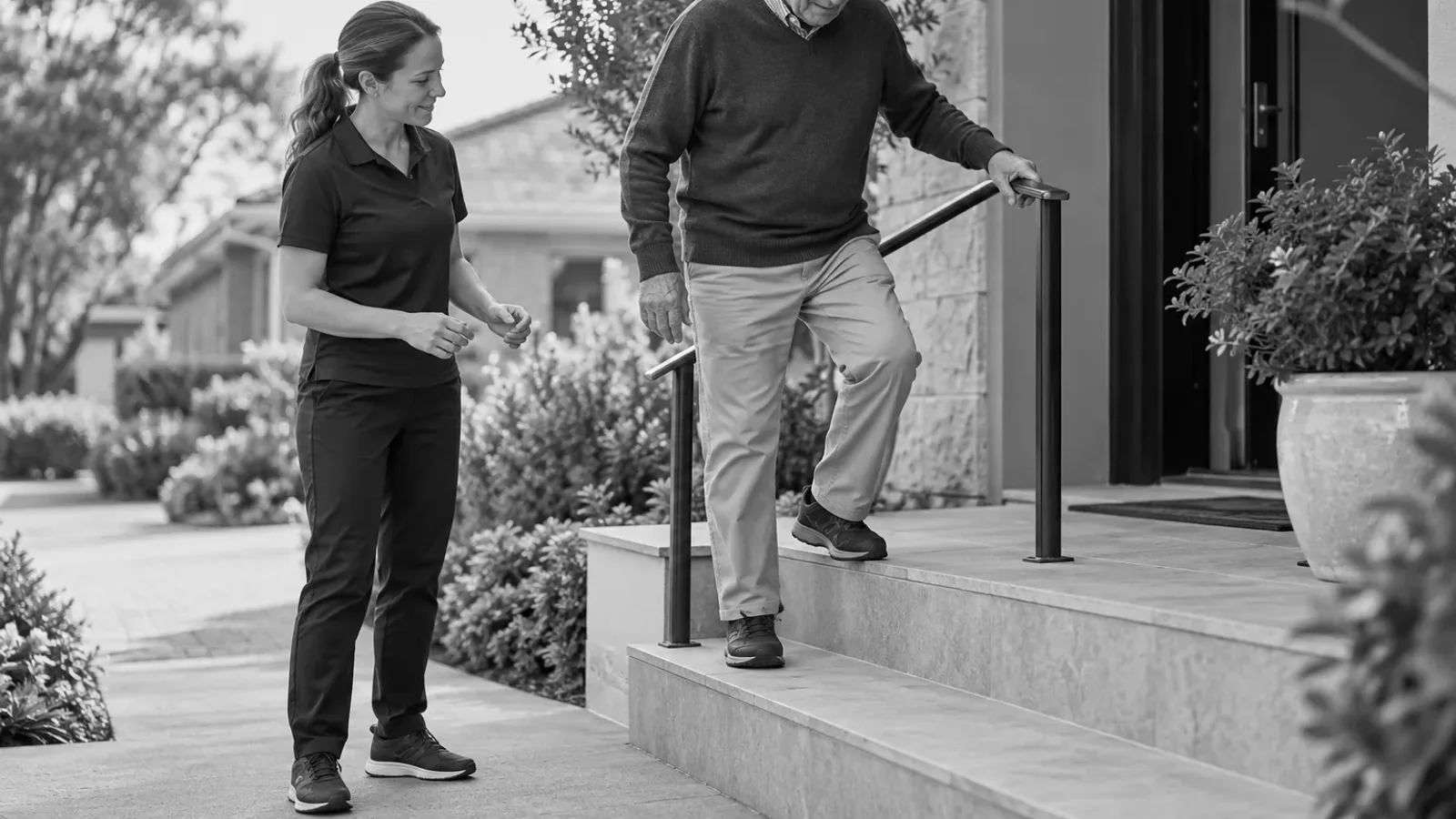
After a fall, people are often told they need to “get their confidence back”.
That sounds straightforward until you consider what confidence actually means.
If the person still has dizziness, a poorly fitted walking aid, reduced balance or an unexplained reason for falling, simply encouraging them to be braver is not enough.
On the other hand, waiting until every possible risk has disappeared can leave the person inactive for months.
Confidence after a fall needs to be rebuilt on something more solid than reassurance.
It should grow from understanding the event, addressing what can be changed and repeatedly experiencing meaningful activities in ways that feel manageable.
Key points
- Confidence after a fall should grow from understanding the event, addressing modifiable risks and practising meaningful activities.
- Reassurance alone is not enough when dizziness, unsuitable equipment or an unexplained fall remains.
- Graded practice should begin with a manageable version of the real task and progress through successful experience.
- Support and walking aids can enable safe practice without representing failure.
- The aim is not fearlessness; it is informed confidence and participation.
Start by understanding the fall
Confidence is difficult to rebuild when the person does not understand what happened.
An unexplained fall leaves a question hanging over every similar activity:
What if it happens again?
Before asking somebody to trust their body, it is worth asking whether the fall has been adequately assessed.
A clear explanation is not always possible.
But even identifying the most plausible contributors can make the next steps more rational.
The assessment should also establish what the person could do before the fall and what has changed since. Without that baseline, it is easy to prescribe a generic exercise programme while missing the actual loss. The important change might be physical, such as slower turning or reduced ability to rise from a chair. It might instead be behavioural: the person still has the capacity to walk outside but no longer attempts it. Often both have changed together.
Confidence should follow evidence
Imagine somebody who has fallen on their front steps.
Telling them “you’ll be fine” may have little effect.
Instead, the steps can be assessed.
Perhaps the rail is awkward.
Perhaps the person struggles when lowering onto one leg.
Perhaps they become unsteady when looking down.
Perhaps the step height varies.
Perhaps carrying a bag makes the task substantially harder.
Now there is something to work with.
Rehabilitation can target the relevant physical demands.
The environment can change.
The person can practise the task with suitable support.
Confidence then develops from successful experience.
Start with a manageable version of the task
Returning to an activity after a fall does not have to mean immediately doing it exactly as before.
A graded return can change one part of the challenge at a time.
Someone who has stopped walking outside might begin on a familiar level path with another person.
Later they may increase distance.
Then they may practise a more variable surface.
Eventually they may return to the specific route they value.
The principle is to make the challenge large enough to promote learning without making failure feel inevitable.
Grading is not simply about doing more repetitions. The clinician and the person can alter distance, speed, surface, lighting, the amount carried, the need to turn or the availability of support. Changing one demand at a time can make progress easier to understand. It also helps identify which part of the task is creating difficulty rather than treating the whole activity as one indivisible problem.
Use support deliberately
There is a persistent idea that genuine confidence means managing without assistance.
That can make people reluctant to use a walking aid, rail or another person’s support.
But confidence is often higher when a person knows they have an effective strategy.
Support is not the opposite of confidence.
Good support can create the conditions in which confidence grows.
Support should still be reviewed. An aid that is the wrong height, used inconsistently or abandoned at the point where it is most needed may not provide the expected benefit. Another person can also give too much or too little help. The goal is reliable support that improves the person’s options, not assistance that silently replaces every opportunity to move.
Practise what the person actually wants to regain
If a person wants to return to gardening, the programme may need to consider uneven ground, bending, carrying and getting up from lower positions.
If they want to use public transport, the relevant demands may include stepping onto a bus, responding to movement and walking while other people are nearby.
If they want to resume shopping, endurance, divided attention and managing a trolley may matter.
Meaningful practice makes progress easier to interpret.
Give the person a strategy for difficult moments
Confidence improves when the person knows what to do if the task begins to feel unsafe. The strategy might be to stop at a particular resting place, move towards a stable support, ask a companion for a specific type of help or abandon the task when dizziness or unusual weakness appears.
This is different from expecting the person to push through every challenge. A planned exit can make practice more approachable because uncertainty has been reduced. It also helps distinguish ordinary effort from warning signs that require the activity to stop or a health professional to be contacted.
Confidence is partly physical and partly predictive
A fall can change what the person expects their body to do.
A kerb that once felt automatic may suddenly feel threatening.
Repeated successful experience can update that prediction.
So can better physical capacity.
So can environmental change.
So can learning an effective compensatory strategy.
Psychologically informed treatment can also help when fear remains excessive relative to the actual situation.
Prediction is one reason specific feedback matters. “That was better” gives little information. “You completed the turn without reaching for the bench, and you kept your steps moving” tells the person what succeeded. Likewise, identifying the exact point where a task became difficult allows the next attempt to be adjusted. Confidence becomes linked to observable experience rather than encouragement alone.
Do not measure progress only by how fearless someone looks
Some people remain cautious even while making meaningful gains.
They may still use a rail.
They may choose not to walk on a wet path.
They may pause before turning.
That does not mean rehabilitation has failed.
Better questions are:
- Are they doing more of what matters?
- Are near-falls changing?
- Are movements becoming more adaptable?
- Is the person using support effectively?
- Has their world become larger again?
Confidence is valuable when it supports choices.
It does not need to produce reckless behaviour.
Families need their confidence rebuilt too
After a serious fall, family members may be reluctant to let the person attempt anything challenging.
This is understandable.
Rehabilitation should include them when the person wants that involvement.
Explain what the person can practise.
Clarify where supervision is appropriate.
Show how equipment should be used.
Agree on warning signs.
Make the plan specific enough that family support does not default to “don’t do it”.
Families may also need opportunities to watch safe practice. Seeing the person manage a task with an agreed strategy can be more reassuring than receiving a general statement that they are improving. It allows relatives to understand when to stand nearby, when to offer physical assistance and when to let the person complete the movement themselves.
There will still be uncertainty
Even excellent assessment cannot predict every fall.
A person may improve substantially and still have another event.
This does not necessarily invalidate the rehabilitation.
The objective is to reduce avoidable risk, improve the person’s ability to respond and make decisions that fit their priorities.
The person should understand both what has improved and what remains uncertain.
That honesty is more useful than promising that treatment has made them “safe”.
Setbacks should be interpreted in the same way. A difficult day, a near-fall or a temporary return of fear does not erase earlier progress. It may indicate fatigue, illness, an unfamiliar environment or a task that advanced too quickly. Reviewing what changed helps the programme adapt without turning one event into proof that recovery is impossible.
Rebuilding confidence means rebuilding options
Confidence after a fall is the relationship between what the person believes they can do and what their current abilities, environment and support actually allow.
Good rehabilitation brings those things closer together.
Sometimes the person becomes physically more capable.
Sometimes the environment becomes easier.
Sometimes they learn a different movement strategy.
Sometimes they accept assistance they previously resisted.
Sometimes they decide that one activity is no longer worth the risk and choose another.
The person should remain involved in that decision. A goal that changes after informed practice is different from a goal abandoned because fear was never explored. Rehabilitation has done useful work when the person can decide from clearer evidence rather than from the memory of one frightening event alone.
The goal is not to erase caution.
It is to prevent fear from making decisions that the person might have made differently if they had better information, better support or better options.
Understand more
- Balance Is More Than Strength: The Clinics GRP Approach to Balance in Older Adults
- Why Do Older Adults Fall? There Is Rarely One Cause
- What Should Happen After an Older Person Falls?
- Fear of Falling: When Being Careful Starts to Shrink Your Life
Relevant care
References
- Australian Commission on Safety and Quality in Health Care. Falls Guidelines for Community Care. 2025. https://www.safetyandquality.gov.au/resources/falls-guidelines-community-care
- Lenouvel E, et al. Cognitive behavioural interventions for reducing fear of falling in older people living in the community. Cochrane. 2023. https://www.cochrane.org/evidence/CD014666_cognitive-behavioural-interventions-reducing-fear-falling-older-people-living-community
- Queensland Health. Healthy active ageing for seniors. https://www.health.qld.gov.au/public-health/groups/seniors/falls-prevention/healthy-active-ageing