
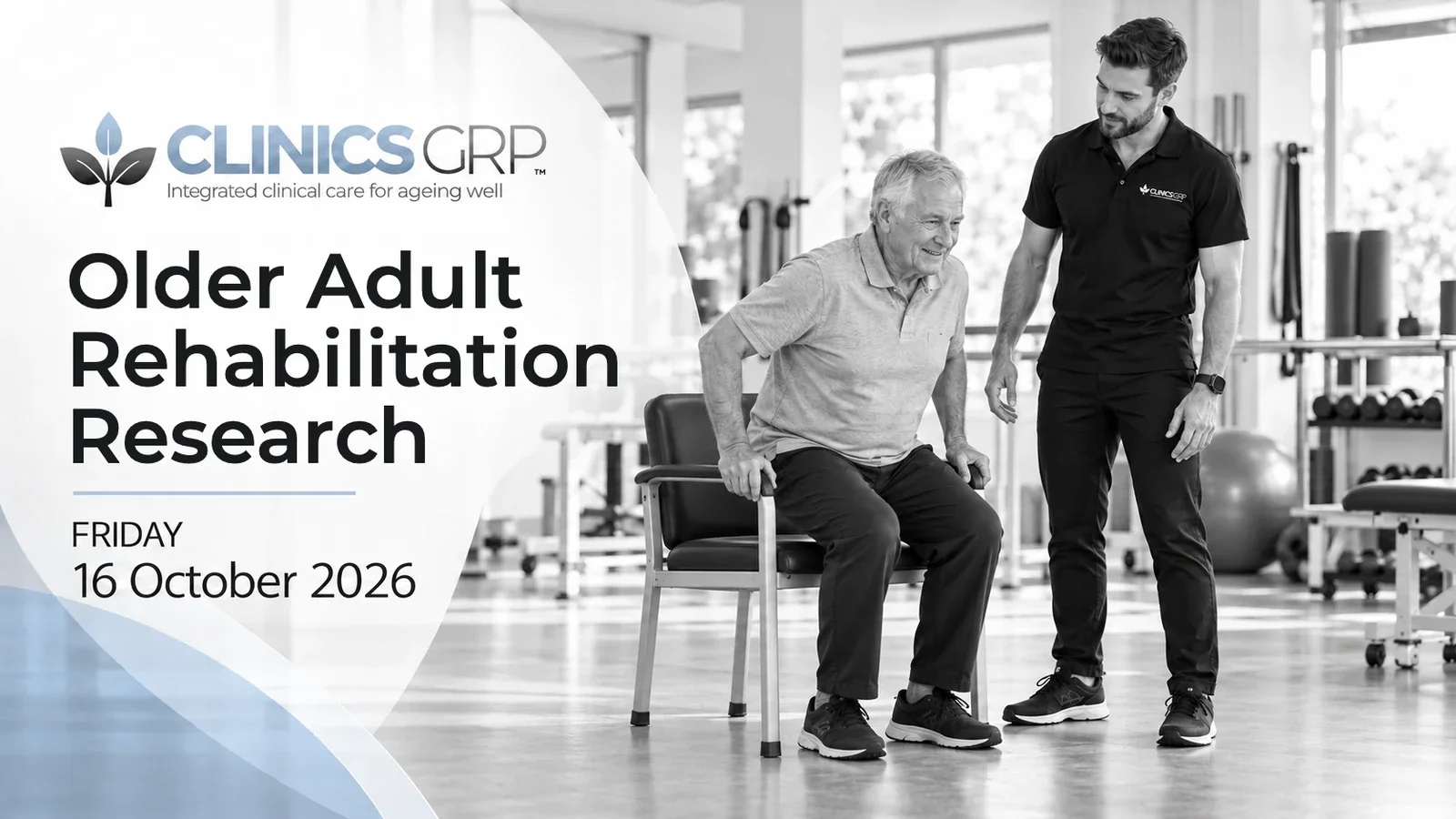
For someone living with Parkinson's disease, the right amount of exercise can be difficult to judge. For someone managing arthritis, there may be several reasonable ways to become stronger and move more comfortably. And for a person receiving care at home, the challenge may be finding enough opportunity to practise safely between appointments.
These are some of the questions behind this week's Older Adult Rehabilitation Research update. At Clinics GRP, we review recent studies to understand what they tell us, what remains uncertain and how that evidence might inform decisions made with each person.
This week, three papers are especially relevant: a large review of exercise in Parkinson's disease, new Australian guidance on exercise for hip and knee osteoarthritis, and a study of home-based falls programmes delivered with help from trained care workers. Two smaller studies add perspective on recovery after stroke and differences between people with knee osteoarthritis.
Parkinson's disease: how much exercise makes a difference?
People living with Parkinson's disease may experience changes in movement speed, balance, walking and the ease of completing everyday tasks. Exercise is an important part of rehabilitation, but choosing a useful programme involves more than deciding which activity to do.
A systematic review published on 10 October brought together 173 randomised trials of exercise for people with Parkinson's disease. Researchers examined different types of exercise and the amount of structured exercise planned each week, looking at motor symptoms, balance, walking speed and a mobility test called the Timed Up and Go.
Some exercise categories appeared more helpful than others for particular outcomes. Across trials, programmes with greater planned weekly exercise exposure were also associated with larger average improvements in motor symptoms, balance and Timed Up and Go performance. The same relationship was not clear for walking speed.
There is an important limit to this finding. The researchers judged confidence in the comparisons to be low or very low. They could not identify one best exercise type or a weekly amount that everyone with Parkinson's disease should aim for. The dose findings compare patterns across studies; they do not prove that increasing exercise by a specific amount will produce a predictable benefit for an individual.
Our interpretation is to pay closer attention to what each exercise session is asking the person to do. Frequency, effort, repetition and progression all matter, alongside symptoms, medication timing, fatigue, other health conditions and the activities the person wants to regain or maintain. A good programme should be sufficiently challenging for that person without treating a published exercise dose as a universal target.
Hip and knee osteoarthritis: there is no single perfect exercise programme
A best-practice review published on 9 October, led by Australian researchers, considered how to prescribe exercise for people with hip or knee osteoarthritis.
The evidence supports exercise as a treatment that can improve pain and function, although the average benefits are generally modest and can vary between people. What the review did not find was one type of exercise that is consistently superior, or a reliably established relationship between doing more exercise and getting a better result.
That is useful news for people who feel unsure whether they should be walking, doing strengthening exercises, attending a class or following a programme at home. There may be several reasonable starting points. The choice should take account of the person's goals, current ability, preferences, access to equipment, symptoms and what they can keep doing over time.
The review also found that in-person, telehealth and self-directed approaches can all improve outcomes. That does not mean every format is suitable for every person. Some people need closer supervision, assistance with progression or help managing other health conditions.
For Clinics GRP, one of the most helpful messages in this review is how we talk about arthritis. An X-ray or diagnosis matters, but it does not tell us everything about a person's capability. We want to understand whether getting out of a chair has become harder, whether stairs have become more difficult, what activities are being avoided and what would be worth working towards.
Exercise-related soreness can occur, particularly when someone begins or changes a programme. The task is to choose a manageable starting point, assess the response and make sensible adjustments rather than assuming there is one prescribed set of exercises that suits everyone.
Falls management at home: improvement in movement is not the same as fewer falls
A Western Australian study published on 5 October followed 69 older adults receiving home-care support. Their average age was about 84 years. The programme combined personalised falls education with exercises intended to improve strength and balance.
Physiotherapists assessed participants and prescribed individual programmes. Trained therapy assistants or support workers helped deliver one supervised session each week, within a structured training and support model. Participants were also encouraged to practise independently between visits.
After 12 weeks, participants generally performed better on a mobility test called Timed Up and Go and reported less concern about falling and better quality of life. Those are worthwhile outcomes in their own right.
But the study did not show a statistically significant reduction in falls or fall-related injuries. It also had no comparison group, so we cannot be certain how much of the observed improvement was caused by the programme itself.
For people receiving care at home, this is a reminder that a falls programme needs careful assessment, adequate exercise challenge and regular review. It should also address the person's home environment, health conditions, confidence and the activities in which difficulties occur.
There is a meaningful difference between someone being supported to complete an established activity and someone being responsible for making clinical decisions about exercise. When a programme requires assessment, modification or progression, those decisions need appropriate professional oversight. This study examined a specific supervised model and does not show that any care worker can safely deliver or change a clinical exercise programme without relevant training and oversight.
After stroke, previous habits may help explain current activity
A study published on 11 October examined 100 people after a minor stroke. Those who had reported lower levels of physical activity before their stroke were more likely to be less active 12 months later.
This was an observational study, so it cannot tell us that being less active before stroke caused inactivity afterwards. Nor should someone's previous habits be treated as a limit on what they might achieve through rehabilitation.
Instead, the finding suggests a useful question for assessment: what was this person's usual pattern of activity before the stroke, and what would help them participate now? Someone who was rarely active may need a different starting point from someone returning to a regular walking routine. In both situations, improving capacity and helping that capacity find a place in daily life are related but distinct goals.
Knee osteoarthritis: people with the same diagnosis can move differently
Another study published on 12 October analysed walking data from 431 adults with knee osteoarthritis and higher body mass index. The researchers identified differences in how forces passed through the lower limbs while walking, and some patterns were associated with pain, walking speed and other clinical characteristics.
The findings are exploratory. They do not establish that changing a particular walking pattern will reduce pain or improve function, and they do not justify a new gait-retraining programme on their own.
They do add to a familiar clinical observation: two people can share a diagnosis while having different strengths, symptoms, movement habits and priorities. The assessment should find out what is happening for that individual rather than presume the diagnosis tells the whole story.
What we take from this week's research
The clearest lesson is that good rehabilitation needs an appropriate dose, a meaningful purpose and a way of checking whether it helps in daily life.
For Parkinson's disease, we should think carefully about training exposure without pretending that one exercise type or intensity is best for everyone. For osteoarthritis, there is room to choose an exercise approach that a person can sustain, rather than searching for a single ideal programme. In home-based falls management, better balance or mobility scores are encouraging, but reducing falls and injuries remains a separate outcome that needs to be measured.
At Clinics GRP, we want rehabilitation decisions to begin with the person: what they are able to do now, what matters to them, what is making that difficult and what kind of change would make a difference. Research helps us choose and test the approach. Individual assessment and regular review tell us whether it is working for the person receiving care.
About this weekly series
Older Adult Rehabilitation Research is published each Friday by Clinics GRP. We review research concerning falls and balance, chronic musculoskeletal conditions, neurological rehabilitation, exercise and ageing, then explain what it may mean for care and everyday life.
The studies discussed here apply to groups of people and are not individual treatment instructions. If you are considering changing your exercise programme, discuss your goals, medical history and current capacity with your treating health professional.
Research referenced in this edition
- Wang L, Wang H, Hong F, Wan Z. Exercise modality and planned weekly exercise exposure for motor outcomes in Parkinson's disease: a systematic review, Bayesian network meta-analysis, and meta-regression. Journal of Neurology. Published 10 October 2026. DOI: 10.1007/s00415-026-14189-y.
- Haber T, Bennell KL, Hinman RS, Zhu S, Nelligan RK. Implementing exercise therapy for hip and knee osteoarthritis in the clinic: a best practice narrative review. Best Practice & Research Clinical Rheumatology. Published 9 October 2026. DOI: 10.1016/j.berh.2026.102205.
- Hang J-A, Francis-Coad J, Burton E, et al. Effectiveness of a novel homecare-delivered falls prevention program on functional mobility in older adults receiving support at home: a prospective cohort study. Health & Social Care in the Community. Published 5 October 2026. DOI: 10.1155/hsc/2850620.
- Knudsen AM, Rolving N, Mortensen JK, Damsbo AG. How does pre-stroke physical activity influence physical activity one year after minor stroke, and what role does cognitive impairment play? Topics in Stroke Rehabilitation. Published 11 October 2026. DOI: 10.1080/10749357.2026.2746396.
- Buck AN, Borgert JE, Lee H, et al. Unsupervised machine learning identifies shared biomechanical and clinical variation in individuals with knee osteoarthritis and high BMI: a secondary analysis of the IDEA trial. Arthritis Care & Research. Published 12 October 2026. DOI: 10.1002/acr.80186.
References
- Wang L, Wang H, Hong F, Wan Z. *Exercise modality and planned weekly exercise exposure for motor outcomes in Parkinson's disease: a systematic review, Bayesian network meta-analysis, and meta-regression.* Journal of Neurology. Published 10 October 2026. DOI: 10.1007/s00415-026-14189-y. https://doi.org/10.1007/s00415-026-14189-y.
- Haber T, Bennell KL, Hinman RS, Zhu S, Nelligan RK. *Implementing exercise therapy for hip and knee osteoarthritis in the clinic: a best practice narrative review.* Best Practice & Research Clinical Rheumatology. Published 9 October 2026. DOI: 10.1016/j.berh.2026.102205. https://doi.org/10.1016/j.berh.2026.102205.
- Hang J-A, Francis-Coad J, Burton E, et al. *Effectiveness of a novel homecare-delivered falls prevention program on functional mobility in older adults receiving support at home: a prospective cohort study.* Health & Social Care in the Community. Published 5 October 2026. DOI: 10.1155/hsc/2850620. https://doi.org/10.1155/hsc/2850620.
- Knudsen AM, Rolving N, Mortensen JK, Damsbo AG. *How does pre-stroke physical activity influence physical activity one year after minor stroke, and what role does cognitive impairment play?* Topics in Stroke Rehabilitation. Published 11 October 2026. DOI: 10.1080/10749357.2026.2746396. https://doi.org/10.1080/10749357.2026.2746396.
- Buck AN, Borgert JE, Lee H, et al. *Unsupervised machine learning identifies shared biomechanical and clinical variation in individuals with knee osteoarthritis and high BMI: a secondary analysis of the IDEA trial.* Arthritis Care & Research. Published 12 October 2026. DOI: 10.1002/acr.80186. https://doi.org/10.1002/acr.80186.