
Key points
- Caution can be an appropriate response to a demanding situation.
- A useful strategy should be judged by its context and effect on everyday life.
- New or progressive gait change should not be dismissed as caution alone.
- Rehabilitation and adaptation can work together to expand meaningful options.
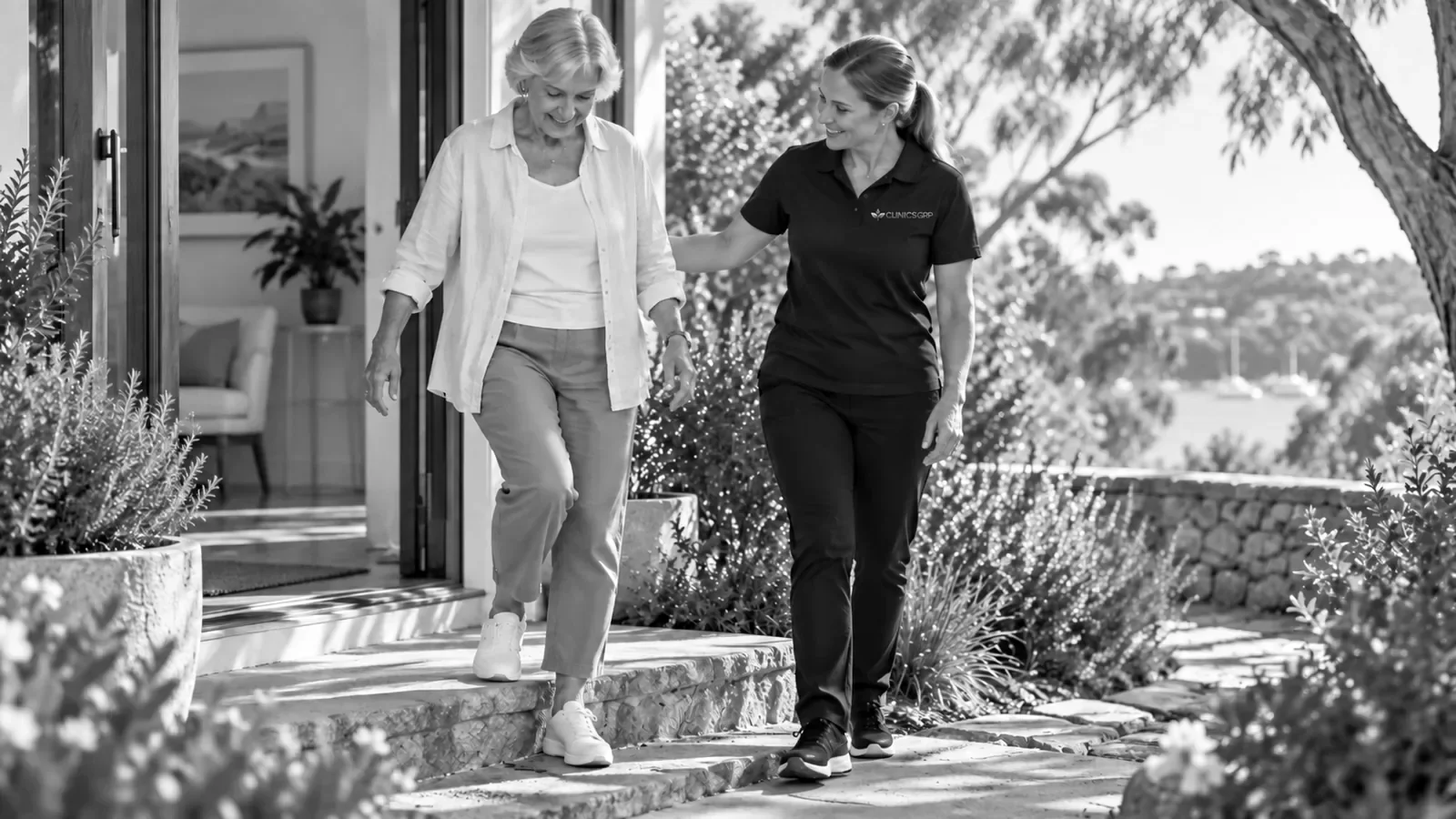
An older person pauses at the top of a path, looks carefully and walks down slowly using a rail. Is that a balance problem, or a sensible way to manage the task? The answer may include both a real difficulty and a useful response to it.
Cautious walking is often discussed as though the caution itself were the enemy. Yet everyone adjusts movement when the surroundings demand it. The clinical question is whether the strategy helps the person, whether it reflects a new problem and whether better options are available.
Our cornerstone, Balance Is More Than Strength, places movement within the person's health, sensory information, confidence, task and environment.
What might cautious walking look like?
People may slow down, shorten steps, spend longer with both feet on the ground or pause before turning. They may seek a rail, use an aid or wait for another person before entering a difficult space.
These observations describe behaviour, not a diagnosis. Similar patterns can occur with pain, reduced confidence, sensory or neurological problems and other contributors. Clinical guidance emphasises that gait must be interpreted alongside history and examination. 1
The phrase “cautious walking” is therefore most useful as the start of a question: what is the person managing by moving this way?
Why caution can make sense
A wet floor, a steep driveway or an unfamiliar step can justify a deliberate approach. Waiting for the route to clear or choosing stable support may reduce demands and allow the activity to continue.
Research shows that perceived postural threat can alter walking in older participants. 2 This demonstrates that movement responds to the situation; it does not prove that every resulting pattern is safer or that the same strategy should be prescribed to everyone.
The practical inference is to examine the fit between the strategy and the task. It is reasonable for a person to move differently in a crowded café than on a clear, familiar path.
Useful adaptation is flexible
A helpful strategy often changes with the circumstances. The person may pause at a doorway, then continue comfortably once the route is clear. They may use a rail on stairs while walking without it on a level surface, if that is appropriate for them.
Flexibility does not mean being able to perform every task without help. It means having workable options. Sometimes the best option is equipment, assistance or a different route.
A strategy deserves review when it no longer achieves its purpose. Repeated near-falls, toe catching, pain, excessive effort or avoidance of valued activities suggest that more needs to be understood.
Caution can coexist with a treatable problem
Someone may have sensibly adapted to a painful joint, dizziness or a change in sensation. Respecting that adaptation does not mean accepting the underlying difficulty without assessment.
New or progressive gait changes can have multiple causes. A clinician may need to consider health conditions, medicines, vision, movement, strength, sensation and cognition. Comprehensive falls guidance supports looking across these contributors rather than assuming a single explanation. 3
The person may benefit from treatment while retaining useful support. It is not necessary to choose between recognising a problem and respecting the way they have managed it.
Fear and confidence need a careful conversation
After a fall, concern can be understandable. It may be linked to injury, an unexplained episode or uncertainty about getting help. Simply saying “you are safe” may not address what the person actually experienced.
Ask which part of the activity feels difficult and what would make it more manageable. The answer might be a rail, practice with a clinician, less time pressure or a clearer explanation of symptoms.
At the same time, confidence alone cannot guarantee a safe response. Useful care seeks confidence that is supported by capability, understanding and appropriate arrangements. It does not reward taking unnecessary risks.
When caution begins to shrink life
Someone may gradually stop using the garden, visiting friends or attending an activity because the route feels uncertain. Their immediate strategy avoids a difficult situation, but the consequence may be fewer opportunities for movement and connection.
This does not mean the person should simply force themselves to continue. It means the activity is important enough to bring into assessment. What is the troublesome section? What support is missing? Could the task be practised, adapted or approached differently?
The aim is to recover options where possible, with an honest discussion of limitations. A person should remain involved in deciding which activities are worth working towards.
A walking aid can be part of a successful strategy
Using a suitable aid may make a journey more achievable or reduce the effort needed. The aid is part of the person's functional setup, not evidence that the journey does not count.
Fit and use matter. A device needs to suit the person and the setting, including turns, doorways and surfaces. Assessment can also consider whether an existing aid is providing the intended benefit or creating difficulties of its own.
Removing support just to make walking appear more independent can miss the person's real goal. If the aim is visiting a friend, the relevant outcome includes getting there with workable support.
What a practical assessment asks
Clinics GRP's Balance and Falls service begins with what changed and what matters. Describe the actual activity and your response: where you pause, what you hold, what symptoms occur and whether the strategy works.
Home physiotherapy may help examine the interaction with a familiar environment. Other medical or allied-health assessment may be needed according to the findings.
A useful plan explains what to retain, what to address and when to review. It should not assume that every cautious person needs the same exercises or a group class.
Rehabilitation can expand the choices available
Depending on the assessment, rehabilitation may address strength, movement, walking adaptability, reactions or confidence. The Balance Program may be suitable when the goals and support needs fit a group setting.
Environmental changes and equipment can be included at the same time. The evidence for balance and functional exercise supports appropriate training, but it does not establish that all adaptations should eventually be removed. 3, 4
Ageing in Full frames success around meaningful participation. A person may continue to walk cautiously on a difficult surface while becoming more comfortable with everyday outings. That can be worthwhile progress.
Knowing when to seek help
Arrange assessment for a new or worsening pattern, repeated near-falls, falls or avoidance that is affecting life. Sudden severe imbalance or new neurological symptoms needs urgent medical attention, not reassurance that the person is merely cautious.
For a wider discussion of outcomes, read The Goal Is Not the Exercise. The Goal Is the Life It Enables. Caution is most usefully judged by whether it helps the person live, and whether care can offer a better range of choices.
References
- Pirker W, Katzenschlager R. Gait disorders in adults and the elderly: a clinical guide. Wiener Klinische Wochenschrift. 2017. PubMed.
- Concern about falls elicits changes in gait parameters in conditions of postural threat in older people. Research article.
- Montero-Odasso M, et al. World guidelines for falls prevention and management for older adults. Age and Ageing. 2022;51:afac205. Guideline.
- Sherrington C, et al. Exercise for preventing falls in older people living in the community. Cochrane. 2019. Review.