
Key points
- Vision, inner-ear signals and body sensation all contribute to balance.
- The nervous system combines information rather than relying on one signal alone.
- The usefulness of each source changes with the task and surroundings.
- Symptoms in one situation cannot identify a faulty sensory system without assessment.
You rarely need to think about where your body is while standing at a kitchen bench. Yet your nervous system is continually using information from your eyes, inner ears and body to help organise movement. Turn your head, reach for a cup or step backwards and the information changes again.
Understanding these signals can make balance difficulties less mysterious. It can also explain why an exercise that looks simple may become harder when the lighting, surface or direction of movement changes. The explanation is broader than “my legs are weak”.
This article develops the sensory part of our cornerstone, Balance Is More Than Strength. It describes established physiology, not a way to diagnose yourself or reproduce a clinical assessment.
Vision provides information about the world around you
Vision helps you locate objects, identify edges and judge a route. It also provides information about movement relative to the surroundings. Walking along a corridor creates a different visual experience from standing beside moving traffic.
Visual information is only as useful as the circumstances allow. Dim lighting, glare, busy patterns or reduced visual function can make some tasks harder. Looking directly at your feet may help with a particular obstacle, but the broader scene also matters for planning where to go next.
Someone who feels uncertain in a busy shopping centre may be responding to several demands at once: visual motion, turning, people crossing their path and divided attention. The location of the symptoms is useful information, but it does not establish their cause.
Vestibular information comes from the inner ears
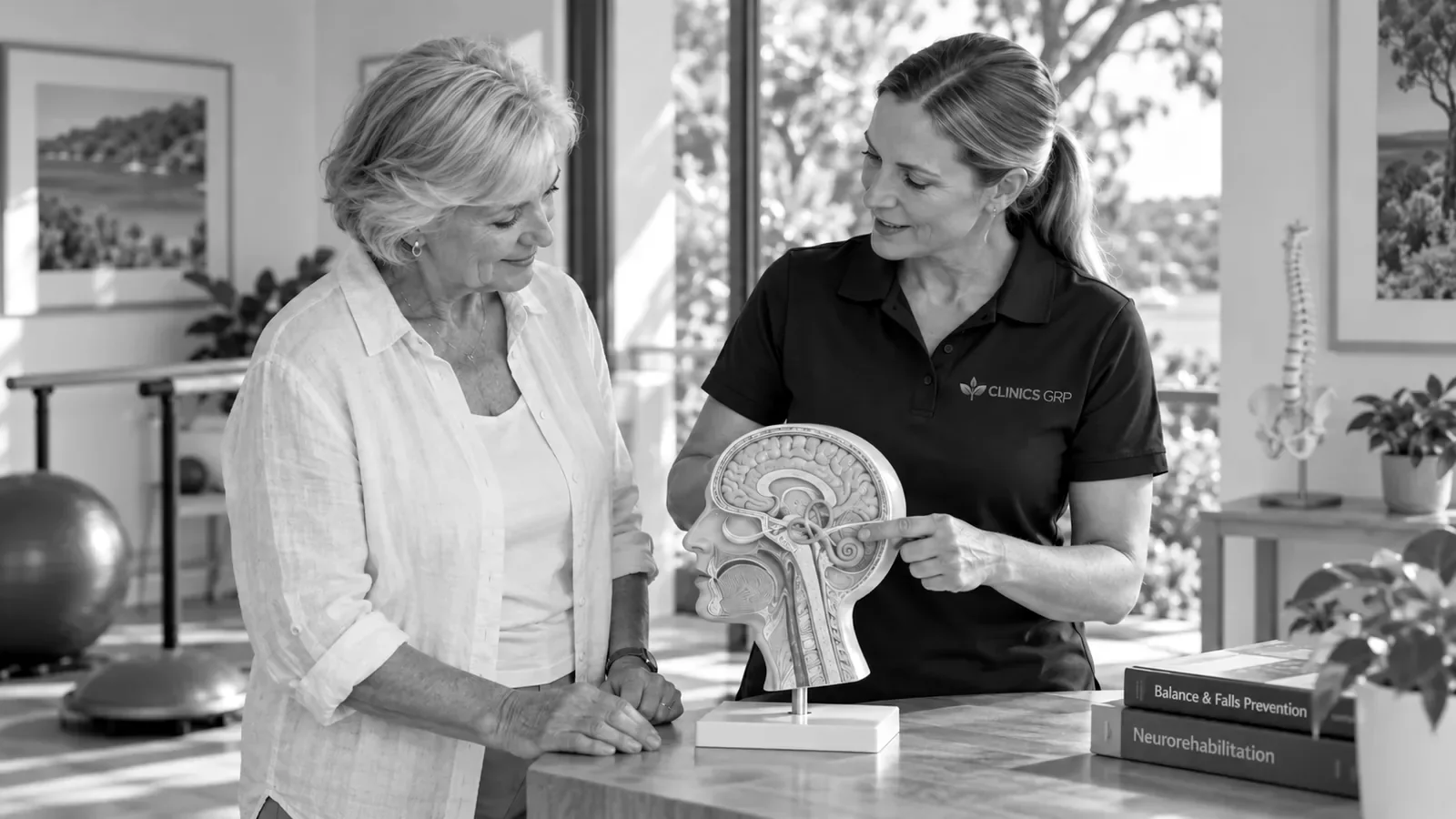
The vestibular organs are located in the inner ears. The semicircular canals help detect head rotation. Other structures, the otolith organs, provide information related to linear acceleration and gravity. These signals contribute to orientation and balance. 1
Vestibular pathways also help coordinate eye movements when the head moves. This supports a reasonably stable view while you walk or look around. A disturbance in vestibular function can therefore affect both how steady you feel and how clear the surroundings seem during movement.
Hearing and vestibular function are related anatomically but are not interchangeable. A hearing problem does not automatically mean a balance disorder, and vestibular symptoms can occur without a hearing complaint. A clinician may ask about both because the combination can be informative.
Proprioception describes your sense of position and movement
Proprioception contributes information about the position and movement of the limbs and trunk. Signals from muscles and other tissues help the nervous system interpret what the body is doing. You do not have to watch every joint to know that you have bent an elbow or moved a foot. 2
Touch and pressure are also relevant. Contact beneath the feet provides information about support. These forms of body sensation belong to the wider somatosensory system. Proprioception and pressure sensation are related contributors, but they are not identical terms.
The distinction matters because “poor proprioception” is sometimes used as a catch-all explanation for unsteadiness. A person may have difficulty with balance for many reasons, and an unstable exercise surface does not selectively measure one sensory ability.
Integration is the essential next step
Receiving information is only part of the process. The nervous system must combine it with the task, the body's mechanics and an appropriate movement response. Sensory integration describes this use of multiple sources of information. 3
Suppose you turn towards someone while stepping through a doorway. Your eyes identify the space, your inner ears signal head movement and your body provides information about position and contact. Meanwhile, you need enough movement, strength and coordination to complete the step. No sensory signal does the whole job.
This also explains why good eyesight does not guarantee good balance. Useful visual information still needs to be combined with other signals and translated into suitable action.
The balance of information can change
Sensory reweighting refers to changes in the relative contribution of sensory inputs. In research, these contributions vary with the conditions rather than remaining fixed. 3, 4
When visual detail becomes less available, the remaining information has greater practical importance. If the supporting surface moves or deforms, information from contact and joint movement may need to be interpreted differently. The nervous system must respond to the situation rather than use one unchanging formula.
Everyday examples illustrate the idea, but they are not clinical tests. Becoming less steady with your eyes closed does not prove an inner-ear disorder or establish a particular percentage of visual dependence. Closing your eyes removes useful information for many people.
Ageing does not affect everyone in the same way
Research describes age-related changes in sensory structures and function, including body sensation. The pattern is variable, and other conditions may add to or differ from age-related changes. 5
A person's activity, health, vision, medicines, pain and movement abilities can influence the overall presentation. It is therefore more useful to ask what has changed for that individual than to assume that everyone of the same age needs the same sensory exercise.
Being able to describe the conditions is helpful: darkness, soft ground, head movement, turning, crowded spaces or fatigue. Include whether the feeling is spinning, faintness, blurred vision or a loss of stability, and how long it lasts.
Assessment connects the explanation to the person
A balance clinician may explore relevant sensory contributors alongside walking, strength, movement, attention and health history. Sometimes further vision, medical or vestibular assessment is needed. The examination should answer a clinical question rather than simply expose a person to increasingly difficult conditions.
Clinics GRP's vestibular service is relevant when assessment suggests a vestibular contributor. Our broader Balance and Falls service considers the interaction with everyday function. Neither pathway assumes that every person who feels unsteady has the same problem.
What the science means for everyday care
The practical message is to match support and rehabilitation to the difficulty. Clearer lighting, an appropriate walking aid, a less demanding route or help with carrying can change what information and movement an activity requires. These adjustments can support participation while assessment or rehabilitation continues.
Exercises may also vary movement, support or sensory conditions when appropriate. Progression needs to suit the person. Standing on an unstable object with eyes closed is not a universal balance exercise and can create an avoidable fall risk without answering the relevant question.
Ageing in Full keeps the purpose visible: being able to do something meaningful. Understanding the signals is useful when it helps explain a plan, choose a practical adaptation or ask a better question. The goal is not to monitor every movement or become anxious about the nervous system.
If unsteadiness is new, worsening or affecting daily activity, arrange assessment. For sudden severe symptoms or signs of a medical emergency, seek urgent care rather than experimenting with sensory challenges at home.
References
- National Institute on Deafness and Other Communication Disorders. Balance disorders. Patient information.
- Proske U, Gandevia SC. The proprioceptive senses: their roles in signaling body shape, body position and movement, and muscle force. Physiological Reviews. 2012;92:1651-1697. PubMed.
- Peterka RJ. Sensory integration for human balance control. Handbook of Clinical Neurology. 2018;159:27-42. PubMed.
- Peterka RJ. Sensorimotor integration in human postural control. Journal of Neurophysiology. 2002;88:1097-1118. Research article.
- Shaffer SW, Harrison AL. Aging of the somatosensory system: a translational perspective. Physical Therapy. 2007. PubMed.