
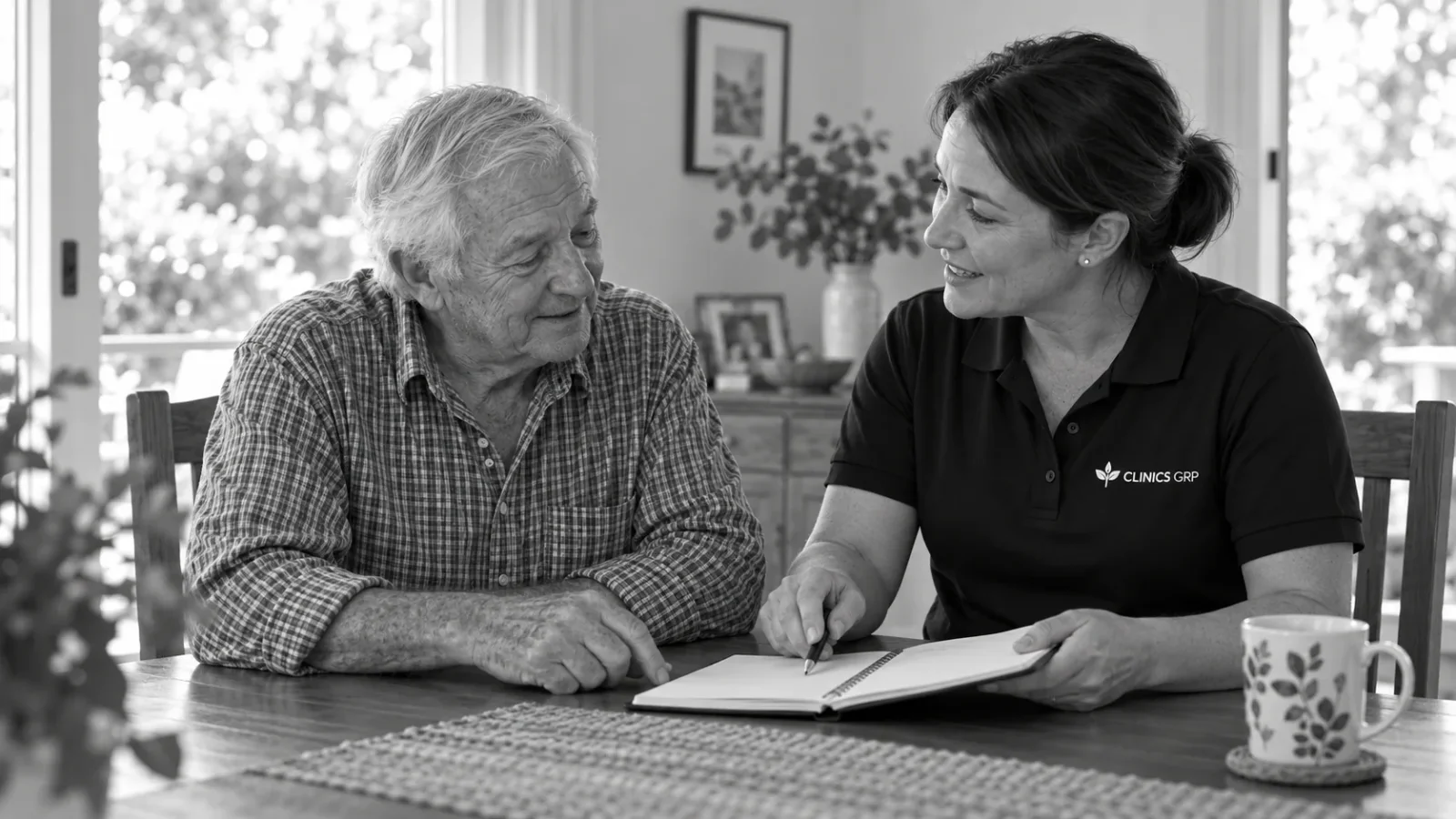
A blood pressure, pulse, temperature or other clinical observation can help describe an older person's condition at a point in time. Its usefulness depends on the question being asked. Was the reading taken because the person felt unwell, after a medicine change, or as part of an agreed monitoring plan? Is it different from that person's usual pattern? What symptoms or changes in function came with it? A number without those details may create reassurance or alarm that the wider assessment does not support.
This article explains what nursing support with medication and clinical monitoring can contribute at home. It does not provide normal ranges, a home testing schedule or a rule for deciding whether someone is safe. Those decisions depend on the person, the device, the clinical plan and the practitioner responsible for interpretation.
Key points
- An observation matters most when its timing, reason and the person’s usual state are recorded together.
- One measurement alone cannot diagnose an illness or replace a clinical assessment.
- The care plan should name who reviews a change, when to escalate and how the response is documented.
Why was this observation taken?
An observation has a purpose before it has a value. A clinician may need to follow a known condition, check a response to treatment, investigate a reported change, or help decide how urgently another assessment is needed. The same reading could be interpreted differently in those settings. If a care team asks for regular observations, the person should know which ones, how often, who reviews them and what should happen if a concern arises between scheduled visits.
The Australian Commission on Safety and Quality in Health Care's Primary and Community Healthcare Clinical Safety Standard calls for systems that recognise serious deterioration and escalate care within the healthcare provider's scope.1 It does not make a single home observation a diagnosis. The standard's focus is on a reliable process: noticing a concern, responding at the right level and communicating with the other relevant people.
At home, that process begins with a clear instruction. “Take observations” is incomplete if nobody has specified the reason, the responsible clinician or the action that follows. A nurse can identify what was requested, document how and when it was measured, and clarify the route for reporting it. Where the requested monitoring is outside accepted service scope or lacks a suitable plan, intake must resolve that before promising visits.
A reading needs a person and a timeline
Clinical observations make more sense alongside the older person's account. Are they eating and drinking as usual? Has breathlessness, pain, confusion, fatigue or walking ability changed? The answer may point to a need for prompt medical review even if one measured value looks familiar. Equally, a reading that differs from a previous one may need to be repeated or assessed in context before it is interpreted. A device can be used incorrectly; conditions at the time of measurement can also differ.
The record should say enough about the measurement to make comparison fair. Was it taken with the agreed device and method? Was the person resting, moving or distressed? Does the plan require a repeat when a result seems inconsistent with how the person appears? These are questions for the trained clinician and the individual monitoring plan, not a universal set of steps for family members. If a device is unfamiliar or the person cannot use it reliably, the team should address that limitation before treating its readings as a dependable trend.
The Aged Care Quality and Safety Commission's comprehensive-care guidance connects clinical monitoring with reassessment when a person's health, behaviour, cognition or function changes.2 That is especially relevant when the concern is reported by the person or someone who sees them between visits. An observation record should not crowd out those reports. It should help the clinician see when a change began, whether it is persisting and what else changed with it.
A trend is often more informative than an isolated number, but “trend” does not mean waiting for several abnormal readings before acting. A sudden serious symptom, an acute change in mental state or a person who appears very unwell may require urgent assessment now. The purpose of comparing readings is to support a safe decision, not to delay one.
What measurements cannot settle
An observation cannot, by itself, identify the cause of a symptom. A temperature may be relevant to an illness, but it does not specify the source or treatment. A pulse or blood-pressure value does not establish why someone feels faint. A blood-glucose result may require interpretation against a prescribed diabetes plan; it is not permission for an untrained person to change medicines. The person may also have a clinically important concern that the available device does not measure.
This limit matters in home care because several people may see the result: the older adult, a family member, a support worker, a nurse and a GP. Each has a different role. A support worker can report a concern through the agreed channel. A nurse can assess and communicate within scope. The prescriber or relevant treating clinician is responsible for decisions that require their authority. A record should make that chain visible instead of leaving the result in a notebook with no owner.
Our article on when a health change needs nursing or medical review explains how those pathways differ. Where observations follow a prescription change, What Should Happen After a Medicine Changes at Home? addresses the additional task of keeping the current instruction and follow-up plan aligned.
Record enough to support interpretation
A useful entry states what was measured, the result and unit, the date and time, relevant symptoms, and any action taken. If the reading was repeated because the first seemed unreliable, that should be clear. If the person declined a measurement, record that respectfully and follow the care plan's communication process. Consent and privacy still apply when measurements are shared among services.
The detail should match the clinical purpose. Recording several numbers with no account of why they were taken can be less useful than one relevant measurement accompanied by a clear description of the person's change. Conversely, a vague note such as “observations stable” may conceal information the next clinician needs. The person should be able to understand what was found and whether any follow-up remains outstanding.
When an observation is sent onward, the handover should answer a practical question: who received it, what clinical concern was raised, what response was agreed, and who will tell the older adult what happens next? The Commission's community standard places communication for safety beside comprehensive care and recognising deterioration.1 A sent message is part of the process; it is not proof that the clinical question has been resolved.
Decide whether the plan still fits
Some observations are appropriate for a defined period. Others may become routine without a clear reason to continue. A review should ask whether the monitoring still addresses the person's goals and current risk, whether it is manageable at home, and whether the responsible practitioner has used the information. More readings are not automatically better. They can add burden or confusion if there is no decision attached to them.
The plan may need to change when the person's condition, treatment, ability to use a device or care arrangement changes. Nursing can bring those changes to the relevant clinician and help explain the updated plan to the person. It cannot substitute a generic schedule for a medical instruction. The Nursing Hub describes how intake determines whether home monitoring is appropriate and within the accepted nursing plan.
If the person has severe symptoms, a sudden major change in physical or mental state, or appears seriously unwell, seek urgent medical help rather than waiting for a scheduled observation. Call Triple Zero (000) for a medical emergency. Clinics GRP is not an emergency or 24-hour service. Ask what has changed for this person, what the whole assessment suggests, and who must respond.
Understand more
- When a Health Change at Home Needs Nursing and When It Needs Medical Review
- What Should Happen After a Medicine Changes at Home?
Relevant care
- Nursing care for older adults
- Medication support and clinical monitoring
- Nursing assessment and care review
References
- Australian Commission on Safety and Quality in Health Care. Primary and Community Healthcare Clinical Safety Standard. https://www.safetyandquality.gov.au/national-standards/primary-and-community-healthcare-standards/clinical-safety-standard
- Aged Care Quality and Safety Commission. Comprehensive care. Strengthened Aged Care Quality Standards. https://www.agedcarequality.gov.au/strengthened-quality-standards/clinical-care/comprehensive-care
General information only; not individual clinical advice. Named clinical review and a recorded review date are required before public publication.