
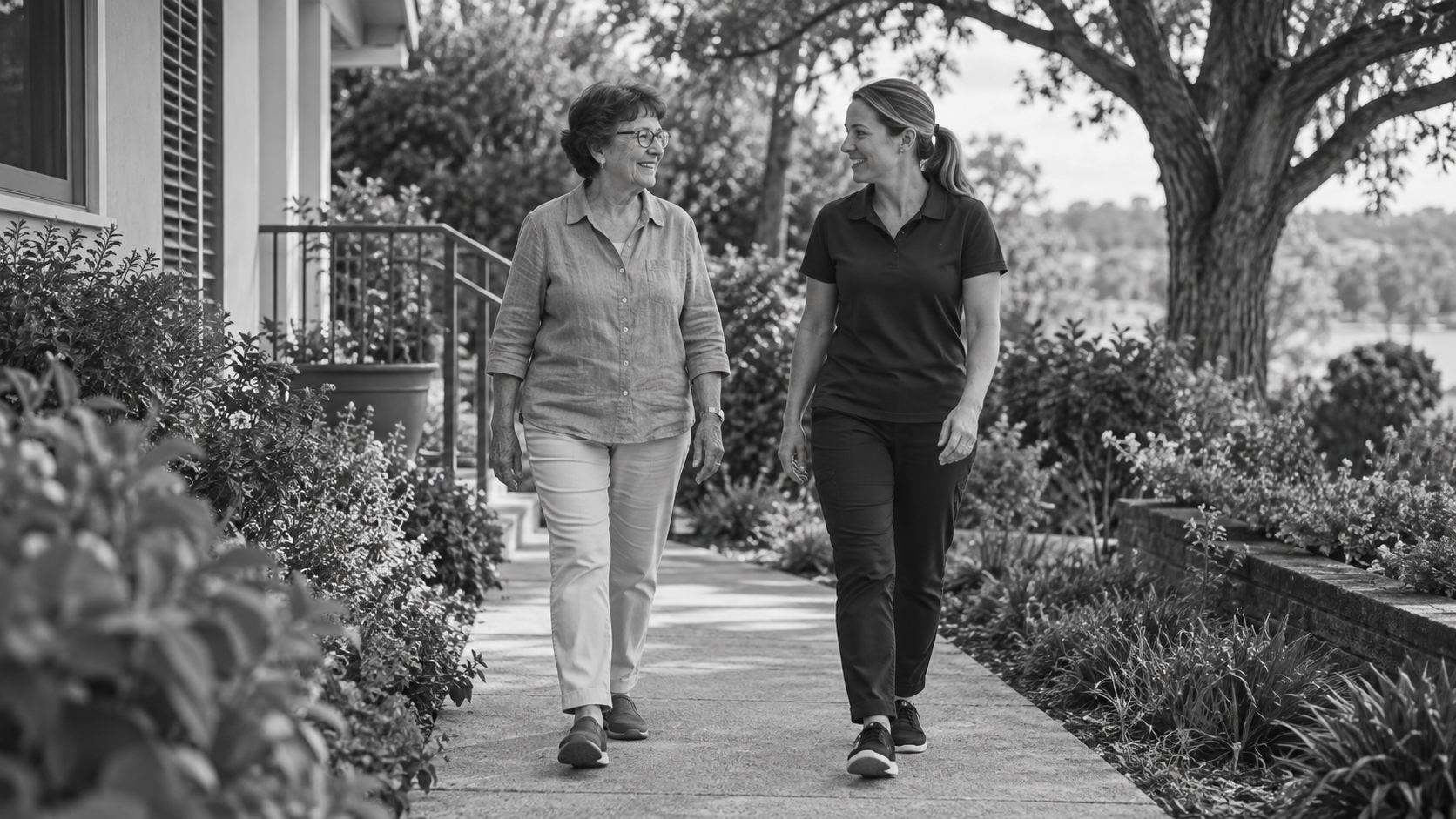
Strength matters in everyday movement. It is also an incomplete explanation of balance. When an older person feels less secure walking, turning or moving around the home, a useful care conversation needs to consider the experience as a whole.
At Clinics GRP, the starting point is the person: what has changed, where it matters and what they want help with. The aim is to understand which concerns need attention and what expertise is appropriate, rather than beginning with the assumption that one exercise will address every balance problem.
This article explains that broader public perspective. It does not provide a home assessment, a diagnosis or an individual exercise prescription.
Key points
- Strength matters, but balance involves more than strength alone.
- Describe when and where feeling unsteady affects daily life.
- Care should consider the individual and the factors relevant to their situation.
- An exercise programme should be appropriate to the person and reviewed as needs change.
Balance belongs to everyday life
People rarely seek help because they want to improve an abstract concept. They may want to reach the bathroom, walk to a neighbour's house, move around the kitchen or attend a family event. Feeling secure enough for those activities can be the practical reason behind a question about balance.
The first useful description is therefore often an ordinary one. “I have started holding the furniture” gives a different starting point from “My balance is poor.” “I feel unsure when I go outside” opens another conversation. Neither statement tells us the cause, but each helps identify what needs to be understood.
An activity also occurs somewhere. The familiar room, the outdoor route and the community venue are not interchangeable descriptions of a person's day. Asking about the setting makes the discussion more concrete without assuming that the environment is the only issue.
Why the picture is broader than muscle strength
Australian community falls guidance considers several areas, including balance and mobility, vision, medicines, footwear and environmental factors. 1 The World Falls Guidelines similarly recommend assessment and interventions directed to an individual's relevant risks. 2 These sources support looking beyond one physical attribute. They do not establish that every person has a problem in every area or that a checklist can identify the cause without clinical judgement.
For the reader, the important implication is simple: a clinician may need to ask about more than exercise. Those questions should have a clear purpose and relate to the concern being discussed. You should be able to ask why a particular issue is relevant and whether another professional's advice is needed.
This is not a reason to dismiss strength. It is a reason to avoid asking strength to explain everything. An appropriate plan may include strengthening, but its purpose should be considered alongside the person's other needs and the evidence relevant to their situation.
What exercise research actually supports
A Cochrane systematic review brought together 108 randomised trials involving 23,407 participants. Programmes centred on balance and functional exercise reduced falls among older people living in the community; evidence for programmes consisting mainly of resistance exercise was uncertain. 3 The review searched studies through May 2018, and reporting of adverse events was limited. It did not establish that all exercise programmes are equivalent or that an individual reader's symptoms have an exercise-related cause.
There is a difference between evidence about fewer falls in a study population and a promise that a particular person will feel steady. Research informs care; it does not remove the need to understand who is seeking help, what they are experiencing and whether the studied intervention is relevant.
The studies also do not validate Clinics GRP's own services or any proprietary clinical model. We use published evidence to inform the questions and recommendations that belong in care, while keeping claims about our organisation separate from the findings of external research.
The meaning of unsteady needs clarification
When someone says they feel unsteady, ask them to describe the experience in their own words. It may be a feeling of insecurity while moving, or they may be trying to describe dizziness. The word itself is not a diagnosis.
Healthdirect describes dizziness as a symptom with several possible causes and identifies circumstances that need medical attention. 4 A new symptom should not automatically be treated as a sign that the person needs a harder exercise programme. The appropriate next step may include medical assessment.
You can tell a professional when the experience began, whether it is recurring and what else you noticed. If the details are unclear, say so. Do not deliberately recreate an episode to provide a better account, and do not remove usual support to demonstrate the difficulty.
Two people may need different conversations
Consider two fictional people who both ask for help with balance. One wants to discuss moving around the bathroom. The other wants to understand why an outdoor outing now feels difficult. Even before considering possible clinical explanations, their immediate priorities and settings differ.
A shared label does not mean that the same plan should follow automatically. Their health histories, existing advice and available support may differ as well. Those details belong in an appropriate assessment, rather than being treated as background information that can be ignored once the word balance appears on a referral.
Individualisation should still be explainable. The person should understand what the plan is intended to help, what evidence informs it and when it will be reviewed. A recommendation is not justified merely by calling it tailored.
Clinical measures should serve a meaningful goal
An assessment may include measurements that help a clinician understand or document a concern. Those results need to be interpreted in context. The person should not have to treat a score as a complete account of their daily life.
If the goal is attending a weekly gathering, a review should make room for that activity. What remains difficult about going? What has changed since the previous conversation? Does the goal still matter in the same way? These questions connect clinical information with the person's reason for seeking care.
Sometimes the measured result and the person's experience may appear different. That is a reason to explore the difference rather than dismiss either account. The purpose is to understand what the available information means for the person, not to make their story fit a single number.
A plan needs to work where life happens
Care recommendations are carried out within ordinary routines. Someone may share a small home, rely on help that is not always available or have caring responsibilities. These practical circumstances should be discussed when planning care.
You can ask what is needed to carry out a recommendation safely and what to do if the arrangement is not available. Do not improvise a more difficult version of an activity or substitute advice from another person's programme. Ask the treating professional to clarify what is appropriate for you.
At Clinics GRP, considering the setting is part of the intended care approach. Depending on the concern, care may involve a clinic, home or another suitable setting. Availability and clinical suitability must be confirmed; a general article cannot establish which service or funding pathway applies.
Review when the picture changes
A plan should remain connected to the current concern. If a new symptom develops, a fall occurs or the expected progress is not happening, tell the professional involved. Completing the original instructions does not mean that every later change has already been considered.
Our public principle is to review, learn and adapt. A review may clarify the purpose of the current plan, identify practical barriers or establish that other professional input is needed. It should include an explanation of the proposed next step and the uncertainty that remains.
This does not mean continually changing care without a reason. It means being accountable for whether the plan still fits the person. The person should be able to report difficulty or lack of progress without feeling that they are being judged for insufficient effort.
Support can coexist with ability
Accepting assistance does not cancel someone's strengths. A person may want help with one activity while continuing to make their own decisions and manage other parts of life. Ask what support they want rather than assuming that one concern defines everything they can do.
If a family member is involved, agree on their role. They may help describe an observation, remember advice or organise an appointment. Their involvement should support the person's voice, not replace it. Different observations can be discussed honestly without making the conversation a contest over who is right.
Goals can include improvement, adaptation, participation and comfort. A meaningful outcome is not necessarily doing every activity alone. The person's preferences and appropriate professional advice should guide that discussion.
Prepare for the conversation without testing yourself
A brief account of the concern is enough to begin. You might note what feels different, which everyday activity is affected and whether there has been a fall or near-fall. Bring existing care advice or a medicines list if available, but do not delay seeking help because your notes are incomplete.
If you are concerned about a medicine, speak with your prescriber or pharmacist. Do not stop or change prescribed medicines on the basis of this article. The timing of a symptom can be useful information without proving that a medicine caused it.
Ask who is responsible for the next step and when the concern will be reviewed. If the instructions are unclear, ask for them in plain language. You do not need to understand specialist terminology to take part in decisions about your care.
What to expect from an explanation
A useful explanation should help you understand the purpose of the next step without claiming more certainty than the assessment supports. You can ask which part of your concern the recommendation addresses, whether anything remains unexplained and how the plan fits with advice you already receive.
You can also ask what would prompt another review. That discussion needs to be specific to your circumstances and led by the professionals responsible for your care. A public article cannot provide personal limits or tell you that an unfamiliar symptom is safe to ignore.
The goal of this wider view is clarity. Balance should not become a mysterious label that makes the person feel powerless, nor should it be reduced to a promise that one exercise will solve everything. There is room for evidence, professional judgement, practical support and the person's own priorities in the same conversation.
When medical advice is needed
Seek medical advice for sudden, severe or recurring dizziness, or an unexplained fall. If dizziness occurs with chest pain, shortness of breath, new weakness or difficulty speaking, call triple zero (000). 4 A routine enquiry or physiotherapy appointment is not an emergency service.
For non-emergency concerns, the useful question is: “What needs to be understood about my balance, beyond how strong I feel?” Appropriate care begins by taking that question seriously and connecting the answer with the life the person wants help living.