
Our approach to care

Care that starts with what matters now

A clear, assessment-led approach that considers the whole person, agrees practical priorities and reviews whether care is making a meaningful difference.

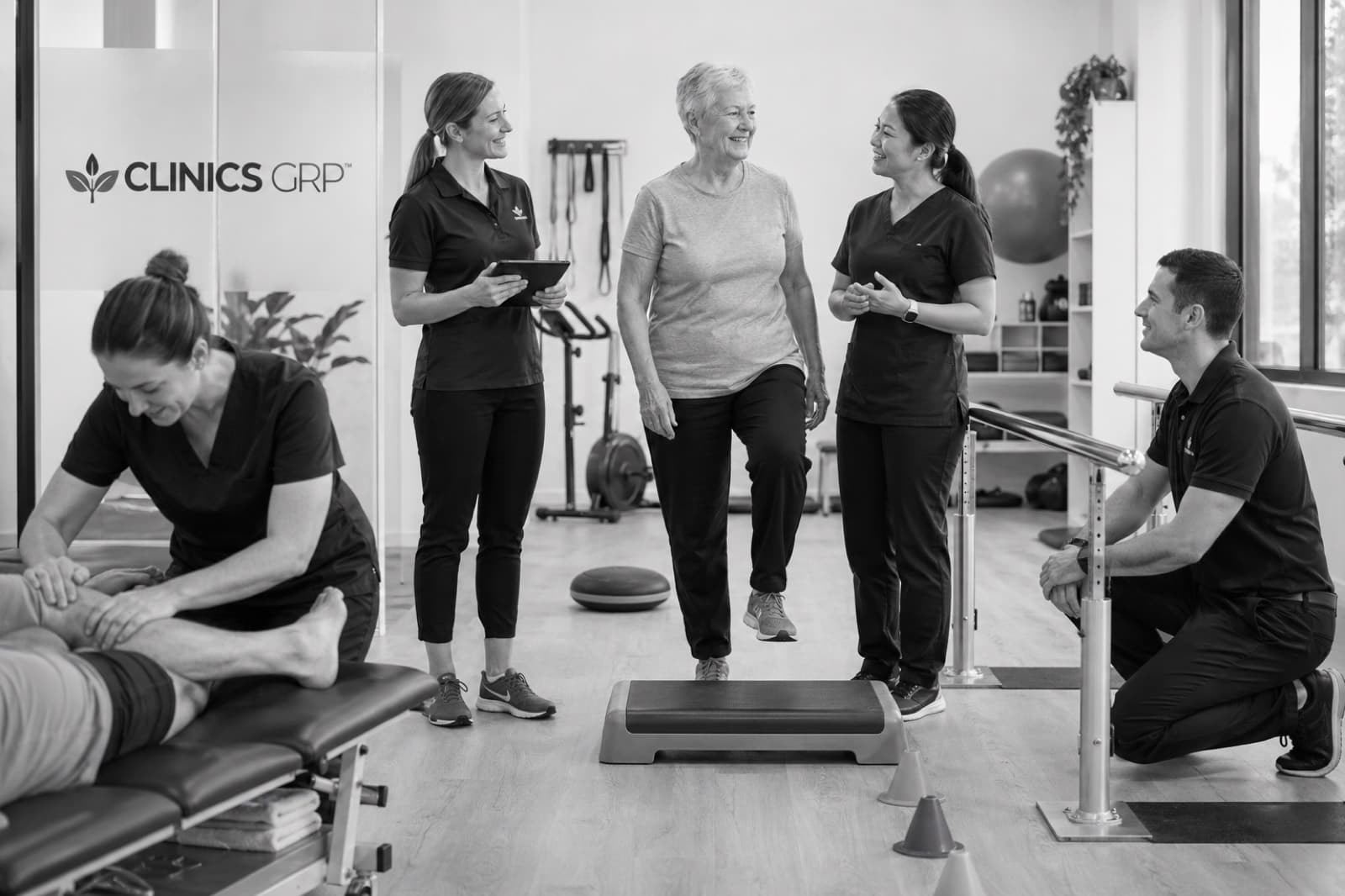
Older adult walking confidently with support from the Clinics GRP clinical team.

The evolution of our clinical approach

Three decades in the making

What began with understanding human performance gradually evolved into a deeper question: what allows people to retain, recover and rebuild meaningful capacity as they age?

The clinical thinking that now informs Clinics GRP began in the clinical practice and education of founder Miles Browning nearly three decades ago, initially through questions about human performance, movement and recovery. It has since evolved through clinical practice, team learning, evidence review, education and research collaboration into the approach Clinics GRP uses today.

01 · The original question

Human performance

The original clinical focus was human performance.

What allows a person to move, adapt, recover and perform at their best?

That question shaped years of clinical practice, observation, education and continued learning.

02 · Different responses

Variation and adaptation

Over time, another pattern became increasingly difficult to ignore. People with apparently similar problems did not always respond in the same way.

The same diagnosis could produce very different limitations. The same treatment could produce very different responses. And what could be seen on assessment was not always the same as what was causing the problem.

That changed the questions we asked. Rather than beginning only with “What is weak?” or “What exercise should this person do?”, the questions became broader.

  • What has changed?
  • Why might it have changed?
  • What is the person trying to get back to?
  • What appears to be limiting them?
  • And is what we are doing actually changing it?

Those questions gradually became central to our clinical approach.

03 · A question evolves

Understanding ageing

As our clinical work increasingly focused on older adults, understanding peak performance evolved into understanding how human capability changes across later life.

Age matters. Health conditions matter. Strength matters. So do previous injuries, recovery from illness, confidence, movement, environment, sensory information, cognition, behaviour and the demands of everyday life.

The challenge is determining what matters for the individual person in front of us. That is why Clinics GRP does not regard chronological age alone as an explanation for a new change in function.

Age is context. It is not the whole explanation.

04 · Connect care with life

Meaningful capacity

A clinical measurement can be useful. But improving a number is not the final purpose of care.

The questions that matter are often more practical: can someone get out of their usual chair, walk safely outside, manage their steps, return home after hospital, go shopping, travel or keep doing something that matters to them?

Can the person do more of the life they want to live?

Clinical care should connect what we measure with what a person needs and wants to be able to do.

05 · Continuing to question

Clinical reasoning today

An intervention is not simply something to complete. There should be a clinical reason for choosing it and some expectation of what should change if that reasoning is correct.

Progress is therefore reviewed. When the expected response occurs, the plan may progress. When it does not, that response is also information.

It may mean the plan needs to change, the person needs to be reassessed, another clinical discipline should become involved or further investigation is appropriate. Repeating the same care is not automatically the answer.

Today, Clinics GRP is built around older-adult clinical care across the clinic, home, community and supported-care settings.

Our approach continues to evolve through clinical practice, case review, clinician education, evidence appraisal, outcome measurement, research collaboration and continued questioning of our own assumptions.

Some ideas are supported by established evidence. Others remain developing clinical hypotheses that require further investigation. We distinguish between the two.

The thinking behind Clinics GRP

Understand the person. Understand the change. Decide what matters. Choose care for a reason. Review what happens next.

How care works

A clear five-step approach

The exact assessment and treatment differ by service, but the public care experience follows the same understandable sequence.

Select a step to explore the detail.

  1. Understand what has changed

    We begin with the person’s concerns, health context, everyday function and what they want to protect or regain.

  2. Look at the whole picture

    Assessment considers movement, health, confidence, environment and the supports around the person—not one symptom in isolation.

  3. Agree what matters now

    Together we identify practical priorities, including what needs attention first and what can be progressed safely over time.

  4. Choose a practical care plan

    Care is matched to the person, the service and the setting that makes the most sense now.

  5. Review progress and adapt

    We look for meaningful change in function, confidence and safety, then continue, adjust or guide the next step as needed.

What you can expect

Similar-looking problems may need different clinical responses

We consider what may be contributing to the person’s difficulties, explain the care plan and review whether it is helping.

Care principle

Understand what has changed

Changes in walking, balance, confidence, strength or everyday function help identify what needs further assessment. They do not automatically tell us why the change has occurred.

Care principle

Connect care with real life

Clinical measures are useful, but the purpose of care is to support meaningful activity, independence and participation wherever possible.

Care principle

Review the response

Treatment should have a clinical rationale and something we expect to change. When progress differs from what was expected, reassessment can help determine the appropriate next step.

Care is assessment-led and reviewed against meaningful changes in function, confidence and safety.

Across services

Different expertise, one clear approach

Each discipline contributes within its own scope while keeping the person’s priorities, safety and progress visible.

Physiotherapy

Movement, balance, strength, recovery and day-to-day function.

Nursing

Clinical follow-up, medication safety, monitoring, wounds and coordination.

Remedial massage therapy

Tissue-based support connected to comfort, movement and recovery goals.

Across settings

Care can move as needs change

The right setting depends on the person, the service and what will make care practical to continue.

inClinicinHomeinCommunityinCareDigital

Intake can help identify the most useful service and setting when the best starting point is not yet clear.

Behind the care experience

How we support this approach across clinicians and settings

Clinical triage, clinician capability, supervision and accountable review support the care you receive. Explore how these systems connect, including when additional expertise or escalation is needed.

Explore clinical quality and our care model →

Your next step

Start with what has changed

You do not need to know the exact service name. Tell our intake team what is happening and we will help guide the next step.