
Key points
- Repeated care may be the right plan when its clinical purpose and review point are clear.
- An unresolved concern across visits can signal that the question, goal or responsible clinician needs to be reconsidered.
- Review should include the older adult's priorities, the observed response, practical delivery and information from other care partners.
- A changed plan may continue, increase, reduce or redirect care; visit volume alone is not the outcome.
- New or serious deterioration must be escalated promptly rather than waiting for a scheduled plan review.
A visit can be completed exactly as planned and still leave the care team uncertain about the bigger picture. Perhaps the same concern returns at every appointment. Perhaps several workers are doing their parts well, but the older adult cannot explain what the whole plan is trying to achieve. Repetition itself is not evidence of poor care. Some nursing needs require dependable ongoing tasks. The signal for review is a pattern of activity without a clear account of purpose, response or next decision.
Our earlier article asks when a nursing assessment is more useful than another routine visit. This article takes the longer view. It examines what a team can learn from repeated tasks across weeks or care settings, how to distinguish valuable maintenance from drift, and how to revise a plan without automatically adding or removing visits.
A task record and a care plan answer different questions
A task record may say that a dressing was changed, observations were taken or a catheter check was completed. Those entries matter for continuity and accountability. A care plan asks more: why is this task being done, what is the intended benefit, what response has been seen, and what would make the team reconsider the approach?
The Australian Commission on Safety and Quality in Health Care's Comprehensive Care Standard links delivery of care to a goal-directed plan, monitoring whether that plan works, and reassessment when needs change.1 The Aged Care Quality and Safety Commission likewise expects assessment, coordinated clinical care and reassessment when an older person's condition or needs change.2 These standards describe organisational responsibilities. They do not dictate a fixed visit count for every person.
If a record contains many completed tasks but little comparison with the intended goal, that gap is worth discussing. It might be a documentation problem, a plan that needs updating or a clinical question that has never been answered. A review is a way to make those possibilities visible, not an assumption that staff have done something wrong.
Look for the pattern, not an arbitrary threshold
There is no safe universal rule that a certain number of visits means a plan has failed. A person may need recurring nursing care for a stable, well understood reason. Another person may need reassessment after only a few visits if symptoms change quickly. The meaningful trigger is the relationship between what was expected and what is happening.
Ask what the original referral sought to address. Has that issue improved, remained stable, worsened or been replaced by another concern? Have several visits generated the same unanswered question? Has the person begun missing valued activities because the care arrangement is difficult to manage? Have family, support workers or another clinician raised a change that the current plan does not capture?
These observations need to be interpreted together. A statement such as "there has been no progress" is incomplete without a starting point and an agreed outcome. Maintaining comfort or preventing deterioration may itself be a valuable goal. Conversely, a routine that looks stable on paper can miss a new difficulty in the person's everyday life.
Bring the older adult's goals back into the discussion
The service may have started after a hospital stay or a wound referral, but the person's main concern can shift. They may now value being able to wash safely, sleep without interruption, manage an appointment schedule or return to a social activity. Those priorities do not replace clinical judgement. They help determine whether the plan still addresses the problems that matter.
The Aged Care Quality and Safety Commission frames comprehensive care as person-centred, coordinated care that reflects the individual's goals and preferences.2 A useful review therefore invites the older adult to describe what has changed in their own terms. Where consent permits, a supporter may add observations from between visits. The team should avoid treating a family member's account as a substitute for the person's voice.
The conversation may reveal that a task is still needed but its timing or setting is difficult. It may reveal that two services are giving inconsistent advice. It may show that a GP, pharmacist, physiotherapist or other clinician needs to answer a question outside nursing scope. The review should bring those issues into one plan rather than letting every appointment solve only its own small piece.
Check whether information and responsibility connect
When several people are involved, repeated tasks can conceal a handover gap. A nurse may send observations to a provider. The provider may assume the GP has reviewed them. The GP may have received no clear question. Everyone has contributed, yet the concern remains open. A plan review should trace the information: what was noticed, to whom it was sent, whether a response was received, and who will act on it.
This is especially relevant after a change in medicine, function, cognition, wound status or continence. The nursing team can document and communicate what it finds, but diagnosis, prescribing and decisions outside nursing scope belong with the appropriate clinician. A revised plan should make that boundary and the next contact point explicit. The provider and care-team support pathway is relevant where several organisations need to coordinate.
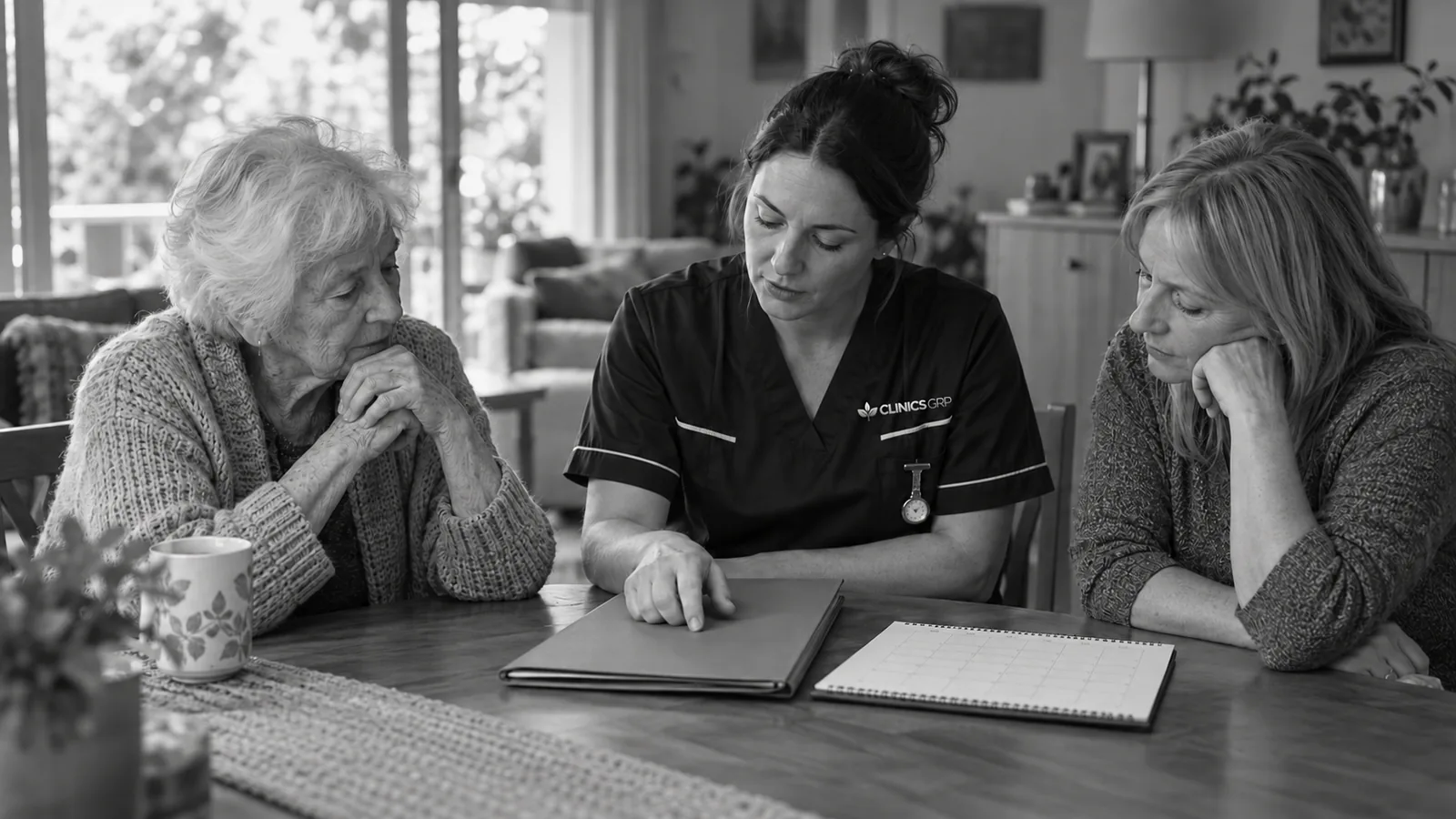
Consider a woman receiving recurring visits after an illness. Each task is completed. Over several weeks, staff hear that she is finding mornings harder, her daughter reports she is leaving the house less, and a support worker asks whether more nursing time should be booked. The pattern deserves a review of the changed function and its urgency, the original nursing goal and whether another assessment or medical advice is needed. It does not establish that more nursing, physiotherapy or a different diagnosis is automatically indicated.
What a useful review can produce
The review should leave an understandable account of current needs, what is known and uncertain, the goal of each continuing task, the owner of each unresolved question, the next review point and what change would trigger earlier contact. It may confirm the existing plan. It may adjust timing, introduce a different clinician, stop an unnecessary task or organise a new service. Each option needs a rationale that can be explained to the older adult.
The nursing assessment and care review pathway describes how Clinics GRP considers changing nursing needs. It is one part of Nursing care for older adults, not a promise that every issue can be resolved by nursing alone. Where mobility and health changes interact, nursing and physiotherapy working together explains the value and limits of coordinated input.
Do not use a planned review as a reason to delay urgent care. Sudden severe illness, chest pain, stroke symptoms, severe breathing difficulty or unresponsiveness needs emergency response: call Triple Zero (000). Other new or worsening concerns require medical advice at an appropriate urgency. Clinics GRP is not an emergency or 24-hour service.
The central question is simple: if the same work keeps being done, can everyone explain why, what it is achieving, and what happens if it no longer fits? A considered answer protects continuity without allowing routine to become the only reason for continuing.
Understand more
- When Is a Nursing Assessment More Useful Than Another Routine Visit?
- Nursing and Physiotherapy Working Together
Relevant care
References
- Australian Commission on Safety and Quality in Health Care. *Comprehensive Care Standard*, using and reviewing the comprehensive care plan. https://www.safetyandquality.gov.au/standards/nsqhs-standards/comprehensive-care-standard/developing-comprehensive-care-plan/action-510
- Aged Care Quality and Safety Commission. *Comprehensive care*, strengthened Aged Care Quality Standards, Outcome 5.4. https://www.agedcarequality.gov.au/strengthened-quality-standards/clinical-care/comprehensive-care