
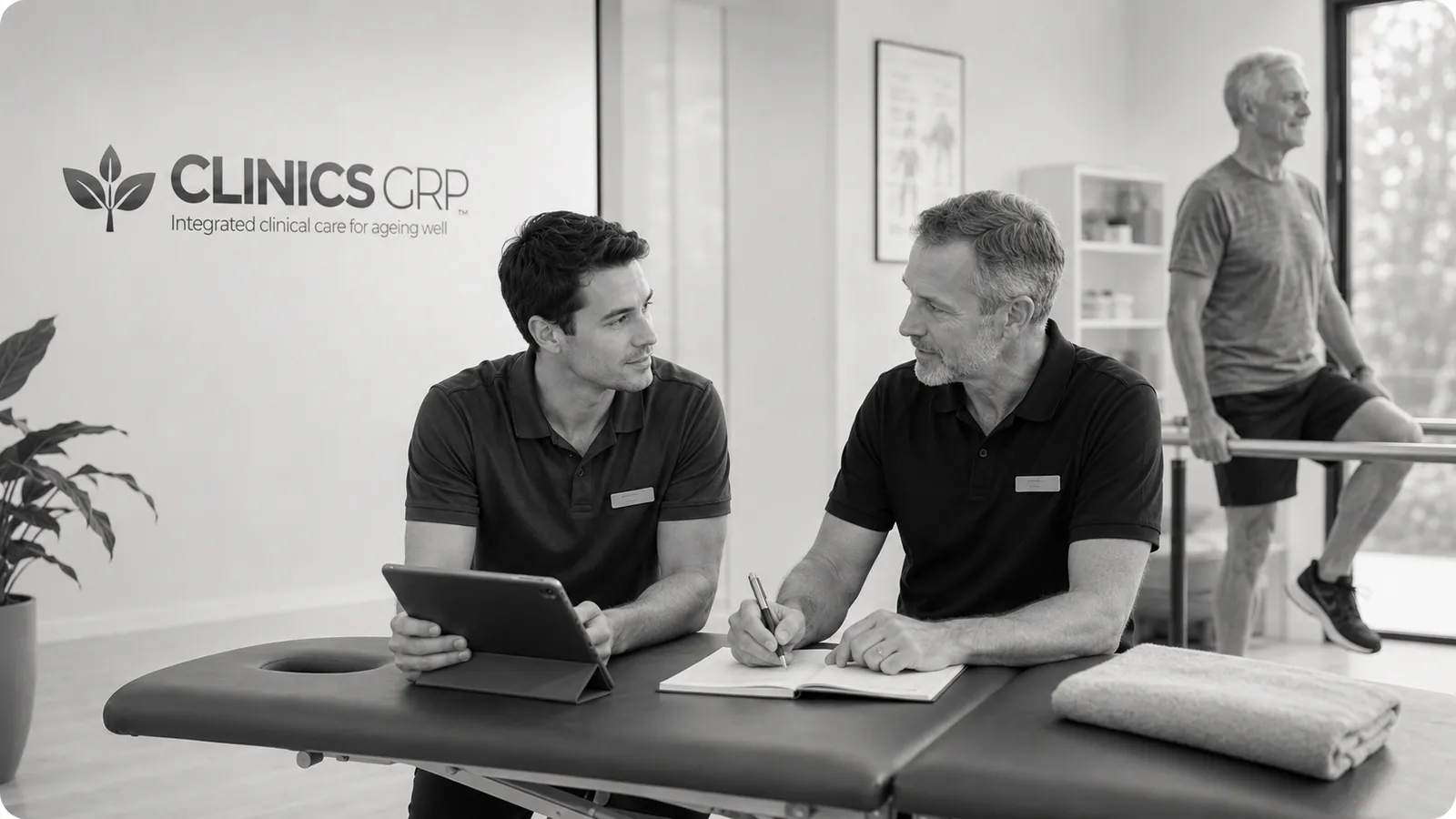
Finishing university does not mean you should be able to manage every patient, setting and professional demand without help.
It means you have met the entry standard for the profession. Your first workplace then has an important role: helping you translate that foundation into safe, reliable and increasingly independent practice.
Graduate advertisements often use the same words — mentoring, development, support and career progression. The more useful question is: what will that support look like during an ordinary working week?
Here are seven practical areas to examine before choosing your first physiotherapy role.
1. Is supervision scheduled and protected?
“Our door is always open” sounds reassuring, but informal availability is not the same as protected clinical supervision.
A strong program should tell you:
- who your supervisor will be;
- how often you will meet;
- whether the time is protected from clinical workload;
- how cases and goals will be reviewed; and
- who you can contact when you need help during the day.
Research with Australian new-graduate physiotherapists has found that accessible support, a suitable mentor, individualised guidance and some self-direction are important features of effective mentoring.
Good supervision should make it safe to discuss uncertainty. It should also provide honest feedback and clear expectations. Support does not mean avoiding accountability; it means having the structure to improve.
2. How will your caseload be introduced?
A graduate program should not be a full caseload with education added after hours.
Australian research into private-practice work readiness found that graduates can find autonomous clinical reasoning, timely caseload management, communication and administrative demands challenging. Transition was easier when graduates had fewer clients, longer consultations, access to experienced colleagues, mentoring and relevant professional development.
Ask whether the employer provides:
- observation before independent appointments;
- joint appointments for initial or complex cases;
- longer appointment or documentation time early in the role;
- a staged increase in workload; and
- capability checks before more complex work is allocated.
A calendar-based ramp assumes every graduate develops at the same rate. A capability-based ramp is safer and more useful: your responsibility increases as your assessment, reasoning, documentation and professional reliability become consistent.
3. Does learning reflect the work you will actually do?
Courses are useful when they improve the care you provide. A long learning library is less valuable if the content is disconnected from your caseload.
Look for a program that combines:
- practical workshops;
- case-based discussion;
- observation and feedback;
- simulation;
- clinical-note and report review;
- multidisciplinary learning; and
- opportunities to apply new knowledge soon after learning it.
For physiotherapists working with older adults, the curriculum should extend beyond a single body region. It may include balance and falls, gait, transfers, mobility aids, neurological conditions, post-hospital recovery, persistent pain, therapeutic exercise, cognition, communication and the influence of the home environment.
This breadth is not a distraction from clinical skill. It is what person-centred physiotherapy often requires.
4. Will you receive help with documentation and communication?
Clinical notes, reports, referral letters and conversations with families or referrers are part of clinical care.
Research into new physiotherapists’ transition to clinical documentation found variable levels of preparedness. Helpful workplace supports included opportunities to practise and reflect, protected documentation time, and access to templates and examples.
Ask how your employer will help you learn to:
- write clear and defensible clinical notes;
- document consent, risk and clinical reasoning;
- prepare useful reports and care plans;
- communicate concerns or deterioration;
- speak with families and carers respectfully; and
- manage difficult conversations or professional boundaries.
If a program teaches treatment techniques but ignores documentation and communication, it is not preparing you for the whole role.
5. Are clinical and operational support separated?
Your clinical supervisor and line manager may be the same person, but the functions are different.
Clinical supervision focuses on assessment, reasoning, treatment, risk and development. Operational support focuses on scheduling, travel, workload, systems, targets and leave.
In community physiotherapy, operational preparation is especially important. A graduate may need to learn how to plan travel, work safely in a person’s home, manage unfamiliar environments, contact the office, and escalate concerns when other team members are not physically nearby.
A good program makes both forms of support visible.
6. Will you be part of a cohort and a wider team?
One-to-one supervision matters, but graduates also learn from each other.
A cohort can provide peer discussion, shared problem-solving and reassurance that uncertainty is a normal part of transition. Multidisciplinary learning also helps graduates understand when another profession may be better placed to assist.
For older-adult care, that may mean working with physiotherapists, nurses, remedial massage therapists, exercise professionals, GPs, specialists, care coordinators, families and carers.
Look for regular huddles, case conferences, peer learning or group supervision — not just a social event at the beginning of the year.
One practical model is a Learning Pod: a small, consistent group connecting the graduate with a named supervisor, peers and experienced clinicians. The value is continuity. The group can revisit cases, follow through on feedback and help the graduate see how clinical reasoning, documentation, communication and escalation work together.
A Learning Pod should complement formal one-to-one supervision, not replace it. Graduates should still know who makes capability decisions, who holds clinical-governance authority and who they contact when a concern needs immediate escalation.
7. What happens after year one — and after the program?
A graduate pathway should make the transition between years as clear as the starting point. If a program runs for two years, the second year should deepen practice rather than simply repeat the first.
By the end of your first year, you should understand:
- the capabilities you have demonstrated;
- the areas that still need support;
- your emerging clinical interests;
- what will change in your second year; and
- how your next development plan will be agreed.
By the end of a second graduate year, you should also be able to show evidence of a sustainable caseload, sound clinical reasoning, reliable documentation and follow-up, appropriate management of complexity, and a defined contribution to team learning or quality improvement.
Career progression does not need to mean management. It may involve deeper clinical practice, clinical education, research, quality improvement, service development or future leadership.
The best next step is the one that fits your capability and the type of physiotherapist you are becoming.
Be cautious of pathways that treat attendance, enthusiasm or time served as evidence of leadership readiness. Supporting students or peers can be valuable development, but formal supervisory and leadership authority should follow demonstrated capability, clear role boundaries and formal appointment.
Questions to take to an interview
Use these questions to move past general claims:
- How much one-to-one clinical supervision will I receive, and is it protected?
- Who is available if I need immediate advice during an appointment or home visit?
- What will my caseload look like in weeks 1, 4, 8 and 12?
- How are observation and joint appointments organised?
- How will my clinical notes and reports be reviewed?
- What capabilities determine when my caseload or complexity increases?
- What support is provided for travel, scheduling and administration?
- How do graduates learn with peers and other disciplines?
- Is there a consistent Learning Pod, mentor group or case-review team, and how does it connect with formal supervision?
- How is supervisor quality monitored?
- If the program extends into a second year, how does that year differ from the first?
- What evidence or capability review determines my pathway after the program?
Clear answers are a good sign. If the program cannot explain how support works, ask to speak with a current or recent graduate before deciding.
The Clinics GRP approach
The Clinics GRP New Graduate Physiotherapy Program is a structured two-year, work-based program in Brisbane for physiotherapists supporting older adults. GPY1 is the entry year and supports the transition into safe, reliable practice. GPY2 follows for graduates progressing from GPY1; it is not a separate intake or position.
The support structure includes a named clinical supervisor, protected one-to-one time, a consistent Learning Pod, a graduate buddy, structured capability reviews and clear escalation. Observation, simulation and joint appointments come before greater independence, with caseload and complexity increasing according to demonstrated capability rather than time alone.
GPY1 moves through foundations, supported practice, integration, capability and consolidation. It concludes with a capability review, development portfolio and a clear GPY2 plan. GPY2 retains structured supervision while the graduate consolidates a sustainable caseload, manages greater complexity, builds depth in an agreed area of older-adult physiotherapy and makes a bounded contribution through peer education, audit or quality improvement. The final GPY2 review and evidence portfolio inform the next stage of development.
Clinical learning reflects whole-person older-adult care. It includes areas such as balance and falls, gait and mobility, therapeutic exercise, post-hospital rehabilitation, neurological, vestibular and musculoskeletal care, documentation, coordinated communication, and sustainable time and travel management. Depending on the appointed role and service availability, experience may span relevant inHome, inClinic, inCommunity and inCare settings.
Our expectation is not that a graduate arrives as a finished clinician. We look for safety, coachability, reliable teamwork and visible growth. Our responsibility is to provide the structure and feedback that allow those qualities to develop into capable practice.
Current 2027 GPY1 opportunity
Applications are open until filled for at least four permanent, full-time GPY1 New Graduate Physiotherapist positions, with capacity to appoint a fifth. The roles are 38 hours per week and are expected to commence in January or February 2027. Home and community travel is required, and visa sponsorship is not available.
Applicants need a recognised physiotherapy qualification and current or pending eligibility for AHPRA registration before commencement. The advertised position sets out the complete requirements. Selection involves an initial interview, a second interview and final selection by the Clinical Director. Clinics GRP also provides a narrated GPY1 interview guide to help applicants understand the evidence and examples expected in the process.
Explore the two-year graduate program and current GPY1 opportunity
Submit a formal GPY1 application
References
- Wells C, Olson R, Bialocerkowski A, et al. Work readiness of new graduate physical therapists for private practice in Australia. Physical Therapy. 2021;101(6):pzab078.
- Chipchase L, Papinniemi A, Dafny H, Levy T, Evans K. Supporting new graduate physiotherapists in their first year of private practice with a structured professional development program. Musculoskeletal Science and Practice. 2022;57:102498.
- Forbes R, Lao A, Wilesmith S, Martin R. An exploration of workplace mentoring preferences of new-graduate physiotherapists within Australian practice. Physiotherapy Research International. 2021;26(1):e1872.
- Wilesmith S, Mandrusiak A, Martin R, Lu A, Forbes R. Writing for the role: a qualitative exploration of new graduate physiotherapists’ transition to practice of clinical documentation. Physiotherapy Theory and Practice. 2025;41(1):115–127.