
Hospital-to-Home Clinical Transition Pathway

Hospital-to-Home care for older adults in Brisbane

Leaving hospital is not the end of care. Clinics GRP brings nursing, physiotherapy and rehabilitation together around the transition home — through one referral and one clinical pathway.

Intake confirms clinical suitability, coverage, funding and appointment timing before care starts.

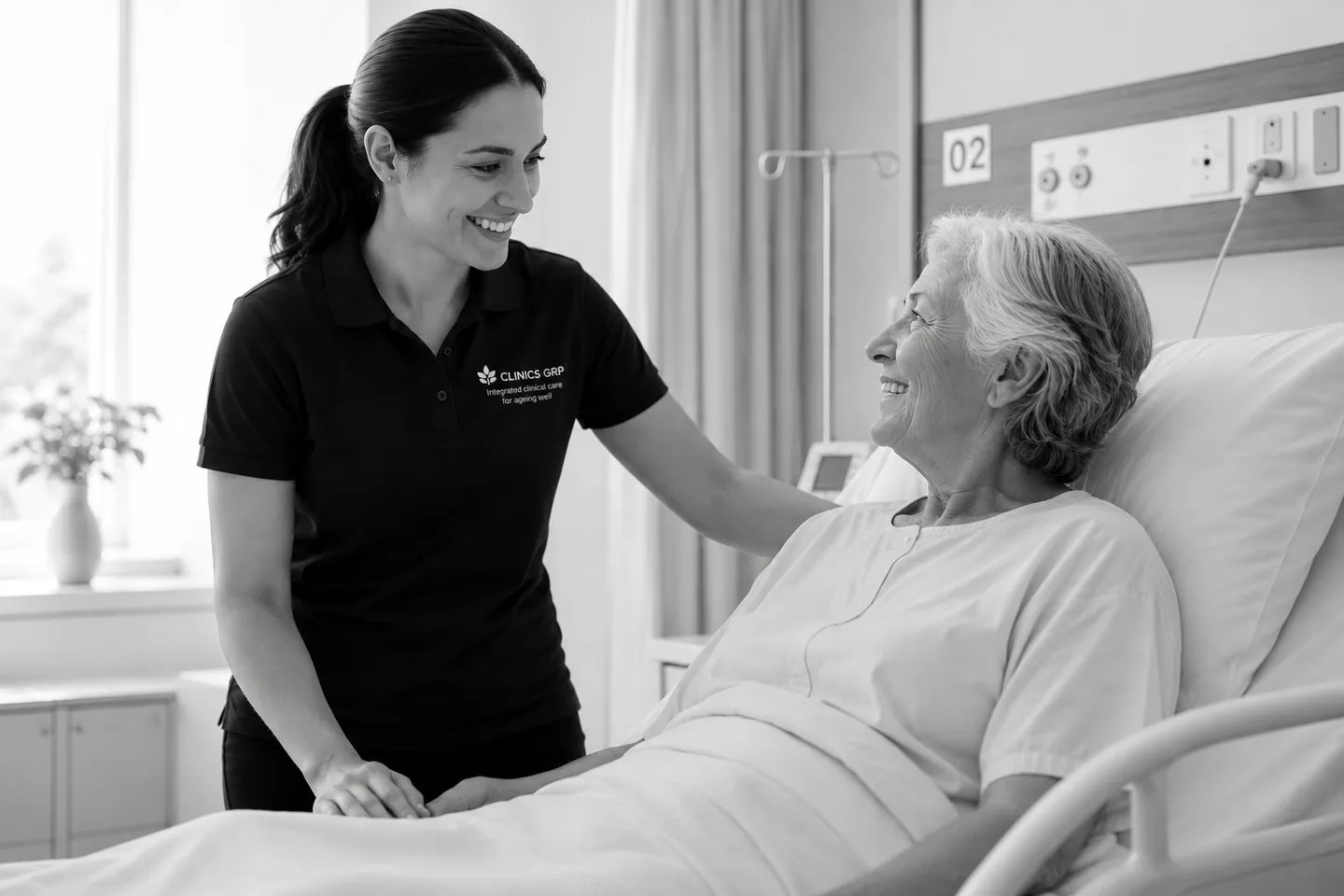
A clinician supporting an older adult during the transition from hospital.

Hospital-to-Home response

Referral acknowledged same business day. Clinical triage by the next business day. Urgent care by the next business day and routine care within 3 business days, subject to clinical suitability and availability.

Business hours are 8:00 am–5:00 pm, Monday–Friday, excluding public holidays, in Brisbane time. Referrals received outside these hours are treated as received on the next business day. Response timeframes run from receipt during business hours.

Urgent care is subject to clinical suitability and service availability. Clinics GRP is not an emergency service; acute or unstable presentations require urgent medical assessment.

Reporting, review and escalation throughout care →

The Hospital-to-Home pathway

One connected journey.
Care that moves with you.

From the first referral to recovery at home, explore how each stage connects—and who helps along the way.

Your clinical lead, care team and follow-up arrangements are confirmed during intake and assessment. “First 72 hours” is an early-care planning focus; assessment timing is agreed individually.

View the journey from your perspective

One referral. One clinical transition lead. A coordinated pathway to the next level of care.

Your pathway, step by step

Select a stage · Swipe to explore

01 · Prepare for home02 · Settle safely at home03 · Recover & continue
Prepare for homeStage 1 of 7Proposed owner: Intake

Stage 1 of 7: One referral starts the pathway

One referral starts the pathway

The hospital, provider, GP, family or older person sends one referral. They do not need to determine whether the person requires physiotherapy, nursing or another component of care before referring.

What happens

  • referral received
  • discharge information gathered
  • provider/funding details identified
  • discharge summary or other relevant documents attached
  • proposed Hospital-to-Home episode and accountable lead confirmed after acceptance

Intended output

  • single clinical episode
  • documents centralised
  • ready for clinical triage

Why this stage matters

Removes the need for multiple discipline-specific referrals and creates one accountable entry point.

What we measure

Service evaluation is active. The measures below support review of clinical progress, function and service utilisation. These measures describe progress and utilisation; they do not establish that Clinics GRP prevents readmissions.

  • Referral-to-acknowledgement time
  • Discharge-to-first-clinical-contact time
  • Mobility / transfer status
  • Falls and near falls
  • Functional goal attainment
  • Clinical escalations
  • ED presentations / hospital readmissions where known
  • Home-to-clinic/community progression
  • Episode duration
  • Clinical hours / service utilisation
Funding and provider arrangements

Services, fees, eligibility and provider authorisation are confirmed individually. This pathway is separate from government Transition Care and Restorative Care programs. Read funding and coverage information.

For individuals and families

We’re home. What happens now?

Tell intake what has changed since hospital and what is difficult at home. You can ask for help without knowing which clinician is needed.

The pathway may suit older adults with reduced mobility or confidence, difficulty with transfers or everyday activities, or nursing follow-up needs after an admission. A referral is a request for review; it does not confirm that care is booked.

Before leaving hospital

  • Ask for your discharge summary and follow-up instructions.
  • Confirm the discharge address, equipment and help available at home.
  • Share the hospital’s advice about mobility, wounds, devices and medication support.
  • Ask the team to check your understanding of the plan and include your chosen carer or support person with your consent. Know who to contact if your condition changes, and confirm appointments with each service.

Keep following your treating team’s discharge instructions. This referral service is not monitored for emergencies. Call 000 in an emergency; seek prompt medical review for deterioration.

Early days at home

Restorative care pathways after hospital

For older adults exploring restorative care pathways in Brisbane, the focus is rebuilding everyday function and independence after hospital. Hospital-to-Home connects assessment, nursing and rehabilitation around the person’s needs and goals.

The proposed Hospital-to-Home Transition Plan records the main priorities, who is involved, agreed follow-up and the next review. Recovery may continue through home rehabilitation, clinic or community exercise, clinically delegated assistant support, or ongoing provider care.

For providers and hospital teams

Clinical capacity for supported discharge into the home

One referral connects community nursing, physiotherapy, functional assessment and reablement around the person leaving hospital. Hospital and provider teams can request coordinated clinical input for a time-sensitive transition.

Functional assessment considers what the person can manage at home, including walking, transfers and everyday activities. Reablement focuses on the person’s goals, rebuilding those activities and adjusting support as needs change.

For time-sensitive discharge, contact intake with the proposed date, immediate risks and available support. Acceptance and the first visit must be confirmed; retain the hospital’s discharge and escalation arrangements until the receiving team agrees the plan.

Provider arrangements can define a contact, escalation process and progress reporting. Reserved capacity, response standards and commercial terms need agreement before they can be offered.

Hospital discharge referral information

Funding and Brisbane coverage

Tell intake about your Support at Home provider, private funding, Medicare or other arrangements — or select unknown. Eligibility, covered services, fees and any provider authorisation must be confirmed for your circumstances.

Clinics GRP Hospital-to-Home is a clinical service pathway. It is separate from the government Transition Care Program and Support at Home Restorative Care Pathway. Those programs have their own assessment and eligibility rules; access to one does not establish access to the other.

Home visits depend on suburb, clinical need and availability. Our Brisbane clinics in Coorparoo, Yeronga and Taigum also provide options as recovery progresses.

Frequently asked questions

Questions about care after hospital

How do I arrange care after hospital discharge in Brisbane?

You, a family member, your hospital team, GP or care provider can send a Hospital-to-Home referral. Include the discharge date, address, contact details and main concerns, with the discharge summary if available. Intake confirms clinical suitability, funding, coverage and appointment timing before care starts.

Can one referral include nursing and physiotherapy after hospital?

Yes. Describe the person’s needs and select nursing, mobility or rehabilitation concerns where relevant. If you are unsure which clinician is needed, ask intake to triage. The clinical team and scope of care are confirmed following review.

Can rehabilitation start at home and continue at a Brisbane clinic?

Care may begin at home when mobility, recovery or access makes a home visit appropriate. As needs change, the treating clinician can discuss clinic or community rehabilitation. Clinics GRP has clinics in Coorparoo, Yeronga and Taigum; home visits depend on suburb, clinical need and availability.

How soon can the first home visit happen?

Share the discharge date and urgency with intake. The first appointment must be confirmed according to clinical need and clinician availability. The first 72 hours is a planning focus, not a guaranteed visit window. A submitted referral does not confirm a booking or acceptance of a discharge plan.

How do restorative care pathways relate to Hospital-to-Home?

Restorative care focuses on rebuilding function and independence. Clinics GRP Hospital-to-Home brings assessment, nursing and rehabilitation together after discharge. It is separate from the government Transition Care Program and Support at Home Restorative Care Pathway. Intake must confirm clinical suitability, funding and provider arrangements; a referral does not establish government program eligibility.

Is this a Hospital in the Home service?

No. Hospital in the Home provides hospital-level treatment under a hospital service. This Clinics GRP pathway coordinates community nursing and rehabilitation after discharge. It does not replace hospital-level acute care, emergency care or the treating team’s discharge instructions.

Refer directly

Refer for Hospital-to-Home review

Complete your referral here. Hospital-to-Home and care at home are already selected. You can attach the discharge summary and review your details before sending.

Cloudflare Turnstile and server-side security checks protect this form. After a successful submission, your confirmation displays a referral reference code to keep for follow-up with intake.

A referral requests an intake review; it does not confirm an appointment. Appointment timing, coverage and funding need confirmation by intake.

01

Step 1 of 3

Referrer and client

Tell us who is making the referral and who requires care.

Referrer details

Client details

Enter the full address where the home visit may be required.

Required fields must be completed to continue.

Connected services

Explore the support around your transition

Read our guide to how Clinics GRP connects services around one person, including recovery after a hospital admission.

Evidence base and review status

The pathway’s design is informed by research into discharge planning, multidisciplinary transitional care, home assessment, carer involvement and rehabilitation after hospitalisation. The studies below inform how care is connected and tailored.

Results vary by population, clinical condition and programme. This research does not establish that the Clinics GRP Hospital-to-Home service prevents readmissions or achieves the outcomes reported in these studies. Direct evidence for this pathway’s specific assistant-supported step-down model remains limited.

Clinical evidence informing pathway design

Coordinated multidisciplinary transition

Across 49 trials involving 25,566 adults with complex care needs, pooled readmission risk was lower with multidisciplinary transitional care (RR 0.88; 95% CI 0.80–0.96). Certainty was low because results differed between studies and publication bias was possible.

Relevance and limits: Supports coordinated transition as a design principle; it does not predict an individual’s outcome or prove this service reduces readmissions.

Collet et al. · The Gerontologist · 2025
Individualised discharge planning

For medical admissions, personalised discharge planning slightly reduced hospital stay and readmission over about three months (RR 0.89; 95% CI 0.81–0.97; moderate-certainty evidence).

Relevance and limits: Informs preparation and transfer of care. A single referral is an operational choice, not an independently proven intervention.

Gonçalves-Bradley et al. · Cochrane · 2022
Continuity for people living with frailty

This review identified person-centred, tailored and continuous care, a small team, follow-up and carer involvement among components of transitional care models.

Relevance and limits: Informs the proposed clinical lead and shared plan; the effect of each individual component cannot be isolated.

Leithaus et al. · International Journal of Integrated Care · 2022
Assessment across function, health and home

A review of 22 trials in at-risk older adults found a small improvement in function with home-based comprehensive geriatric assessment at 6–24 months (SMD 0.17; 95% CI 0.09–0.25).

Relevance and limits: Supports looking beyond one discipline. Clinics GRP’s early home review is not a formal Comprehensive Geriatric Assessment and does not reproduce the full intervention studied.

Hayes et al. · Journal of the American Geriatrics Society · 2025
Patient and carer involvement

Trials integrating informal carers into discharge planning reported fewer readmissions at 90 and 180 days than usual care.

Relevance and limits: Informs checking understanding of the plan and involving the person’s chosen support people, with consent. These findings are not service-level outcome claims.

Rodakowski et al. · Journal of the American Geriatrics Society · 2017
Rehabilitation matched to assessed needs

Ten trials of home exercise after hospitalisation found improvements in some measures of daily activity, mobility and quality of life, depending on the comparison.

Relevance and limits: Supports considering individually prescribed rehabilitation; it does not establish that every person benefits from the same exercise package.

Lin et al. · Clinical Rehabilitation · 2022
A limitation: extended exercise is not universally beneficial

In 740 older people with frailty, the extended home exercise programme did not improve the primary physical quality-of-life outcome at 12 months and was not cost-effective.

Relevance and limits: This cautions against routine extended exercise for everyone after discharge. It does not validate Clinics GRP’s alternative model; assessment, reassessment and service evaluation remain necessary.

HERO randomised trial · Age and Ageing · 2026

Australian clinical guidance

The Australian Commission on Safety and Quality in Health Care emphasises communication at transfers, agreed goals, patient and carer involvement, structured handover and continuity of medicines information. These are design references, not a claim of accreditation or endorsement.

Program and policy references

The government Transition Care Program and Restorative Care Pathway have separate eligibility and funding rules. These references explain program context, not this service’s effectiveness.

Clinics GRP Hospital-to-Home does not provide Hospital in the Home or replace hospital-level acute care. HITH research is not used here as evidence of this pathway’s efficacy.

Review status: Reviewed and approved by the Clinics GRP Clinical Review Team on 7 September 2026. This is an evidence-informed service description, not a validated clinical protocol.

Service evaluation is active. Clinical, functional and service measures are used to review the pathway. Active evaluation does not establish that the service reduces readmissions or achieves the outcomes reported in published studies.

Arrange care directly with our clinical team

Explore self-funded care in our clinics, at home and across appropriate care settings. You do not need a Support at Home plan. Clinical suitability, availability and any applicable rebate requirements are confirmed before care begins.

Explore Private Care →