
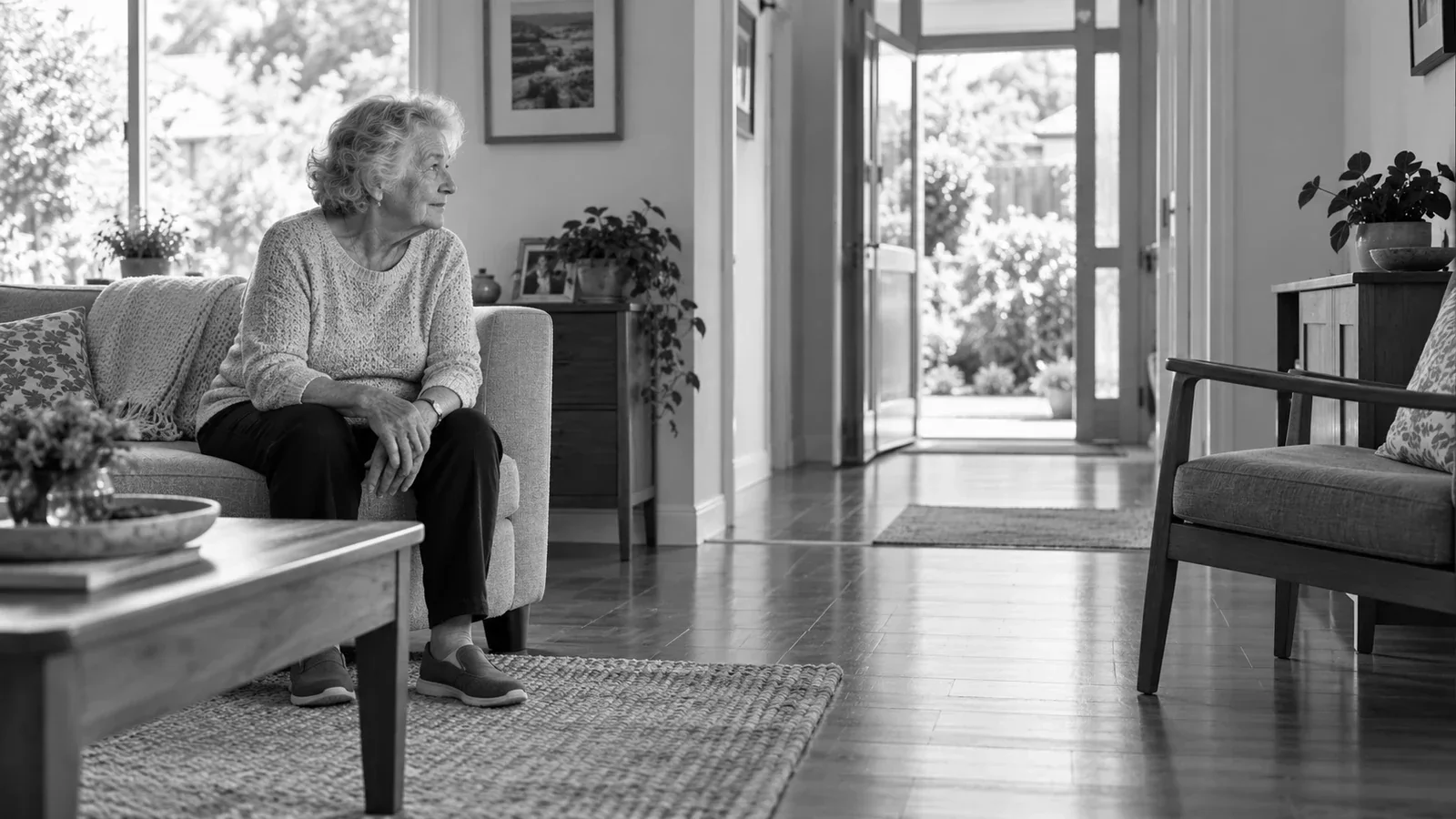
A clinic, a home, a community place and a supported-care setting are not interchangeable. Each makes different things possible to observe, practise and coordinate. The choice should follow the person's concern rather than a rule that one setting is always better.
The Ageing in Full perspective starts in real life. A person may manage a step in a clinic but struggle with the uneven path outside their home. Another may benefit from clinic equipment or a quieter assessment space. The question is where care can best understand and support the task that matters.
Key points
- Choose a setting for the clinical question and everyday task, not by label alone.
- Home visits can reveal environmental and support factors that a clinic cannot show.
- Clinic and community settings can each offer useful opportunities.
- The setting may change over an episode of care; it is not a required sequence.
When a clinic is useful
A clinic may offer space and equipment for particular assessments and treatments. It can make repeated measures easier and allow focused practice away from distractions. For someone who can travel comfortably, this may be the right starting point. The clinician should still ask how the measured task relates to life outside the clinic.
When home or another real setting matters
A home visit may be useful when travel is difficult, when the concern arises in a specific room or routine, or when equipment and support need to be seen in context. Community-based care may help when the relevant task is entering a shop, walking on a particular surface or joining an activity. A supported-care setting may require coordination with people who assist day to day.
The World Health Organization defines rehabilitation in relation to functioning in interaction with the environment.1 Its ICOPE guidance also considers social care and support needs in a personalised plan.2 Those principles support choosing a setting that reveals the problem and helps practise a useful response.
Moving between settings
A person may begin at home and later attend a clinic, or begin in a clinic and then need to practise in a real-world setting. Someone else may stay in one setting throughout. Digital information, booking and communication can support the work across settings, but they do not automatically replace an in-person assessment or treatment when that is needed.
Availability, coverage, funding and the person's preferences also matter. Intake should confirm what is possible. The clinical decision should remain open to review if the chosen setting is not helping with the intended task.
Keep the person's choice visible
The most convenient setting for a service is not always the most useful for the person. Ask what care there is meant to achieve, what the person can manage, and how progress will be judged. A setting is a tool for care, not an outcome in itself.
Match the place to the question
The setting should make the assessment more useful. If the question is how a person moves through a particular doorway or gets up from their own chair, seeing the home may reveal details a clinic cannot. If the question requires a controlled test, equipment or a quiet space to learn a new movement, a clinic may be more suitable. A community setting can show what happens on the route to a shop or activity. No place is automatically the most person-centred; the choice depends on what the care needs to discover or change.
Ask which part of the task is difficult and where it happens. Is the challenge a low chair, a narrow passage, uneven ground, the distance between rest points, or the demands of a busy place? Does the person move differently when someone is present? A clinic observation can be a useful first clue, but it may not reproduce the whole situation. A home visit can reveal the actual set-up, yet it may not offer the equipment or space needed for every intervention.
WHO describes functioning in the context of the person's environment.1 This supports looking beyond a diagnosis or a score. It does not imply that every assessment must happen at home. A clear clinical question should guide the setting and the information collected there.
Consider travel and the cost of attending
Travel is part of the care burden. Getting to a clinic may be straightforward for one person and exhausting or impractical for another. Transport, parking, stairs, a support person's availability and the effect of a long outing can change whether an appointment is worthwhile. These factors deserve discussion when choosing care, even if the clinic would be clinically useful.
Home care can remove a travel barrier, but it has its own limits. The home may be crowded, noisy or lack safe space for a particular assessment or practice. A person may also prefer privacy away from family members or housemates. The clinician should ask permission before involving others and explain what the visit will cover. The person's preference is relevant alongside the clinical task and service availability.
Digital check-ins or written plans may support communication between visits. They cannot show every movement, resolve all safety concerns or replace an in-person assessment when that is needed. A remote option should be chosen because it can answer the current question, not merely because it is easy to schedule.
When care crosses settings
An episode may move from home to clinic, or from clinic to a real-world task. Such a transition should have a reason. Perhaps the person first needs an assessment in a familiar environment, then later benefits from supervised practice with equipment. Perhaps a measured clinic gain has not carried over to the steps outside the home, prompting a visit there. The person should understand what each setting adds.
Information should move with the care. If another clinician takes over, the handoff should explain the goal, relevant findings, what has been tried and what remains uncertain. A person should not have to reconstruct the plan at every new appointment. Consent and privacy arrangements still apply, particularly across organisations.
A supported-care setting introduces other people into the day-to-day task. Staff may know how the person usually transfers, walks or manages routines. Their observations can be useful, with the person's consent and voice kept central. The treatment plan should fit the actual support available. A technique that can only be carried out when a visiting clinician is present may not solve the daily problem.
Judge the setting by what it helps the person do
At review, ask whether care in this place has changed the intended task. Has the person learned a movement that works at home? Has a home visit identified a practical barrier? Has community practice made a chosen outing more manageable? If not, the setting or method may need to change. A convenient appointment location is not itself an outcome.
Funding, coverage and appointment availability can constrain the options. The service should explain these honestly and help the person understand what is possible. It should not describe an unavailable setting as the only clinically valid choice. The plan can still identify the most important question and use the available route thoughtfully.
The Ageing in Full perspective keeps ordinary life in view. A person may value attending a clinic because it offers focus and social contact. Another may prefer to work in the home where the difficulty actually happens. Neither preference is trivial. The decision should combine clinical reasoning with the person's experience, and it should be revisited when the answer is no longer serving their goal.
References
- World Health Organization. Rehabilitation. 2024. https://www.who.int/news-room/fact-sheets/detail/rehabilitation
- World Health Organization. Integrated care for older people: guidance for person-centred assessment and pathways in primary care, 2nd edition. 2025. https://www.who.int/publications/i/item/9789240103726