
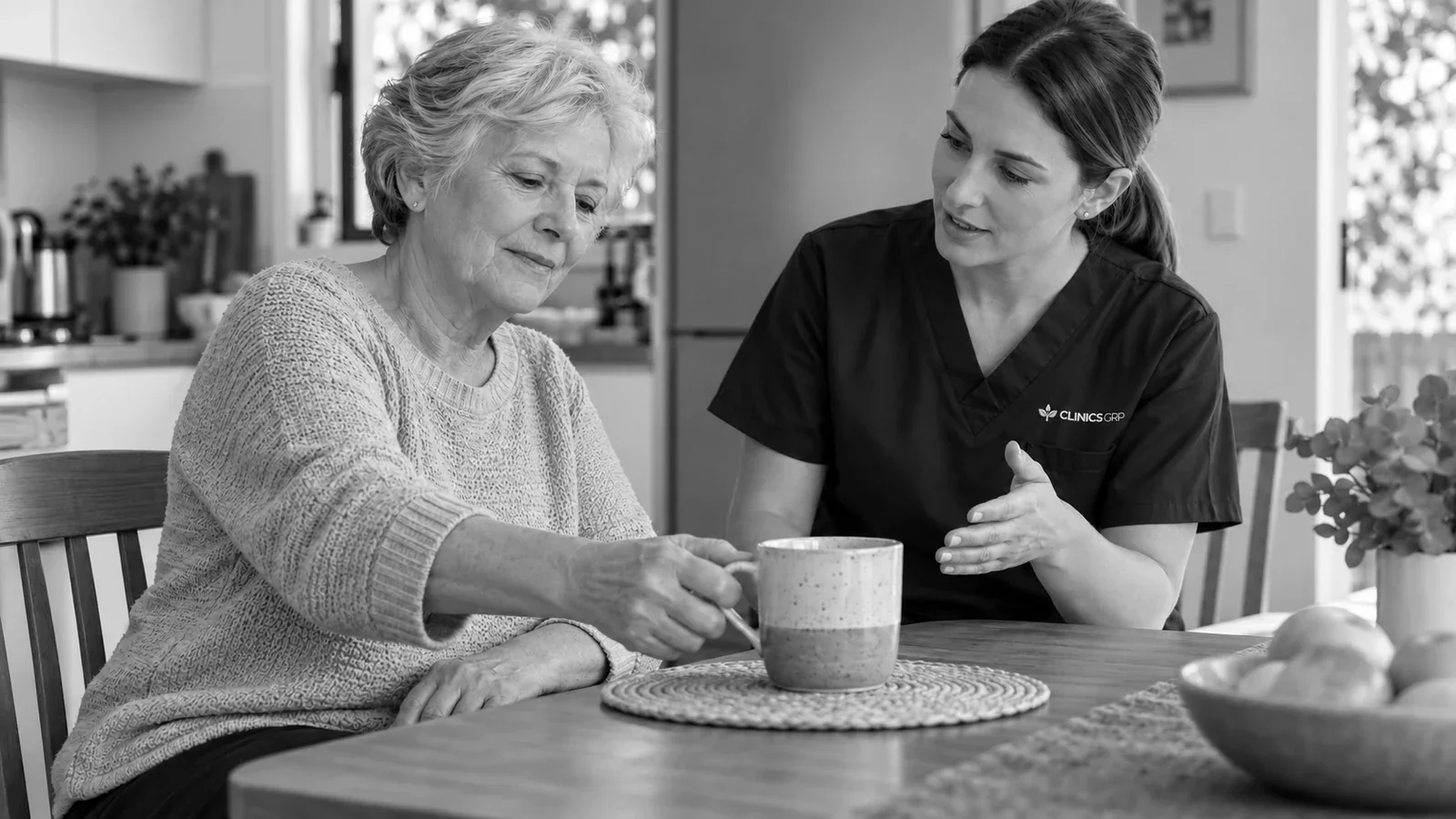
Pain can make an ordinary task feel uncertain. Someone may still be able to climb stairs, but now avoids them because each step hurts. Another person may complete the shopping but need the rest of the day to recover. A useful assessment asks about the pain and the activity it is changing.
The Ageing in Full perspective does not require a person to “push through” to prove resilience. It also does not assume that pain means all movement should stop. The aim is to understand what is happening, what matters to the person and which options are suitable for this particular situation.
Key points
- Pain intensity is only one part of the picture; timing, behaviour and effect on activity matter.
- A diagnosis may help guide care, but it does not describe a person's whole experience.
- Treatment, practice, adaptation and medical review can each have a place depending on the assessment.
- The plan should be reviewed against a task or outcome the person values.
Ask what pain has changed
A clinician may ask where pain is felt, how it began, whether it varies, what makes it worse or easier, and how it affects sleep or activity. They may examine movement and strength and consider health history and recent changes. A task such as rising from a chair may show how pain, weakness, joint movement and confidence interact.
That task matters because the goal might not be “zero pain” before life can continue. For one person the priority is to prepare a meal; for another it is to visit a friend. This does not minimise pain. It keeps the care plan tied to an outcome that the person can recognise.
Treatment should fit the explanation
Osteoarthritis is one example where evidence-based guidance recommends tailored therapeutic exercise and information as core care, with manual therapy considered for hip or knee osteoarthritis only alongside exercise.1 This guidance does not mean every pain problem is osteoarthritis or that the same programme suits everyone. Assessment must consider the actual condition and the person's circumstances.
A physiotherapy plan may include education, graded movement or task practice, strength work, adaptation, or hands-on care where it is appropriate. It may also require input from a GP or another clinician. The purpose of each part should be clear. If a treatment feels helpful during an appointment but does not change the task that matters, that is useful information for review.
Keep room for choice and revision
Australian shared-decision guidance describes a process that combines evidence with the person's values, preferences and circumstances.2 This includes honest discussion of uncertainty, effort and alternatives. A person may choose a smaller or different goal when the original one no longer fits. That choice should not be treated as giving up.
If pain changes rapidly, becomes severe or does not fit the current explanation, seek appropriate medical review. A physiotherapist should be willing to reconsider the plan rather than repeating treatment by habit.
Make the task specific
Pain can interrupt a task in more than one way. A person may avoid standing long enough to cook, need help to get into a car, or stop visiting a friend because the walk from the bus is too demanding. The location and intensity of pain matter, but they do not tell the whole story. Ask what the person has changed in response: the distance, the route, the pace, the equipment, the amount of help, or the decision to leave the task undone.
This detail gives care a practical target. “Walk without pain” may be an important hope, but it may not be the first useful milestone. A shorter walk with a rest, an easier way to enter the car, or enough comfort to prepare a meal can be meaningful. The person should choose which of these outcomes matters; a clinician should not assume that the most measurable one is automatically the most valuable.
Pain also has a time course. Is it new or long-standing? Does it settle after a particular activity, persist through the night, or vary with stress and fatigue? Has there been an injury or another health change? A physiotherapist can ask these questions to guide assessment and decide whether another medical opinion is needed. No website can interpret a new or severe symptom for an individual.
What can treatment reasonably aim to do?
The purpose of treatment should be explicit. Education may help a person understand a condition and weigh options. Movement practice may address a task that has become difficult. Strength work may support capacity when assessment suggests that it is relevant. Equipment or a change to the task may reduce the demand. Hands-on treatment, where appropriate, should have a clear role within the wider plan rather than become an automatic repeat appointment.
For osteoarthritis, NICE guidance identifies therapeutic exercise and information as core treatments, with the type and dose adapted to the person.1 That is guidance for a defined condition. It is not evidence that every pain problem needs the same exercise, or that more exercise is always better. A clinician should explain which evidence applies, where uncertainty remains, and how the plan will respond to the person's symptoms and preferences.
Some people worry that any painful movement signals damage; others have been told to ignore pain altogether. Neither rule is reliable for every condition. The safe and useful level of activity depends on an assessment. The plan should include a way to notice whether a task is becoming easier, whether symptoms are settling as expected, and whether the activity is still acceptable to the person. If the response is unexpected, it is a reason to review the reasoning.
Keep the person in the decision
Shared decision-making means more than offering a menu of treatments. The clinician brings evidence and a clinical explanation; the person brings experience of the task, acceptable effort, worries and priorities.2 A choice may involve trade-offs. A home programme might fit a person's routine but feel lonely or difficult to remember. Supervised appointments might help confidence but require transport. An adaptation might preserve an outing even while pain remains. Discussing those realities makes the choice more honest.
Pain can affect sleep, mood and participation. It is reasonable to say so. That information can change the plan and may point to another clinician's contribution. It does not make the pain “only psychological.” Equally, a diagnosis on a scan does not settle the meaning of the symptom or dictate a single intervention. The assessment should hold physical findings and lived experience together.
The Ageing in Full principle is that a person's dignity and purpose do not depend on a pain score. A goal may be to do more, to keep doing something, or to find another way to participate. The choice can change over time. Someone who first wants to regain a previous walking distance may later decide that a shorter reliable route achieves what they need. Review should make space for that decision without labelling it failure.
Know when to revisit the explanation
At review, compare what was expected with what actually happened. Did the planned activity change the relevant task? Was the treatment tolerable? Did a new symptom appear? Was the original goal realistic in the current health and home context? It is possible for a person to report some benefit and still need a different approach. It is also possible for a treatment to feel pleasant without producing a meaningful change outside the appointment.
If pain is severe, rapidly changing, unexplained or associated with other concerning symptoms, seek appropriate medical advice. A physiotherapist should refer or coordinate care when the problem exceeds their scope. The person should leave knowing who to contact and what change would prompt earlier review. Clear boundaries protect trust and avoid making the person carry uncertainty alone.
The question is not simply whether pain has disappeared. It is whether the person understands the options, can take part in the decision, and is moving toward an outcome they recognise as worthwhile. That is a more demanding standard than repeating the same treatment because it was started before.
References
- National Institute for Health and Care Excellence. Osteoarthritis in over 16s: diagnosis and management (NG226). 2022. https://www.nice.org.uk/guidance/NG226/chapter/recommendations
- Australian Commission on Safety and Quality in Health Care. Shared decision-making. https://www.safetyandquality.gov.au/clinical-topics/shared-decision-making