
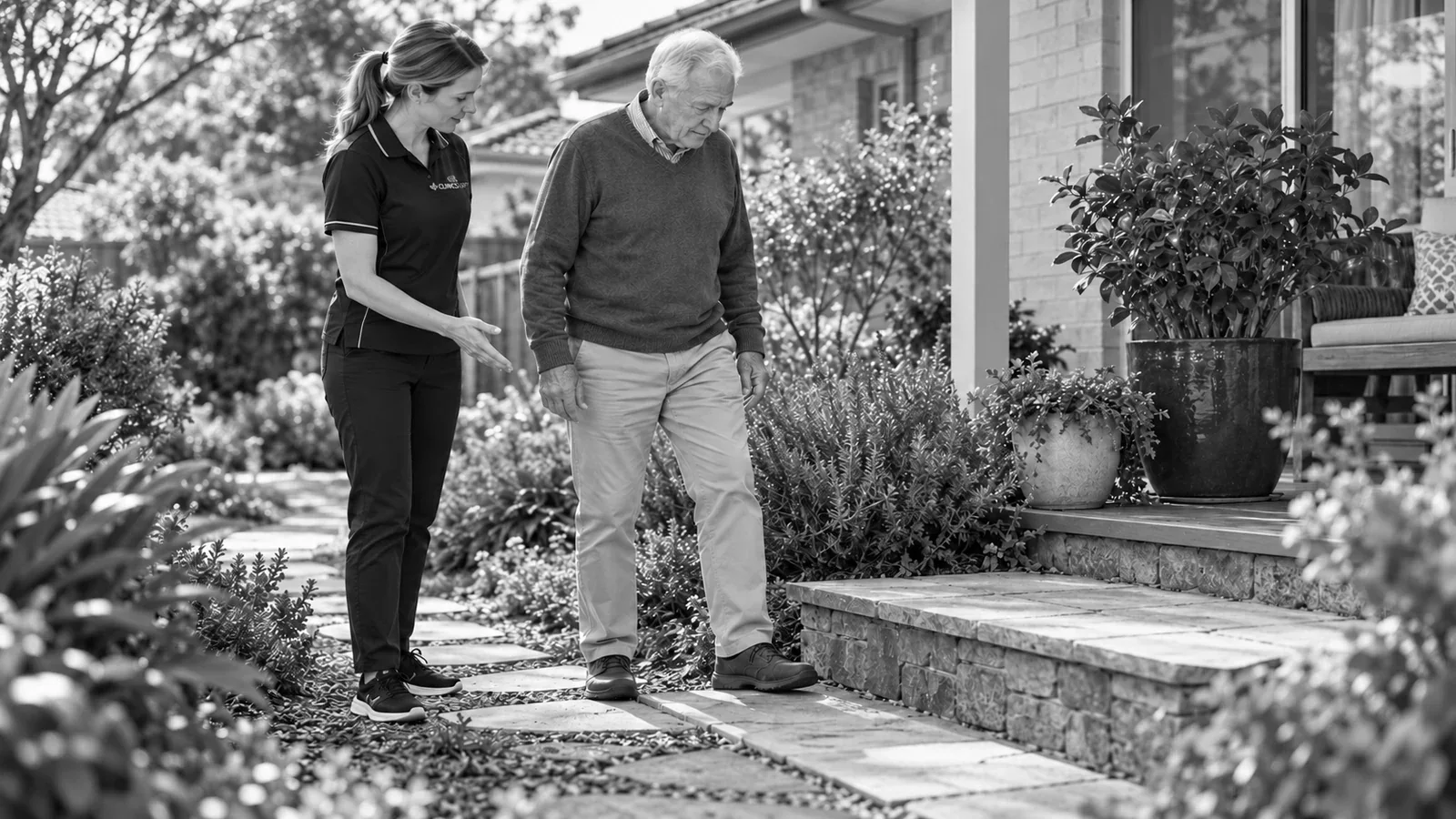
A shorter walk, a slower turn or more effort on the stairs can be easy to dismiss as age. Age can influence physical capacity, but it does not explain every new difficulty. The useful first question is: what changed, for this person, in this task and context?
Ageing in Full treats age as context rather than a diagnosis. That perspective invites curiosity without promising that every change can be reversed. The aim is to find a sound next step and protect the person's say in what happens.
Key points
- Describe the specific task that has changed, rather than relying on “my mobility is worse”.
- Note the timing, setting and any recent health or support changes.
- Assessment may find several contributors, including physical capacity and the environment.
- A sudden, severe or otherwise concerning change belongs in medical assessment.
Make the change visible
Compare a task with the person's own earlier pattern. Is it now harder to get up from a low chair, walk from the car to a shop, carry something while walking, or finish a familiar outing? Does the change appear every time, or only when tired, hurried or in an unfamiliar place? Has pain, breathlessness, dizziness, fear or fatigue appeared with it?
These details matter because “walking less” can have many explanations. A person may have lost strength after illness. Pain may alter the way they move. A walking aid may no longer fit the task. A change in eyesight, medicines, heart or lung health may need another clinician's attention. Physiotherapy can investigate movement and function, but it should not claim every possible cause as its own.
Connect the finding to the task
A physiotherapist may observe movement, strength, balance or endurance and ask about the environment in which the task happens. The World Health Organization describes functioning as arising from a health condition in interaction with the person's environment.1 Its ICOPE guidance asks clinicians to detect changes in capacity, identify support needs and develop a personalised plan.2
This is why a clinic test and the real task can both be useful. A measured improvement is valuable when it helps explain whether the person can do more of what matters to them. Sometimes maintaining an ability, reducing effort or changing the method is a meaningful outcome.
Decide the next useful step
If a change is gradual and movement-related, physiotherapy may be a useful starting point. If it is sudden, severe, unexplained, or accompanied by other concerning symptoms, seek medical assessment promptly. If falls, near-falls or dizziness are the dominant concern, the dedicated Balance & Falls pathway may fit better. Intake can help direct an enquiry when the right route is unclear.
The assessment should end with a working explanation, an agreed plan and a way to review it. If the explanation does not fit the response to care, revisit it. Changing course is good clinical reasoning, not a failure by the person.
Notice the pattern before naming the cause
“I am slowing down” can describe several different experiences. One person walks the same distance but needs a rest afterwards. Another manages the distance easily on a flat path and hesitates at a kerb. Someone else moves well in the morning and finds late afternoon difficult. Asking when and where the change appears makes the concern more precise. It also prevents age from becoming an explanation by default.
Try comparing a current task with your own usual pattern, rather than with another person's ability. How long has the task changed? Was there an illness, admission, fall, new symptom or change in medicines around that time? Has the amount of activity altered because of weather, transport, caring work or a change at home? A physiotherapist can use this account to decide which movement findings are relevant. You do not need to decide for yourself whether the cause is “muscle weakness” or “balance.”
Some signs call for a different pace of response. A sudden loss of movement, new severe symptoms or a rapid unexplained deterioration needs medical assessment. The exact route depends on the circumstances and local services. An article cannot triage an individual case. If you are worried by an abrupt change, seek timely professional advice rather than waiting for a routine physiotherapy appointment.
What an assessment can add
An assessment may compare the way you stand up, turn, step, carry or walk with the task you described. The clinician might examine strength, joint movement, balance, endurance or the effect of pain, then decide whether more information is needed. The findings are clues, not a complete account of the person. A single walk across a clinic may look different from walking through a busy car park while thinking about traffic.
The environment deserves attention too. A low sofa, poor lighting, uneven paving or a route without a place to rest can turn a manageable movement into a difficult one. Changing the environment may sometimes help sooner than changing physical capacity. Conversely, a person may feel capable at home yet struggle on a longer community trip because the demand is greater. Both situations are real and worth documenting.
WHO's rehabilitation description places functioning in the relationship between a health condition and the person's environment.1 That does not imply every barrier is solved by equipment or training. It asks a better question: what is limiting this person in this situation, and which part of the situation can reasonably change? The answer may involve physiotherapy, another clinician, practical support, or a combination.
Choose a goal that can be recognised in ordinary life
A useful goal is often more concrete than “improve mobility.” It might be getting from the bedroom to the bathroom at night with less difficulty, walking far enough to attend a weekly group, or managing the steps into a family home. These examples are not a prescription. They show how a task can give the plan a clear purpose and make review more meaningful.
The goal should account for the person's preferences. Someone may want to walk further; someone else may prefer a shorter distance with less pain or a more reliable way to manage a doorway. Keeping an ability can matter as much as regaining one. Adaptation can preserve participation without pretending the original task has stayed the same. The person should be able to say which trade-off they accept.
Progress can be checked with more than one kind of information. A test of strength or walking may help, but the person should also describe what happens outside the clinic. Is the outing easier? Does the task require fewer rests? Is confidence improving because the plan feels safer and better understood? If a score changes but the valued task does not, the mismatch is a reason to reassess, not a reason to dismiss the person's report.
When the first plan does not fit
The first explanation is provisional. If the change continues despite a suitable plan, or if new symptoms emerge, the clinician should reconsider it. Perhaps the task demand was misunderstood. Perhaps the amount of practice was impractical, or another condition is contributing. A review can change the goal, the intervention, the setting or the clinician involved.
People may hesitate to say that an exercise is difficult, that travel is exhausting or that the proposed outcome is not worth the effort. These details are central to care. A workable plan should fit the person's life rather than rely on an ideal week. The Ageing in Full approach preserves the person's agency here: the decision is made with them, and the result is judged by what matters to them.
If you are unsure where to start, describe the change and its timing when you make contact. You do not need to select a diagnosis before seeking help. A sound service response should identify whether routine physiotherapy, a specialist pathway or prompt medical review is the more appropriate next step.
References
- World Health Organization. Rehabilitation. 2024. https://www.who.int/news-room/fact-sheets/detail/rehabilitation
- World Health Organization. Integrated care for older people: guidance for person-centred assessment and pathways in primary care, 2nd edition. 2025. https://www.who.int/publications/i/item/9789240103726