
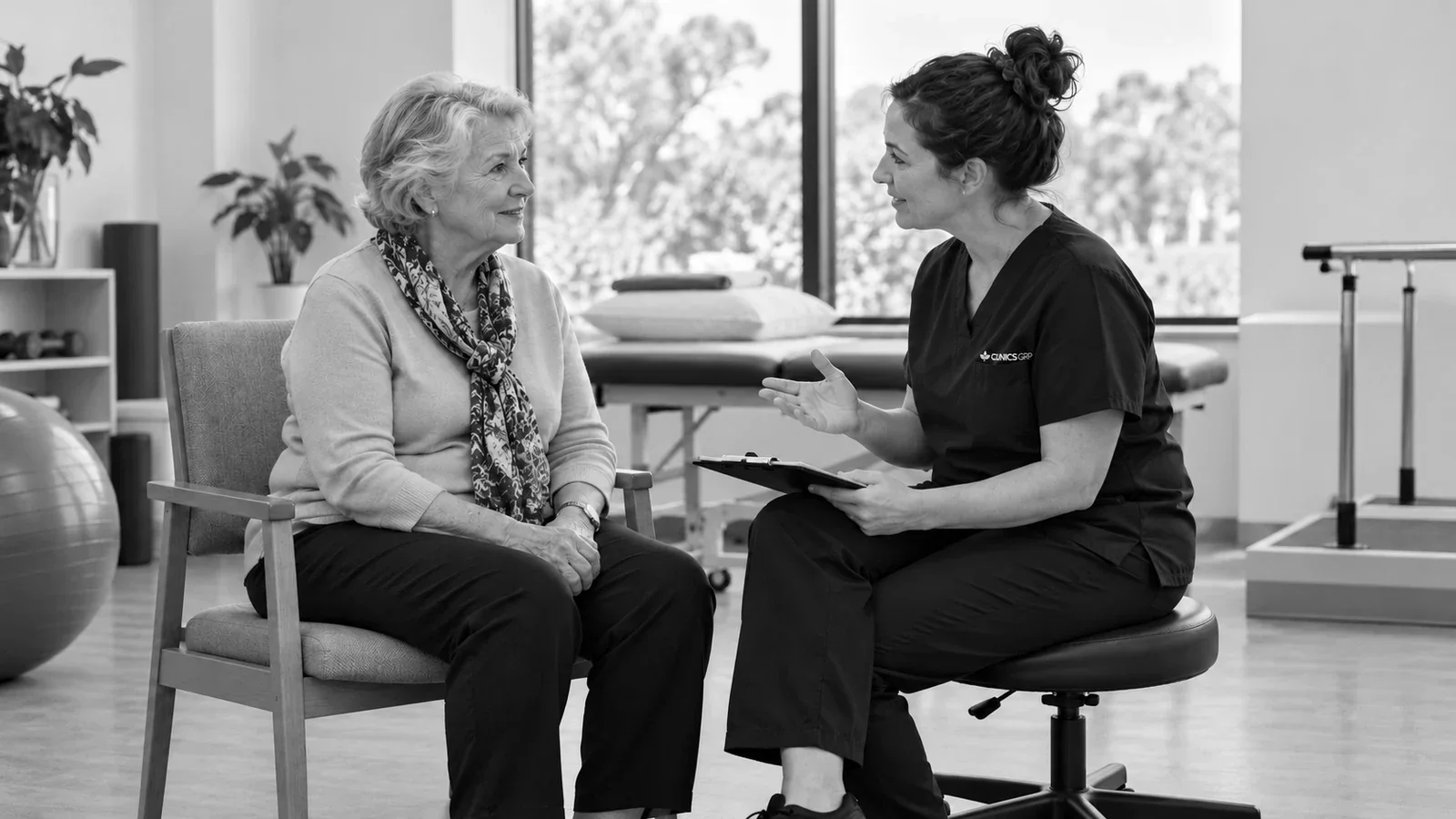
A first physiotherapy appointment is a chance to understand what has changed and what help would be useful. The answer may involve treatment or exercise. It may also involve another clinician, a different care setting, equipment, or a decision to watch and review. An assessment should not assume the answer before hearing the person's account.
The Ageing in Full approach starts with a whole person in a real life. A difficulty getting out of a chair may affect a morning routine, a visit to friends or the ability to help a partner. Those meanings do not replace physical assessment. They tell the physiotherapist which physical findings matter most to investigate.
Key points
- Bring the change you have noticed and the task that matters to you.
- Expect questions about health context, symptoms, movement and your usual environment.
- A useful assessment explains what is known, what remains uncertain and what happens next.
- You should have a say in the goal and the plan.
Start with the change
The physiotherapist may ask when the difficulty began, whether it is improving or worsening, and what makes it easier or harder. Relevant history can include a recent illness, surgery, fall, medicine change, pain, fatigue or a change in support at home. The questions should be proportionate to the concern. You do not need to arrive with a perfect account.
It helps to name an ordinary task: getting up from the dining chair, walking to the letterbox, managing a step, standing long enough to prepare a meal, or returning to an outing. That gives the assessment a practical reference point. A test result can help, but it cannot by itself say whether care is working for that task.
Look at the whole picture
Depending on the concern, assessment may include movement, strength, mobility, endurance, balance, pain behaviour and how a task is performed. The clinician may also consider footwear, a walking aid, the layout of a room, available help and the person's confidence. Not every item is required at every appointment.
The World Health Organization's ICOPE guidance describes person-centred assessment and a personalised plan that considers capacity and support needs.1 Australian comprehensive-care standards likewise emphasise shared decisions and goals that reflect the person's needs.2 These are broad care principles, not a fixed physiotherapy test battery.
Leave with a working explanation
At the end, ask what the findings suggest, what is still uncertain and why the proposed next step fits. The plan might involve practice, treatment, adaptation or further assessment. If symptoms point outside physiotherapy's scope, an appropriate medical or other clinical review may be more useful.
Agree how progress will be checked. This might include a clinical measure and a task the person cares about. If the plan is not helping, reassessment should be possible. The first appointment begins a conversation; it does not have to settle the whole course of care.
What to bring, and what you do not need to prepare
An appointment works best when you can describe the change in your own words. You might bring a medicine list, a discharge summary, a referral, or the walking aid you normally use. If a family member or supporter knows the history well, you may choose to include them. None of these is a condition of being heard. People often arrive with an incomplete story, especially after an illness or hospital stay. The clinician's job is to help organise it with you.
Consider the difference between “my knee hurts” and “I have stopped going to the market because the walk from the car park feels uncertain.” Both statements matter. The first identifies a symptom; the second shows its effect on life. If you can, notice whether the problem occurs at a particular time of day, after a certain distance, on uneven ground, or when you are tired. These details can guide assessment without requiring you to keep a formal diary.
Tell the physiotherapist if you are worried about falling, about making symptoms worse, or about losing an activity that matters. Such concerns are information, not a failure of confidence. They may change how the appointment is paced and what a sensible first step looks like. Equally, say if the proposed goal seems too small, too ambitious, or simply unrelated to what you want.
What the examination is trying to answer
A movement test has a purpose only if the answer can influence care. A clinician might observe how you rise from a chair to understand strength, balance, pain and the way you use your arms. They may ask you to walk a short distance to see whether speed, turning, a walking aid or fatigue changes the task. A pain-related assessment may include movement and relevant screening questions. The selection of tests depends on your concern and health context; it is not a checklist that every older person must complete.
A test can reveal what is possible on that day, in that room. It may not show what happens in a crowded shopping centre, on a wet path, or while carrying groceries. This is why the clinician should connect observed performance with your account of ordinary life. Where the two differ, the difference deserves exploration rather than dismissal. The environment, pace, attention demands and available support can all matter.
Assessment also includes deciding what not to test immediately. If a new symptom, a recent injury or a medical concern changes the safety picture, the physiotherapist may pause a movement test and arrange another assessment. That is still a useful outcome of the appointment. It means the next step has been chosen with the uncertainty in view.
A plan should be understandable and workable
Before leaving, you should be able to explain the plan in ordinary language: what the main concern appears to be, what you will try, why it might help, and when it will be reviewed. A plan might include supervised practice, a manageable activity between visits, advice about a task, or a referral. It may also involve observing a change before deciding on more treatment. The right amount of detail depends on the situation.
Ask how the proposed activity fits into your actual week. A programme that assumes a clear floor, spare equipment, transport and uninterrupted time may be unrealistic. If a plan is hard to follow, the problem may be the design of the plan rather than the person's motivation. Shared decision-making means discussing practical barriers and acceptable alternatives, not merely asking for agreement after the choice has been made.2
The first review point should be specific enough to be useful. “See how it goes” leaves too much unclear. The clinician and person might agree to revisit a valued task, a symptom pattern and one appropriate clinical measure after a reasonable period. Improvement may mean easier movement, greater confidence, fewer interruptions, or a better way of doing the task. It does not need to mean a perfect test score.
If the first answer is uncertain
Sometimes the assessment produces several plausible explanations. Pain may coexist with reduced strength. A change after hospital discharge may reflect illness, inactivity, medication effects and a different home routine. A person can have a named diagnosis and still have a separate new problem that deserves attention. Good care makes these possibilities visible and updates the explanation as information arrives.
You can ask, “What else could account for this?”, “What would make you change the plan?”, and “Who should I contact if the situation worsens?” These are reasonable questions. The answers help define the boundary of physiotherapy care and the point at which another clinician should be involved. A working explanation is useful precisely because it can be tested and revised.
The broader Ageing in Full principle is that the person's life remains the reference point. Age may shape risk, recovery time and support needs, but it does not tell a clinician what the person values or make a new change inevitable. An assessment respects both clinical evidence and the person's own account. Its success is a clearer, shared next step, not the number of tests completed.
References
- World Health Organization. Integrated care for older people: guidance for person-centred assessment and pathways in primary care, 2nd edition. 2025. https://www.who.int/publications/i/item/9789240103726
- Australian Commission on Safety and Quality in Health Care. Comprehensive Care Standard. https://www.safetyandquality.gov.au/national-standards/nsqhs-standards/comprehensive-care-standard