
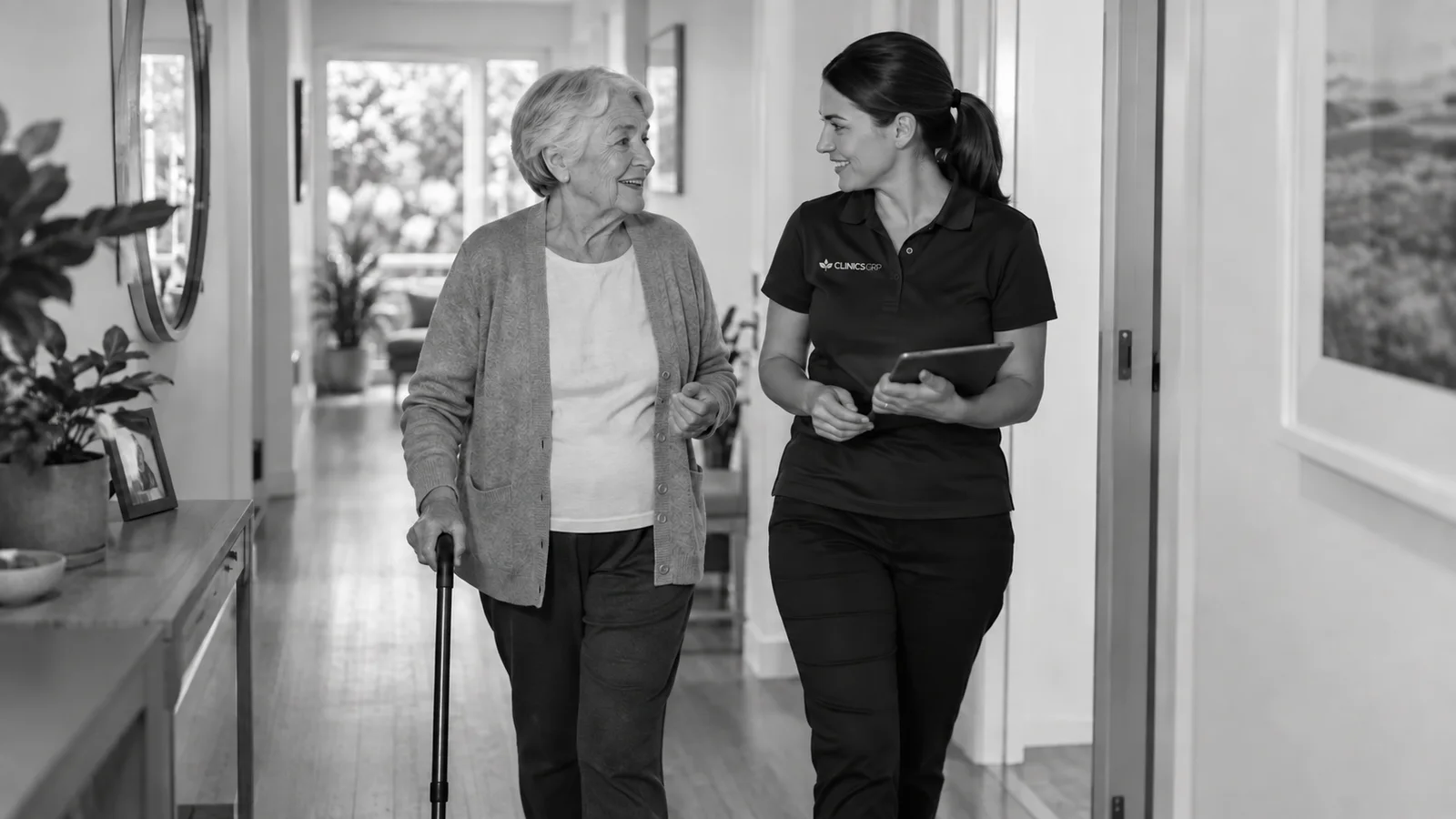
An older person starts taking the long way around the house to avoid two steps. Someone who used to walk to the letterbox now asks a family member to collect the mail. After an illness, getting out of a favourite chair becomes unexpectedly difficult.
These changes can sound small when described individually. Together, they may change how someone lives. Physiotherapy under Support at Home can help assess changes in movement and function and develop an appropriate plan, where the service is approved and authorised. The starting point is understanding what has changed and what the person wants to be able to do.
At Clinics GRP, that conversation connects assessment with everyday life. A referral for physiotherapy should lead to more than a list of exercises: it should help establish the problem being addressed, the purpose of care and how its usefulness will be reviewed.
Key points
- Physiotherapy can address assessed needs involving mobility, balance, transfers and everyday function.
- A home assessment helps relate a movement difficulty to the surroundings in which it occurs.
- Funding arrangements and clinical suitability both need confirmation before care begins.
- Progress should be judged against meaningful goals and reviewed when the response is unexpected.
When is physiotherapy worth considering?
The reason for seeking help is often a change rather than a diagnosis. Walking may require more effort. A person may need help to stand, avoid leaving the house or feel less confident moving between rooms. Family members might notice that ordinary activities are gradually disappearing from the week.
A useful referral describes that change in practical terms. “She has stopped walking to the garden since her hospital stay” tells a clinician more about the immediate concern than “needs strengthening”. The second statement proposes a treatment before the difficulty has been understood.
This does not mean strength is unimportant. It means the assessment should establish whether weakness, pain, balance difficulty or another concern is relevant, and whether the presentation needs additional clinical or medical input. Different people can arrive at the same activity limitation for different reasons.
People do not need to settle all those questions before making an enquiry. Explaining the change, its timing and its effect on daily life provides a useful beginning.
How physiotherapy fits the funding pathway
Support at Home services must match assessed needs recorded in the support plan.1 Physiotherapy sits within clinical supports, for which participants do not pay a contribution under the current arrangements.2
That does not establish that every requested appointment is approved or available. The provider still needs to confirm the relevant service, available funding, agreed delivery arrangements and authorisation. Clinical suitability is a separate question for the treating team.
For families, these distinctions can prevent confusion. An appointment might be clinically appropriate while its funding arrangements remain unresolved. Equally, an available budget does not determine which intervention is appropriate. Both questions deserve clear answers before a plan is put into effect.
The Clinics GRP Support at Home pathway explains how an enquiry moves through clinical intake, provider arrangements and planned care. It is a useful starting point for a participant, family member or care partner who is unsure how to begin.
Why assess movement at home?
Home is where many functional problems become visible. A person may manage a standard chair elsewhere but struggle with the low chair they use each evening. A short walk in an uncluttered room may not reflect the effort of reaching the bathroom or negotiating the front entrance.
These observations help make the conversation specific. Which task matters? Where does it become difficult? How much assistance is currently needed? What would a useful improvement allow the person to do?
An assessment should also respect the home as the person's space. The clinician can explain what they would like to observe and ask permission. Family participation should support the person's account, with consent, rather than replace it.
Home physiotherapy may therefore be a practical setting for assessment and rehabilitation. It is not automatically the best setting for every stage of care. The appropriate location can be reconsidered as needs, access and goals change.
What does the evidence tell us?
A 2019 Cochrane review found that exercise reduced the rate of falls by 23% among older people living in the community. The main analysis included 59 trials and 12,981 participants.3 This was a relative reduction in the number of falls over time, not a promise that each participant's personal risk would fall by the same amount.
The review supports appropriately designed exercise for falls prevention. It does not show that every exercise programme works equally well, or that an individual home visit guarantees fewer falls. It also does not evaluate the Clinics GRP pathway.
For someone seeking physiotherapy, the practical implication is to ask what the proposed care is intended to address. A programme for falls prevention may have a different purpose from rehabilitation after surgery or support for a painful movement. Evidence becomes useful when it is interpreted in relation to the person receiving care.
What should a useful plan contain?
A useful plan makes its purpose understandable. “Improve lower-limb function” may be meaningful to a clinician, but the person may care most about standing up without asking their partner for help. Recording both connects the clinical work with the reason it matters.
The plan should explain the proposed treatment, any activities to practise between appointments and the support needed to do them appropriately. Instructions should suit the person's communication needs. A lengthy handout is of limited value if it leaves someone unsure what they are meant to do.
There should also be a way to discuss difficulties. If an activity is uncomfortable, impractical or confusing, that information belongs in the review. It should not simply disappear beneath an assumption that the person has failed to follow instructions.
The amount and frequency of care need individual consideration. A standard number of visits cannot establish what every person needs. The important question is why the proposed arrangement is reasonable for this person's goals and circumstances.
How will we know whether it is helping?
Clinical measures can help track change, but daily experience matters alongside them. Is standing easier? Can the person reach the garden with the agreed support? Has an activity become possible more often, with less difficulty or greater confidence?
An apparent improvement during an appointment may not yet translate into ordinary life. That difference is useful to discuss. The home task might involve other demands, or the agreed goal may need a different approach.
Progress can also mean maintaining an important ability where improvement is uncertain. Maintenance should have a clear purpose and review plan; it should not be assumed simply because appointments continue.
If the expected response is not occurring, the clinician should consider whether reassessment or another professional opinion is needed. Continuing care should remain a considered decision.
When another discipline may help
Movement difficulties do not always sit neatly within one service. A wound may affect how someone walks. A nursing concern may complicate participation in rehabilitation. A new medical problem may require assessment before physiotherapy proceeds.
Where appropriate, nursing care and physiotherapy can contribute to a coordinated plan. The purpose is to address identified needs, with clear professional responsibilities and communication. More disciplines are useful when they add something the person needs, rather than simply increasing the number of appointments.
For a family or provider, a helpful question is: “Who needs to know about this change, and who will coordinate the next step?” That makes responsibility easier to understand.
Starting the conversation
Before contacting the team, note what has changed, when it began and which daily activities are affected. If available, have the provider's details and relevant assessment or discharge information ready. Share clinical documents through the agreed secure referral process.
You can explore Support at Home clinical care or contact Clinics GRP to discuss the appropriate starting point. Services remain subject to assessment, provider authorisation, location and availability.
The aim is a plan that helps explain the difficulty and gives care a meaningful direction: something the person understands, can participate in and can review with their clinician.