
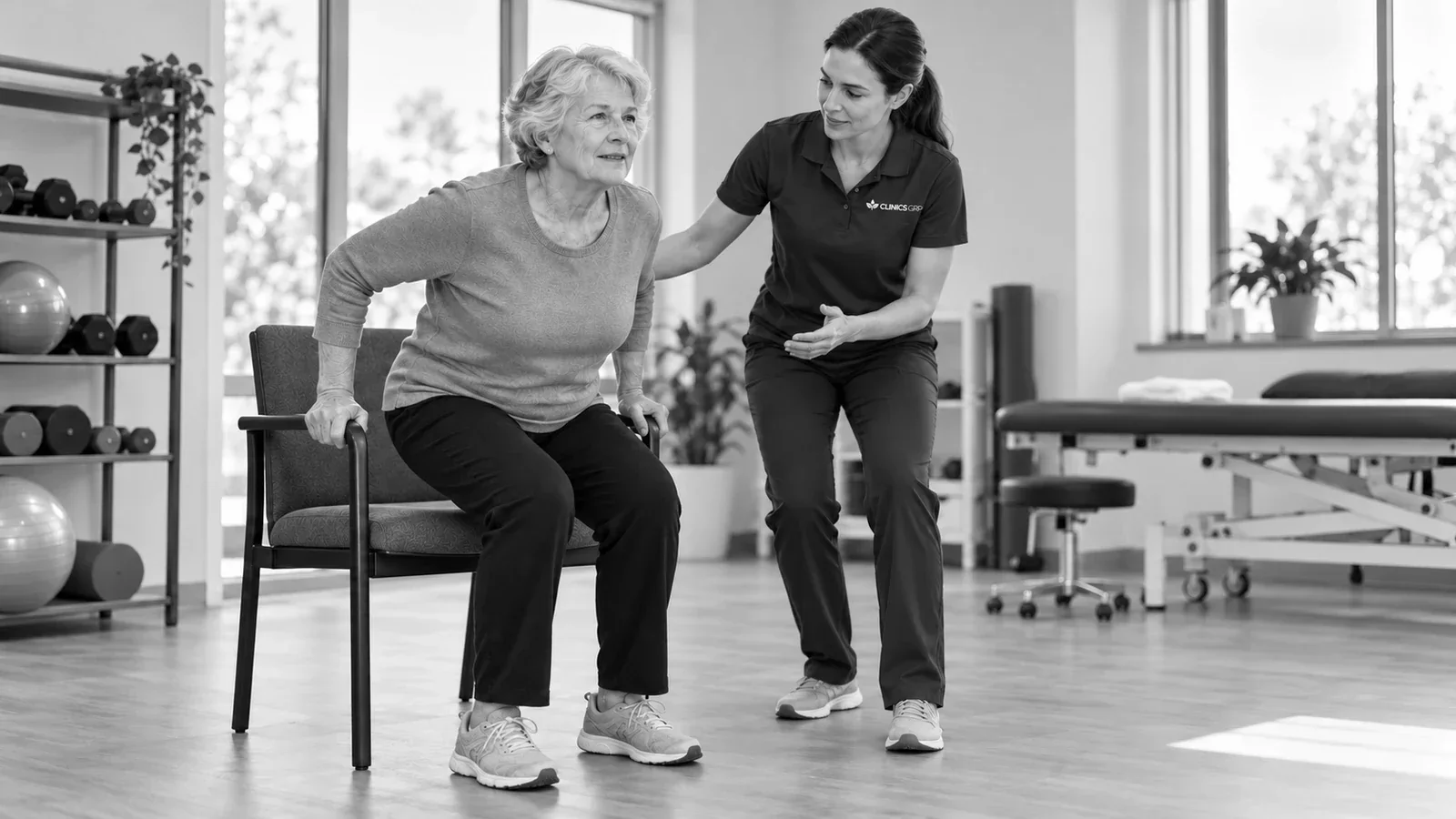
After illness, a hospital stay or a period of doing less, a familiar task may demand more effort. Standing from a chair, carrying groceries or finishing a walk may feel different. People often call this “deconditioning”, but that label should begin a question rather than end an assessment.
Ageing in Full asks us to face the change without turning it into a verdict about the person. A loss of capacity can be distressing. It may also be one part of a more complicated picture involving pain, nutrition, medicines, heart or lung health, confidence, support and the environment.
Key points
- Reduced activity and strength can affect everyday function, but do not explain every change.
- A plan should connect physical findings to a task the person wants to do.
- Strength practice may help some older adults; the starting point and progression need to fit the person.
- Maintaining or adapting a valued activity can also be a legitimate goal.
Understand what changed
A physiotherapist may ask what the person could do before, what happened during the period of illness or reduced activity, and what is now difficult. They may consider strength, mobility, endurance, symptoms and the ability to perform a real task. If the change is marked, unexplained or accompanied by other health concerns, medical assessment may be needed.
A person who can perform a single chair rise in a clinic may still struggle to prepare breakfast when tired or to manage stairs at home. The environment, timing and support available affect what a physical capacity means in daily life. That is why the goal should name a task, not just a muscle group.
What does the evidence support?
A Cochrane review found that progressive resistance training can improve strength and aspects of physical function in older adults, while the size and relevance of benefit vary across people and outcomes.1 A separate review of mobility training for community-dwelling older people with frailty found improvements in measured mobility and functioning, but individual suitability and safety still require assessment.2
Neither review proves that a particular programme will restore a person's previous ability. The useful approach is to choose a feasible starting point, practise at an appropriate challenge, and review both the measure and the real task. WHO physical-activity guidance recognises that people with health conditions may need to work within their abilities and circumstances.3
Progress can take several forms
For one person, progress may mean getting up with less effort. For another, it may mean safely completing part of a journey with a walking aid or accepting help for one task so energy remains for another. Sometimes maintaining capacity through a difficult period matters. A plan can include exercise, task practice, equipment, pacing or another clinician's input.
If the chosen work is not changing what matters, reassess. The question is not whether the person tried hard enough. It is whether the explanation, support and plan still fit the situation.
Describe the period when capacity changed
The word “deconditioning” can hide important differences. A person may have spent two weeks in hospital, months caring for someone while doing little outside the home, or several days unwell with a sharp drop in activity. Those histories suggest different questions. What did the person do before? What changed during that period? Which tasks are now difficult, and are they improving, stable or still declining? A physiotherapist needs this sequence before deciding how much reduced activity explains.
It is also useful to ask what made activity difficult in the first place. Pain, dizziness, breathlessness, fatigue, a change in medicines or fear after a fall may still be present. If they are, simply adding more exercise may be poorly matched to the problem. The clinician should consider whether another assessment is needed and explain where the boundary of physiotherapy lies. A new or rapidly worsening difficulty deserves timely clinical attention.
The person's environment can amplify a small reduction in strength. A low chair may become much harder to leave; a staircase may leave no place to pause. A walker may be useful indoors but awkward on a narrow path. Understanding the task in its setting helps separate physical capacity from practical barriers. Both can be addressed, but they call for different responses.
Make practice relevant and feasible
Strength work is useful when it supports an agreed function. For someone whose priority is getting up from a chair, the clinician may consider lower-limb capacity, the chair itself, balance and the way the person uses their arms. For someone wanting to return to a community outing, endurance, walking conditions and access to rest may matter just as much. “Get stronger” is not specific enough to guide the whole plan.
Evidence that resistance training can improve strength and some physical outcomes in older adults is encouraging.1 It does not remove the need to choose an appropriate starting point, account for health conditions, and review the response. A programme that is too demanding may be abandoned or cause avoidable difficulty. One that never changes may be insufficient for the intended task. Progression is a clinical decision made with the person, not a fixed timetable drawn from a general article.
Practice can take several forms. Supervised sessions may help when a person needs assessment, feedback or confidence. A simple home routine may fit better when travel is tiring, provided it is safe and understood. Practising the actual task can complement general strengthening. The person should know the purpose of each part and how it connects to daily life. If a home plan depends on equipment, space or support they do not have, it needs redesign.
Review function as well as a test result
A chair-rise or walking measure can help track a change under repeatable conditions. It can also miss what matters: whether the person can prepare a meal without becoming exhausted, manage a step in the rain, or visit family. Review should compare both the clinical measure and the lived task. If the scores improve but the person's life does not, ask why. Perhaps the goal was too distant, another barrier remains, or the wrong capacity was prioritised.
The size and relevance of improvement vary across studies and people.12 It is better to discuss a reasonable expected direction and review point than to promise full recovery. A person may regain some capacity while still needing a walking aid. Another may keep a valued task through a period of illness without improving a score. Neither outcome should be dismissed merely because it differs from the original hope.
WHO guidance encourages physical activity within a person's abilities and circumstances.3 That is a population-level principle, not an individual exercise prescription. A clinician should translate it into a plan that accounts for symptoms, preferences and access. The person should be able to say whether the work is manageable and worth the effort.
When maintenance or adaptation is the better goal
Recovery is not always a straight line. Health conditions may fluctuate, and some losses cannot be fully reversed. In those situations, maintaining the ability to dress, cook, garden or attend a regular gathering can be an important result. The task might be done differently, with a rest, a device, or help at one stage. Such changes can protect participation and choice.
Adaptation should not be imposed as a substitute for assessment. First ask what can change through care and what remains uncertain. Then discuss the trade-offs with the person. A walking aid, for example, may support a longer outing but feel unwelcome at first. The clinician can explain its possible value, check that it fits the task and listen to the person's view. The outcome belongs to the person, not to a standard of independence chosen by someone else.
Ageing in Full holds two ideas together: physical capacity matters, and dignity does not depend on a particular level of capacity. Naming deconditioning can be useful when it is supported by the history and findings. It should never end the enquiry, erase other causes, or make the person responsible for a plan that did not fit their life. The useful question is what would help them do more of what they value, or preserve it, from where they are now.
References
- Cochrane. Progressive resistance strength training for improving physical function in older adults. https://www.cochrane.org/evidence/CD002759_progressive-resistance-strength-training-improving-physical-function-older-adults
- Cochrane. Mobility training for increasing mobility and functioning in older people who are frail. https://www.cochrane.org/evidence/CD010494_mobility-training-increasing-mobility-and-functioning-older-people-who-are-frail
- World Health Organization. WHO guidelines on physical activity and sedentary behaviour. 2020. https://www.who.int/publications-detail-redirect/9789240015128