
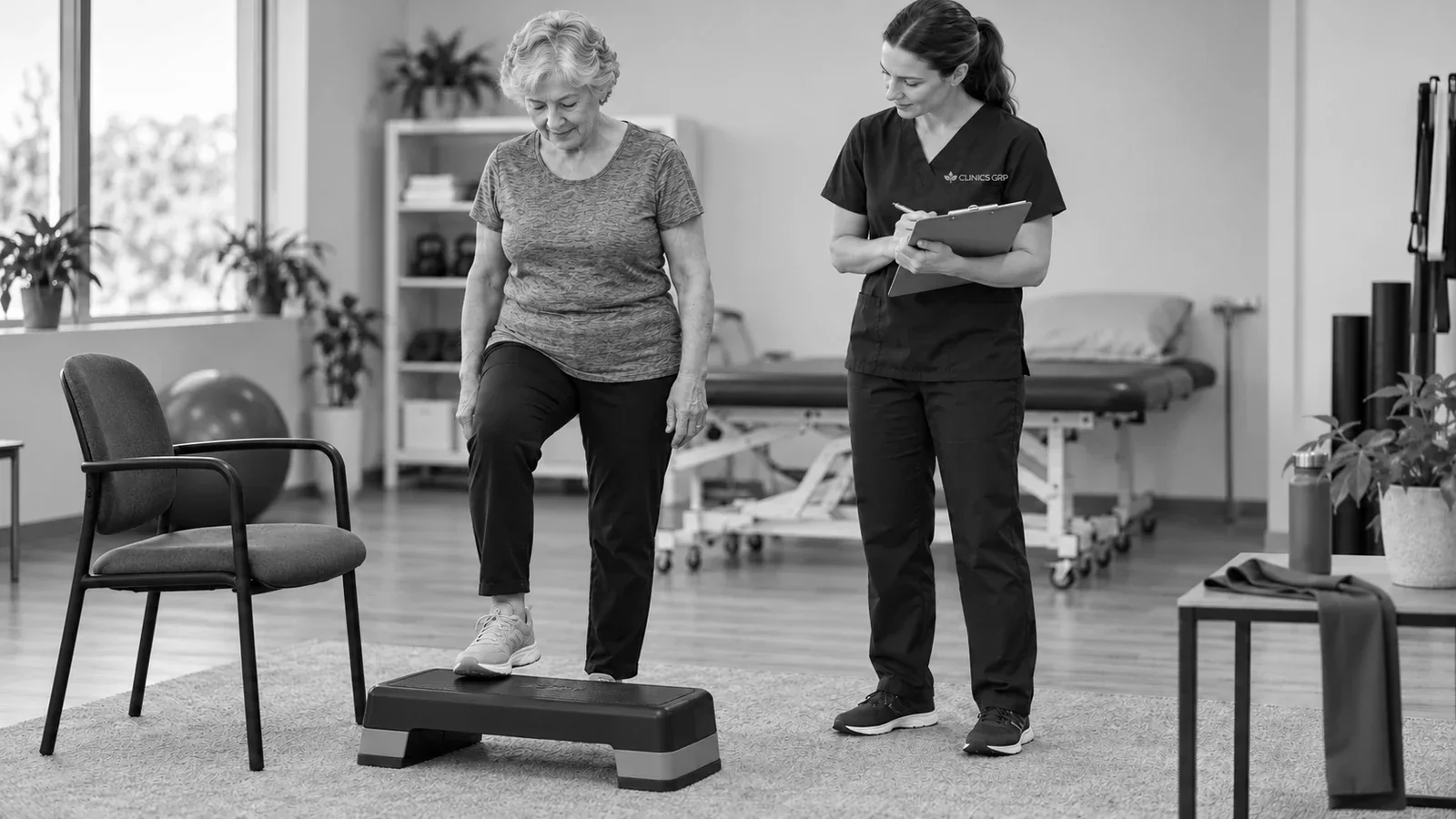
The words physiotherapy, rehabilitation and therapeutic exercise often appear together. They are related, but they do not describe exactly the same job. The useful question is not which label sounds most comprehensive. It is what has changed and what kind of help the person needs now.
Key points
- Physiotherapy can assess movement, pain and physical function and guide treatment.
- Rehabilitation is a broader process of working towards everyday functioning after a health change.
- Therapeutic exercise is a structured part of care when practice or physical conditioning fits the assessment.
- The route can change as the person's needs and goals become clearer.
Physiotherapy: understand and respond
Physiotherapy begins with an assessment of the concern and its effect on movement or function. The physiotherapist may examine strength, mobility, pain, endurance or another relevant finding. They then explain a working interpretation and agree a plan. Treatment can include movement practice, exercise, education, adaptation or other appropriate care. It may also lead to another clinician when the concern is outside physiotherapy's scope.
A person does not need to know the exact service name before asking for help. “Getting up from the dining chair has become much harder” is often a better starting point than “I need six sessions of physiotherapy”.
Rehabilitation: connect care to daily life
The World Health Organization describes rehabilitation as work to optimise functioning and reduce disability in interaction with the person's environment.1 It may involve several professions and several approaches, including treatment, task practice, environmental changes and assistive products. Its purpose is connected to daily life, not only a clinic measure.
Rehabilitation may follow illness, surgery or hospitalisation, or address a longer change in capacity. Some episodes are focused and time-limited; others need ongoing review. A person may regain an ability, maintain one, or find a different way to take part. Ageing in Full reminds us that an adapted method can preserve the purpose of an activity.
Therapeutic exercise: a planned form of practice
Therapeutic exercise is not simply “exercise because exercise is good”. It is chosen for a clinical reason and shaped by the person's findings and goals. It may target strength, endurance, joint movement, balance, task capacity or confidence with movement. It can sit within physiotherapy or rehabilitation rather than replace the broader assessment.
WHO physical-activity guidance provides population-level recommendations for older adults.2 Those recommendations do not tell an individual with pain, illness or complex needs which exercise to begin tomorrow. Assessment, tailoring and review bridge that gap.
Choose the starting point, then keep reviewing
At Clinics GRP, general physiotherapy can be the starting point when the concern needs assessment. Rehabilitation may fit when a wider episode of recovery or reconditioning is needed. Post-Hospital Rehabilitation has a more focused relationship to physical capacity lost around a hospital stay. Therapeutic Exercise suits a structured practice programme when that is the agreed clinical approach.
These are service descriptions, not diagnoses. Intake can help choose a route, and assessment may change it. The right pathway is the one that serves the person's actual need, not the one with the broadest name.
The same person may need more than one approach
Imagine someone who has become less steady and less active after an illness. A physiotherapist may first assess movement, symptoms and safety. The agreed plan may then include practice rising from a chair and walking, with review of how these changes carry into home life. If the episode also requires help with daily routines, equipment, communication or other needs, rehabilitation can bring those pieces together. Therapeutic exercise may be one part of either plan. The labels overlap because they describe different levels of care, not competing diagnoses.
A second person might have a long-standing painful knee but no recent hospital stay. Their main concern is getting to a local group each week. A physiotherapy assessment may help establish what limits the journey and whether exercise, task adaptation, education or another clinical opinion is useful. Calling the whole episode “rehabilitation” may be reasonable if care spans several functions and settings, but the name alone does not tell them what will happen. They need a clear explanation of the proposed work.
These examples are not instructions to select a service from a website. They show why the concern, the person's priorities and the clinical findings should lead the route. A person can start with a general enquiry and receive help finding the appropriate pathway.
What the terms do and do not promise
Physiotherapy is a profession with an assessment and treatment scope. It does not mean every appointment must involve hands-on treatment or an exercise sheet. A useful visit may identify a concern requiring medical assessment, explain why a task is difficult, or decide that a short period of monitoring is sensible. The next step should be based on the findings and the person's goals.
Rehabilitation describes a purpose: improving or maintaining functioning in real life, or reducing the effect of a health condition in the person's environment.1 It may be delivered by physiotherapists and other clinicians, depending on need. It does not promise a return to an earlier level of ability. It also should not be treated as a fixed number of sessions. The plan needs review because health, capacity and priorities can change.
Therapeutic exercise describes a chosen method. It can involve strength, mobility, endurance, balance or repeated practice of a task. It is therapeutic because the content and amount have a clinical reason, not because any particular movement is special. Population activity advice supports being active where possible but cannot replace individual assessment.2 An exercise plan that does not connect to the person's concern or cannot be carried out in their setting needs revision.
Why the care setting may matter
The same approach can look different in a clinic, at home or after discharge. A clinic may provide room, equipment and a controlled place to observe movement. A home visit may reveal a low chair, narrow hallway, steps or the way a task is actually done. Post-hospital work may need to consider fatigue, medical follow-up and the transition from supervised care. The setting should be chosen for the clinical question, not only for convenience.
Sometimes care moves between settings. An early clinic assessment may identify that the person's real difficulty appears only at home. A home assessment may establish a safe starting point before later practice in a different place. The person should understand why a move is proposed and how information will be handed on. They should not have to repeat the same story without a clear reason.
The setting can also affect who is involved. Rehabilitation may require coordination with a GP, nursing, occupational therapy or another service when assessment shows that need. It should not automatically involve every discipline. The wider team exists to address distinct problems in a coherent plan, with consent and clear responsibilities.
How to choose a useful first conversation
When making an enquiry, describe the task and the change rather than trying to select a technical label. Useful details include when the problem began, whether it followed an illness or hospital stay, where the task is difficult, and what the person hopes to do. Mention any new or concerning symptoms so intake can direct the enquiry appropriately. If the change is abrupt or severe, seek timely medical advice.
Ask what the first appointment is expected to establish. Is the aim to understand the concern, plan a rehabilitation episode, or begin a practice programme after prior assessment? Ask who will review progress and what would change the route. A clear answer is more helpful than a service name alone.
Ageing in Full adds a practical test to each option: does this care help the person keep a meaningful purpose in view? Regaining a function may be the goal. Maintaining one, using support, or changing the way it is done may be equally valid. The right route is the one that answers the current clinical question and respects the person's choice about the life it is meant to support.
References
- World Health Organization. Rehabilitation. 2024. https://www.who.int/news-room/fact-sheets/detail/rehabilitation
- World Health Organization. WHO guidelines on physical activity and sedentary behaviour. 2020. https://www.who.int/publications-detail-redirect/9789240015128