
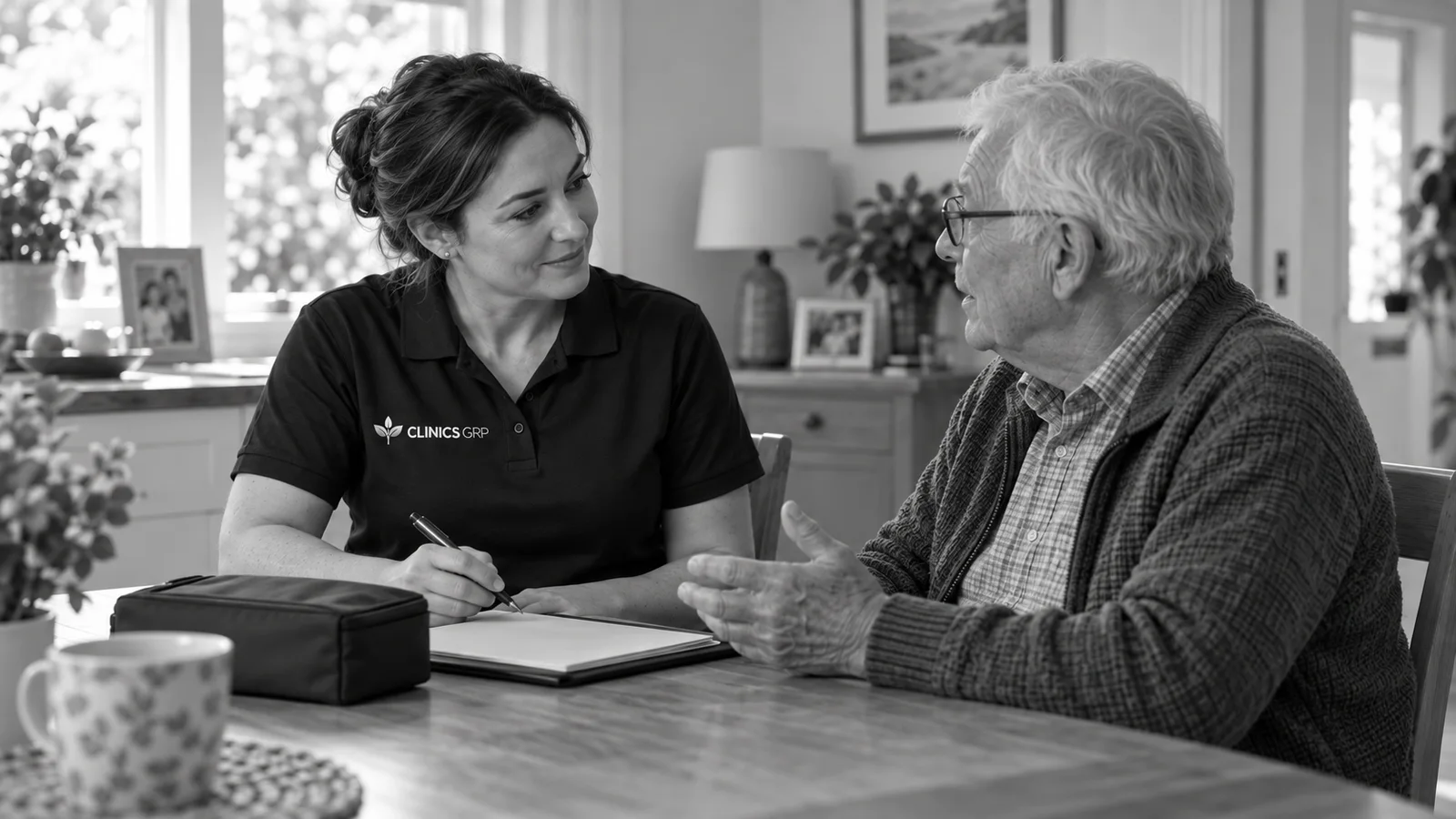
For someone living at home with a urinary catheter or a stoma, the equipment is only one part of daily life. There may also be questions about comfort, confidence, supplies, changes in function and whom to contact when something is different. A routine task can be completed while an important concern remains unspoken.
Good nursing follow-up should connect the agreed clinical plan with the person's experience at home. It should make responsibilities clear and recognise when a problem needs the treating doctor, a specialist nurse or urgent medical care.
At Clinics GRP, that means starting with the person, the reason for the referral and the limits of the available service. Catheter and stoma care should not be reduced to a universal checklist or an assumption that every nurse provides every procedure.
Two different areas of care
A urinary catheter drains urine from the bladder. There are different types, and an individual's care instructions depend on their device and clinical circumstances. Some catheters are needed temporarily; others are used for longer periods.1
A stoma is a surgically created opening. In this article, stoma care refers to bowel or urinary stomas, such as a colostomy, ileostomy or urostomy. These differ in purpose and management. It does not refer to every type of surgical opening or imply that care requirements are interchangeable.2
A person may need support with either, both or neither. Bringing them together here reflects a shared need for clear follow-up, not a claim that one set of instructions applies to both. The first question is which condition, device and specialist plan the nursing service has been asked to support.
Start with the current plan
Before arranging ongoing visits, the team should establish what information is available. That might include discharge instructions, the reason for the catheter or stoma, the treating team, relevant medical orders and an existing review schedule. Missing or conflicting instructions should be clarified rather than filled in with assumptions.
It should be clear which tasks the person manages, what assistance they want and what the nurse has agreed to provide. Any procedure must fit the clinician's competence, authorisation and the individual's plan. The Nursing and Midwifery Board's standards require registered nurses to assess, plan, deliver and evaluate care within professional responsibilities.3
A referral saying only “catheter care” or “stoma support” may therefore need further discussion. It does not specify the actual task, urgency, supplies, specialist involvement or the person's ability to manage between visits.
What nursing observation can add
A follow-up conversation may identify pain, discomfort, leakage, skin concerns or difficulty managing the agreed routine. The person may have become less confident, need more help with clothing or be avoiding an outing because they are worried about the equipment.
These observations do not automatically establish a cause. They help the nurse decide what needs further assessment or communication to the appropriate clinician. The aim is to make a change visible and actionable rather than repeatedly record that the scheduled task was completed.
Our catheter and stoma care pathway provides a starting point for discussing the requested nursing support. Acceptance depends on the task, clinical information, staff capability and service arrangements. A specialist or hospital-based service may be required for needs outside the available scope.
Catheter problems need an escalation plan
Healthdirect advises immediate attention if a catheter is not draining or causes pain. An indwelling catheter that falls out requires immediate contact with a doctor or nurse, or attendance at an urgent care service or emergency department. Blood in the urine also needs prompt medical attention.1
Do not wait for the next routine visit to report these problems. Do not attempt insertion, replacement or flushing based on this article. A person trained to carry out a particular task should follow their individual instructions and seek help when the situation falls outside them.
The contact plan should distinguish routine questions from urgent clinical problems. It should also explain what to do outside the nursing service's operating hours. Knowing a phone number is not enough if nobody has explained when that service is available or whether it can respond to the problem described.
Stoma follow-up needs the right expertise
A stomal therapy nurse can help with questions about equipment, skin care and adapting to daily life. Healthdirect describes specialist nursing support as part of learning to manage a stoma and finding suitable equipment.2
Community nursing may support an established plan and communicate changes, but it should not be presented as a substitute for all specialist stomal therapy. Persistent leakage, skin difficulty or a change that the person cannot manage should prompt review through the appropriate clinical team.
Advice also needs to match the type of stoma. For an ileostomy, reduced or absent output with pain or vomiting, significant bleeding, or signs of dehydration require urgent clinical advice. The NHS identifies these as possible complications requiring assessment.4 This article uses that source for clinical warning signs; Australian readers should use their local medical and emergency services, not UK contact numbers.
Everyday function is a legitimate care priority
A person may understand the technical instructions but still find them difficult because of vision, hand function, fatigue or the arrangement of their home. It is useful to ask what is manageable in practice, without assuming that the person must become fully independent or that a family member can take over indefinitely.
Support should be discussed with the person. Privacy and consent matter when intimate care is involved, and the person's preferences about family participation should be respected. They may want help with one task while retaining control of another.
A useful goal could be feeling more confident about asking for help, understanding the contact plan or managing an agreed routine with appropriate assistance. These are examples of possible priorities, not promised outcomes. Clinical stability and specialist review may need to take precedence over other goals.
Supplies and communication should be planned
Follow-up becomes difficult when essential supplies are missing or the person receives different instructions from different services. The care team should agree how supplies are ordered, who checks availability and whom to contact if the usual arrangement fails.
That does not mean every product is interchangeable or that the community nurse should independently substitute equipment. Changes need to be consistent with the individual plan and appropriate professional advice. Product availability is an operational question; product suitability is also a clinical one.
Following a hospital stay, the handover should identify outstanding questions and who is responsible for resolving them. The Australian Commission on Safety and Quality in Health Care highlights transitions between settings as an important area for continuity and coordination.5 The Hospital-to-Home pathway explains the broader role of coordinated recovery support.
A hypothetical example: repeated leakage
Imagine a person who reports repeated stoma leakage but says they are coping. Further conversation reveals that they have stopped visiting family because they fear an accident. An extra routine visit might provide short-term reassurance, but it does not necessarily explain the recurring problem.
A nurse can document what the person reports, review the agreed support and communicate the concern to the appropriate specialist. The next step depends on assessment; the example does not establish a product fault, a particular treatment or an expected result.
This fictional situation illustrates why follow-up should consider both the clinical issue and its consequences. A person can appear to be managing the task while their life is becoming more restricted. That is information worth bringing into the care plan.
Review needs a named next step
After a visit, the person and relevant care team should know what was observed, what was done, what remains uncertain and when follow-up is expected. If a referral or medical response is needed, responsibility should be explicit. Sending a message should not be confused with confirming that the issue has been addressed.
If someone becomes critically unwell, collapses or has severe breathing difficulty, call Triple Zero (000).6 Clinics GRP is not an emergency or 24-hour service. The person's urgent plan must remain usable between scheduled visits.
To discuss suitability, contact the Clinics GRP nursing service with current instructions and a clear description of the requested support. For Support at Home, service and product arrangements require provider confirmation. The sources cited inform components of care, not proof that the Clinics GRP pathway prevents complications. Good follow-up is an ongoing responsibility to assess, communicate and review within the right clinical scope.