
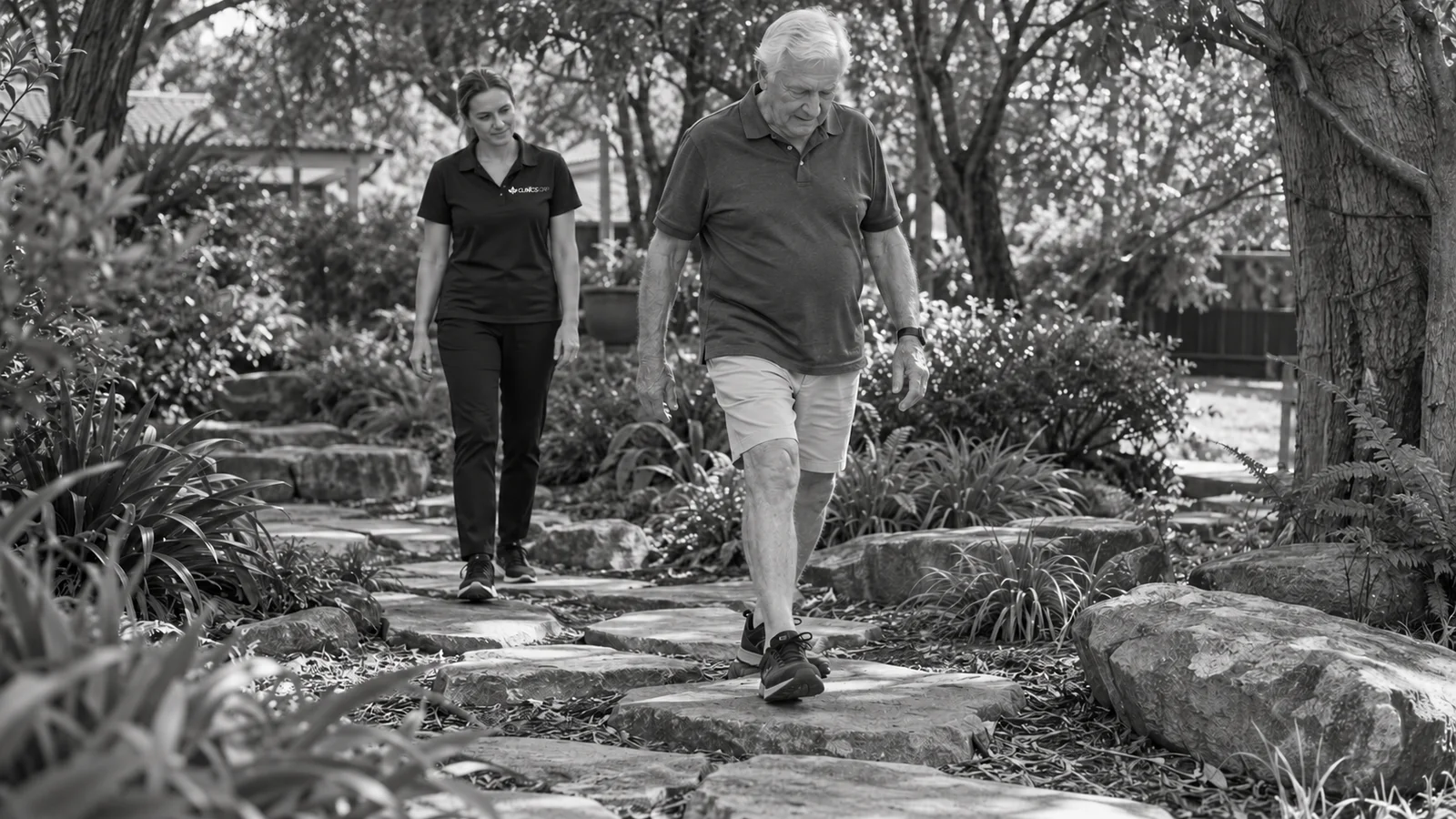
An older adult who walks more slowly, takes smaller steps or reaches for a handrail is sometimes told to be more confident. That advice can miss an important point. The nervous system may be responding rationally to uncertainty.
When vision, vestibular information or sensation from the feet is less reliable, the system has less certainty about body position and the environment. Slowing down can create more time to gather information. Shorter steps can keep the feet closer to the body. A handrail or walking aid can add support and another source of sensory information.
These choices are part of the integrated balance system described in Balance Is More Than Strength. A safer strategy is not automatically a problem. Its value depends on the task, the environment and whether the person can adapt when conditions change.
Key points
- Sensory uncertainty can lead to slower, smaller or more deliberate movement.
- These changes may reduce immediate demand and increase the time available to respond.
- A cautious strategy can be useful in one situation and unnecessarily restrictive in another.
- Stiffening and excessive attention can sometimes make movement less adaptable.
- Assessment should explain why the strategy appears before trying to remove it.
What is sensory uncertainty?
Sensory uncertainty means that the nervous system has less confidence in the information available for estimating position, movement or the surroundings.
The source may be environmental. Dim light reduces visual detail. Thick carpet changes information from the feet. A busy shopping centre creates moving visual information and distraction.
The source may also involve the person. Reduced sensation, dizziness, pain, visual change, fatigue, medication effects or previous falls can alter how information is received and interpreted.
The nervous system combines several signals and adjusts its reliance on them. This process is known as sensory integration and reweighting.1 When available signals remain uncertain or conflict, the movement plan may become more conservative.
Why slowing down can help
Speed changes the mechanical and cognitive demands of walking. A slower pace can provide more time to inspect the surface, plan foot placement and respond to a disturbance. It may also reduce momentum during a turn or descent.
This does not mean slower is always safer. Very slow walking can become effortful, and excessive step-to-step control can interrupt a person's natural rhythm. The useful speed is one that fits the task and preserves enough reserve to respond.
The article Is Cautious Walking a Problem or a Smart Adaptation? explains why the pattern, context and consequences matter more than speed alone.
Why steps may become shorter or wider
Shorter steps can keep the body's centre of mass closer to the supporting feet. A slightly wider base can increase side-to-side stability. More time with both feet on the ground can reduce the period spent in single-leg support.
These changes are often understandable on uneven or unfamiliar ground. They may become less efficient if used rigidly on every surface. A very wide or shuffling pattern can create new challenges, including reduced foot clearance or difficulty changing pace.
An observational study using wearable sensors found that older adults with a history of falls took longer and used more steps during a 180 degree turn than non-fallers. The authors interpreted this as a possible cautionary strategy.2 The study was small and cannot show that the strategy caused or prevented falls. It does show why movement choices need to be interpreted in context.
Why holding on changes more than strength demand
A handrail, bench or walking aid provides mechanical support, but contact also gives sensory information through the hand. This can improve awareness of body movement and the relationship to the surroundings.
The idea that support always diminishes function is therefore mistaken. An appropriate aid can increase the area a person can access, reduce cognitive demand and allow more confident participation. The important questions are whether it is correctly selected, fitted and used, and whether the environment allows it to work.
When caution becomes costly
A strategy can become limiting when it is used regardless of the actual demand. Examples include looking down continuously on a clear path, holding the breath, co-contracting muscles strongly, refusing all head movement or avoiding any situation outside the home.
Persistent stiffness may reduce the small, flexible adjustments needed for balance. Constant visual monitoring may leave less attention for traffic, signs or conversation. Avoidance can reduce physical activity and opportunities to practise.
This is not a reason to force faster movement. It is a reason to identify what the person predicts, what information they trust and what task they want to regain.
Confidence can change the movement plan
Fear after a fall or near-fall can influence attention and muscle activity. The nervous system may treat a task as threatening even when the current environment is safer. That prediction can lead to protective movement before any instability occurs.
Confidence should be treated as a meaningful clinical factor, not as a personality flaw. Current international falls guidance includes concerns about falling, cognition and personal goals within multifactorial assessment.3
Improving confidence usually requires successful experience at an appropriate level, along with a credible explanation and any necessary environmental or equipment changes. Reassurance alone may not alter the sensory or mechanical problem.
Why two challenges together can reveal the issue
Many people cope well when only one source of uncertainty is present. Difficulty appears when challenges combine: dim light plus a soft surface, turning plus conversation, or an obstacle plus time pressure.
A 2025 systematic review and meta-analysis found that sensory integration is associated with aspects of gait in older adults, while emphasising variation in assessment methods and study populations.4 This supports examining combinations of sensory and walking demands. It does not justify diagnosing a sensory problem from one difficult task.
Reserve changes the meaning of the strategy
Two people can use the same slower pace for different reasons. One may be choosing an efficient speed for a rough path and still have capacity to step quickly if needed. Another may already be near their maximum physical or attentional capacity. The visible strategy is similar, but the available reserve is different.
Assessment can explore this by changing one demand at a time and watching whether the person can adapt. The aim is not to push to failure. It is to understand how much choice remains when conditions change.
How assessment can distinguish useful caution from restriction
A clinician can compare movement across conditions and ask:
- Does the strategy change when the surface, lighting or task changes?
- Can the person increase speed or step length when it is safe to do so?
- Does using a rail or aid improve the task?
- Is the person stiff, breath-holding or watching the feet continuously?
- What happens during turning, head movement or conversation?
- Is there dizziness, pain, reduced sensation or visual difficulty?
- Which activities are being avoided?
- Has there been a fall, near-fall or loss of confidence?
No single balance test provides a complete prediction of falls. An umbrella review found inconsistent results across common gait and balance tools.5 The explanation must combine history, observation, examination and the person's real environment.
What treatment may look like
Treatment may retain a protective strategy where it is sensible while gradually expanding options elsewhere. It can include:
- practice changing speed and step length
- strength and power training where capacity is limited
- turning, obstacle and reactive stepping tasks
- carefully graded sensory challenges
- use of a rail or walking aid
- footwear or environmental changes
- vestibular, vision or medical review where indicated
- practice in the home or community setting.
The aim is not to make someone walk quickly at all costs. It is to develop a range of effective strategies and the judgement to select one that fits the situation.
Progress may therefore look like smoother changes of speed, less unnecessary stiffness, better selection of support and renewed access to a valued route. A faster stopwatch time is only useful when it accompanies effective control.
When to seek assessment
Assessment may be helpful when walking has become consistently slower or more guarded, when a person avoids uneven ground or dim places, when confidence is falling, or when a new aid is being considered. Sudden severe dizziness, new weakness, fainting, chest pain or a sudden inability to walk requires urgent medical assessment.
Understand more
- Balance Is More Than Strength
- Is Cautious Walking a Problem or a Smart Adaptation?
- Why Uneven Ground Becomes Harder as We Age