
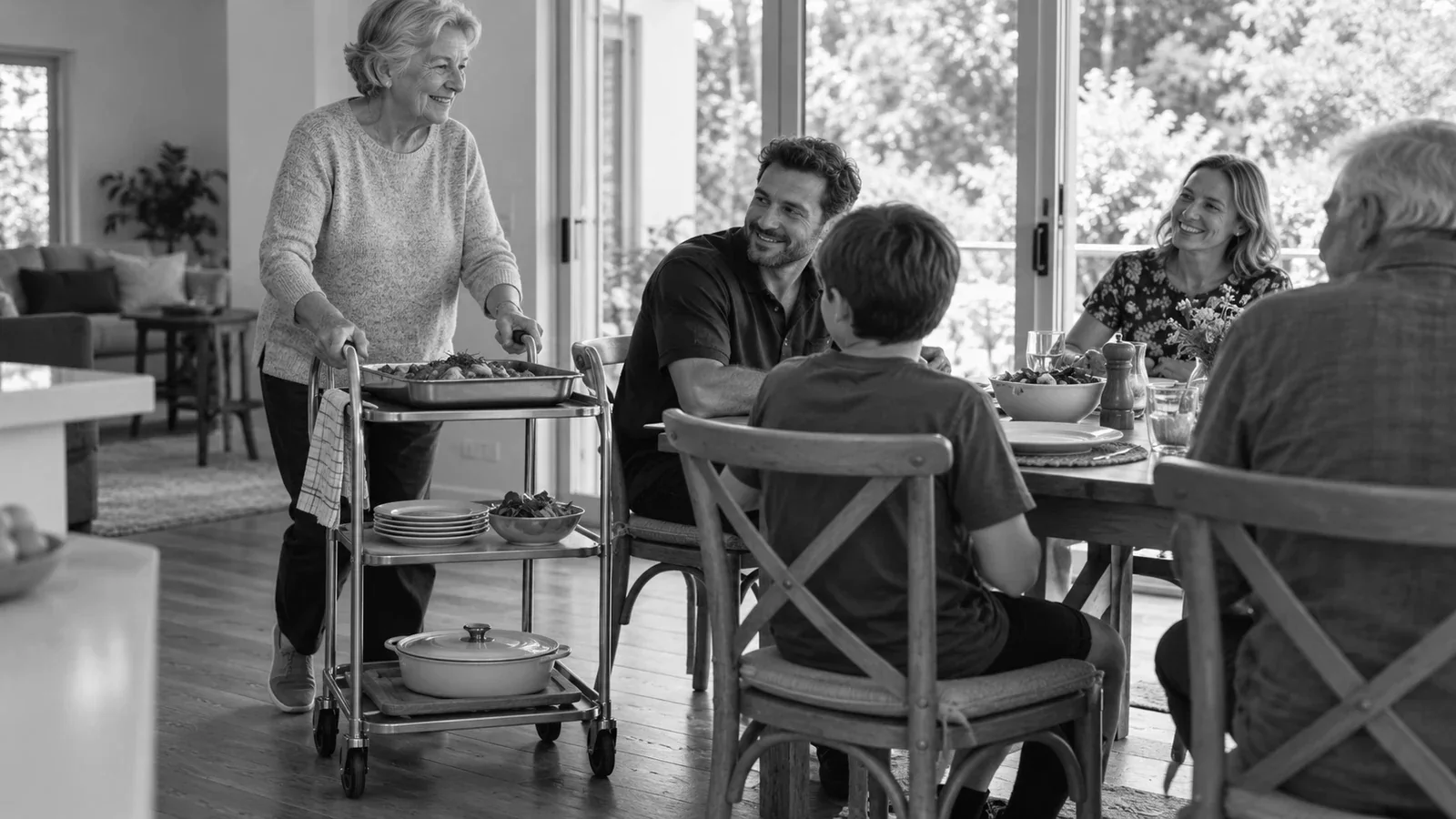
A familiar task can carry more meaning than it appears to. A person who can no longer manage the whole garden may still want to choose plants, tend one bed or teach someone else what they know. The physical method can change while the purpose remains.
Ageing in Full treats adaptation as an expression of agency, not a consolation prize. It also leaves room for grief when an old way is lost. Clinical care should investigate what can improve and make space for another method where that better serves the person.
Key points
- Ask what the activity gives the person before changing how it is done.
- Practice, equipment, environmental change and support can work alongside treatment.
- Aids should be chosen and reviewed for the task and person, not prescribed as a symbol of decline.
- A person should have a meaningful say in the trade-offs.
Begin with purpose
Consider a person who used to walk to a local shop. The outing may provide food, exercise, conversation and a sense of belonging. If walking the full distance becomes too difficult, simply replacing the shopping with a delivery solves only one part of the problem. The person may prefer a shorter walk, a different route, transport for one leg or another way to see the people there.
That discussion can reveal which part of the activity matters most. It also prevents a well-meaning helper from taking over more than the person wants.
What can change?
A physiotherapist may work on movement, strength, endurance or confidence with a relevant task. An occupational therapist may help with the way a task or environment is arranged. A walking aid, seating change, rail or other assistive product may help some people. WHO describes assistive products as tools that can support functioning, inclusion and participation.1 Rehabilitation can combine treatment with environmental adaptation, education and assistive products.2
A product still needs appropriate selection, fitting, practice and follow-up. A walking aid that is unsuitable for the person or route may not help. The same is true of a plan that saves effort in one task but makes the rest of the day harder. The question is what the changed method makes possible and at what cost.
Support can protect choice
Someone may accept help with carrying bags so they can keep choosing food and speaking with neighbours. Another may want to do part of a task independently and receive help with the remainder. Neither arrangement determines the person's dignity. Shared decisions should consider clinical evidence, preferences and circumstances together.3
Review the change after it has been used in ordinary life. Does the person feel safer, more comfortable or more able to take part? Has the new method introduced a different problem? If so, adapt again. The aim is not to preserve an old method at all costs; it is to keep the person's purpose visible.
Discover the purpose before changing the task
A task may serve several purposes at once. Shopping can provide food, movement, familiar conversation and a sense of choice. Gardening can be exercise, pleasure, memory and a way to care for a place. If a person is finding one method difficult, a well-meant replacement may solve the practical chore while removing the part they valued most. The first question is therefore, “What do you want this activity to make possible?”
The answer may be specific. Someone might want to choose their own produce but be willing to let another person carry it. Someone might want to be present for a family meal without preparing every part. These distinctions matter because adaptation is not a single product or technique. It is a design choice made around the person's purpose, capacity and setting.
It is also reasonable to acknowledge loss. A different method may be useful and still feel disappointing. The clinician need not turn every change into a cheerful story. Respectful care makes room for that feeling while exploring what remains possible and what clinical treatment may still improve.
Examine the task in its real setting
Assessment can break an activity into parts: getting there, carrying, standing, reaching, turning, resting and returning. Which part has become difficult? Is pain, strength, balance, endurance or the environment the main barrier? Does the person have reliable help, or would the plan depend on support that is not actually available? A clinician should investigate the relevant physical and practical factors before recommending a change.
A task practised in a clinic may differ from the same task at home or in the community. A step may be higher, a room narrower, or the person may need to manage several demands at once. Where possible and appropriate, observation in the real setting can reveal a better option. It may also show that the original method is still viable with treatment or practice rather than a permanent adaptation.
WHO describes rehabilitation as an approach that can include care, education, assistive products and changes to the environment.2 These options can work together. Adaptation does not mean abandoning rehabilitation; it can make a meaningful activity possible while physical capacity is assessed and supported.
Choose an aid for the person and the place
Assistive products can support functioning and participation.1 Their usefulness depends on the person, the task and the environment. A walking aid that works on a level indoor floor may be awkward on a narrow outdoor route. A device may create a new storage or transport problem. A seat placed for rest may help one task and obstruct another. Selection, fitting, practice and review matter.
The person should be able to compare the expected benefit with the inconvenience or visibility of an aid. Some people welcome a tool that restores choice; others need time to consider it. The clinician can explain the clinical reasoning and offer a trial where appropriate, but should not treat reluctance as ignorance. Equally, a person's preference does not remove the need to discuss a safety concern honestly.
Support from another person can be part of the method. Accepting help with one step may enable the person to do the rest. The arrangement should be agreed rather than assumed. The person may want help only at certain times or in certain places. A good plan protects their say in how the activity happens.
Review the whole consequence, not one successful attempt
An adaptation should be tested against ordinary life. Did it make the activity easier, safer or more worthwhile? Did it introduce a different problem, such as extra effort, embarrassment or reliance on someone unavailable? Could the person still do the part they valued? These questions are as important as whether the task could be completed once during an appointment.
The plan may need several revisions. A person might use one route in good weather and another when tired. They may choose transport for part of a journey, or split a task over time. The clinician should explain which options require assessment and which can be chosen as ordinary preferences. If symptoms or capacity change, revisit the clinical explanation as well as the method.
Shared decision-making combines evidence with values and circumstances.3 It means a person can choose among reasonable options after hearing their likely benefits, burdens and uncertainty. An adaptation is not automatically better because it saves effort; the saved effort must serve a purpose the person cares about.
Ageing in Full keeps dignity independent of how much help a task requires. The aim is neither to preserve every old method nor to replace it too quickly. Care should investigate what can improve, make support available where useful, and let the person define what participation means. The method can change without surrendering the purpose.
References
- World Health Organization. Assistive technology. 2024. https://www.who.int/news-room/fact-sheets/detail/assistive-technology
- World Health Organization. Rehabilitation. 2024. https://www.who.int/news-room/fact-sheets/detail/rehabilitation
- Australian Commission on Safety and Quality in Health Care. Shared decision-making. https://www.safetyandquality.gov.au/clinical-topics/shared-decision-making