
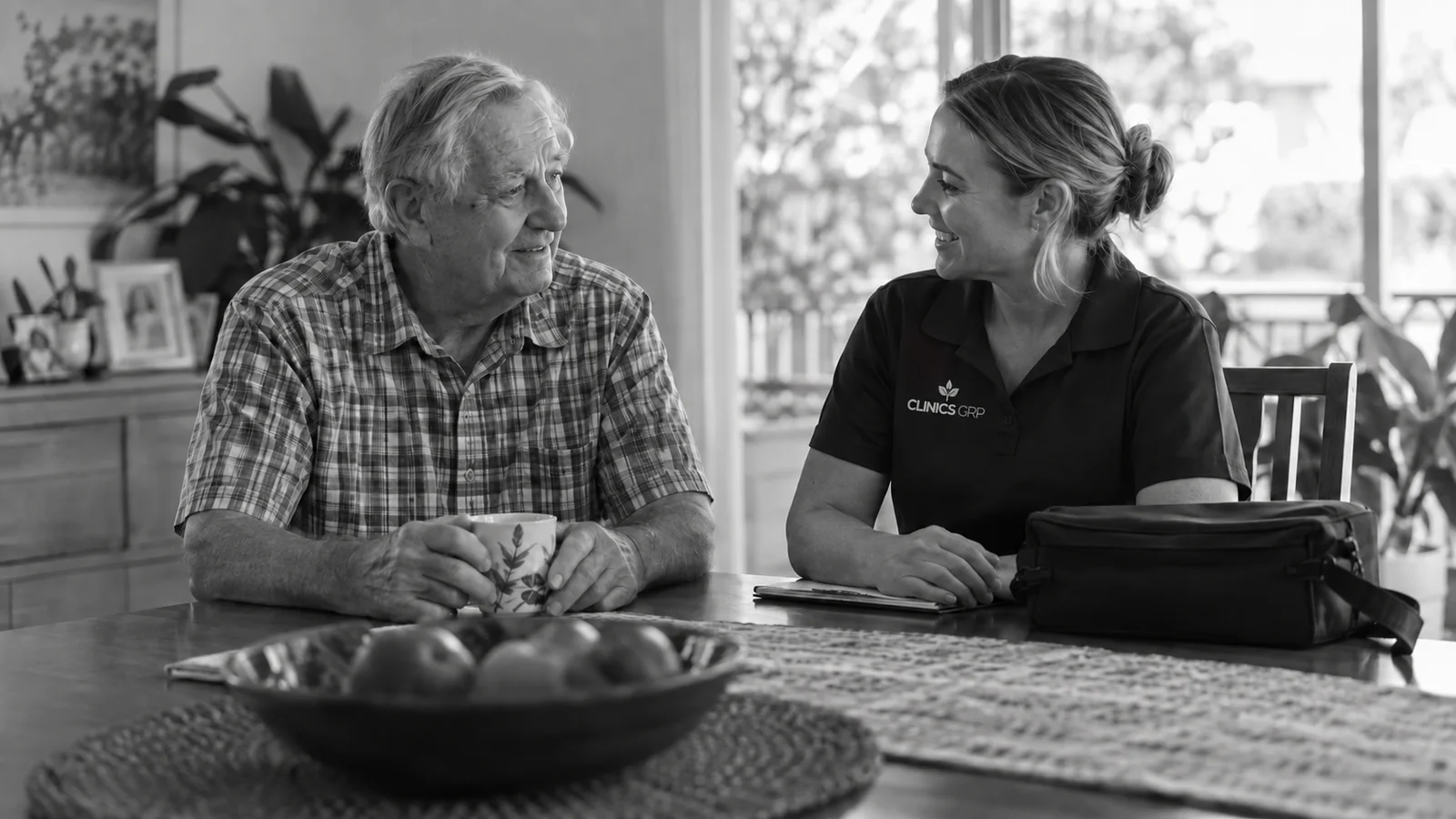
A family may recognise that something is becoming harder without knowing whether it requires nursing. A dressing needs attention. Medicines have changed after hospital. A person who usually manages well is finding a familiar care routine confusing or difficult.
Nursing under Support at Home can address approved clinical needs in the home, subject to assessment and provider arrangements. The useful question is what requires nursing knowledge, assessment or treatment, and how that care connects with the person's wider health needs.
At Clinics GRP, nursing is part of a connected approach to older-adult care. The purpose is to understand the current concern, establish appropriate responsibilities and help the person and their care team know what happens next.
Key points
- Nursing may be appropriate for wounds, medicines support, monitoring, continence or other assessed clinical needs.
- A change in someone's usual ability to manage care is worth describing clearly.
- Nursing, personal care and medical treatment have different responsibilities, even when they overlap in daily life.
- A home nursing plan should include communication, review and clear advice about escalating concerns.
The difference between needing help and needing nursing
Daily assistance can make an enormous difference to living at home. Help getting dressed, preparing a meal or keeping a routine organised may support independence. Nursing brings clinical assessment and care within the nurse's scope of practice.
The distinction is not always obvious to a family. A person might need help putting on clothes because a shoulder is painful, because a wound makes dressing difficult, or because several difficulties occur together. Describing what happens is more useful than trying to choose a professional title immediately.
An intake conversation can help clarify the starting point. It should not imply that a short conversation has replaced a clinical assessment. Sometimes the next step is nursing; sometimes physiotherapy, the GP or another service needs to be involved.
The Support at Home clinical care pathway provides a place to begin when the required discipline is uncertain.
Common reasons to discuss a nursing assessment
Wound and skin concerns are one reason. Questions may include whether the current care instructions are clear, how treatment is progressing and who should review a change. A wound plan needs an appropriate clinical basis; a family should not be left to improvise treatment from general internet advice.
Medicines support is another. The issue might involve following an authorised regimen, understanding a changed routine or recognising a concern that should be referred to the prescriber or pharmacist. Nursing support does not mean a person should independently alter doses or stop medicines.
Continence, catheter or stoma care may also create needs for nursing assessment, education or management. These can be sensitive topics. Privacy, consent and the person's preferences should shape how they are discussed and how care is delivered.
Clinics GRP nursing services describe the available pathways in more detail. The appropriate service depends on the actual presentation and available clinical capability.
Why the wider picture matters
A nursing task sits within a person's life. A dressing routine may be difficult because of limited movement. The person may understand instructions but struggle to carry them out alone. Their usual family support may have changed.
National data help explain why a single-issue view can be incomplete. AIHW estimated that 38% of Australians had two or more of the selected long-term health conditions in 2022.1 That figure covers Australians across age groups; it is not a rate of nursing need among Support at Home participants.
The statistic provides context, not a diagnosis. It cannot tell us which services one person requires. The practical question remains whether another health or functional concern affects the proposed nursing care, and who needs to be involved.
Recognising those connections can lead to a clearer plan. It should not lead automatically to more appointments or assumptions about an older person's ability to manage.
What should the first nursing visit establish?
The person should understand why the nurse is there and have an opportunity to explain their concerns. Clinical information from the referral can help, but it should be checked against what is happening now.
A useful assessment clarifies the current need, relevant instructions, what the person can manage and where assistance is required. It also identifies information that is missing. If an instruction needs clarification from another clinician, that uncertainty should be resolved through an appropriate channel.
For example, a discharge document might describe a care requirement without making the follow-up arrangements clear. A useful response is to establish who is responsible and how the person can contact them. Quietly assuming that another service has organised follow-up can leave a gap.
The assessment should finish with an understandable next step, even if further information is needed before treatment can be finalised.
How does Support at Home funding fit?
Nursing is a clinical support service. Under current Support at Home contribution arrangements, participants do not pay a contribution for clinical supports.2 The service must nevertheless be approved and appropriately arranged through the provider.
It is helpful to distinguish the person's clinical need from the administrative steps required to deliver it. A recommendation does not itself confirm funding or a booking. The provider and clinical team need to agree what has been authorised and how care will proceed.
Families can ask for the arrangements to be explained in ordinary language. Which nursing service is being organised? What information is still needed? Who will confirm the appointment? If arrangements change, who should be contacted?
Questions about a particular budget or contribution should be confirmed with the provider using current programme guidance.
Nursing and physiotherapy can address connected needs
Consider an illustrative situation: a person returns home after hospital with a nursing care requirement and difficulty moving around the house. This is a hypothetical example, not a patient story or a promised treatment pathway.
Nursing may address the relevant clinical care needs while home physiotherapy assesses movement and function. Each clinician needs to understand information relevant to their work, including any agreed precautions or changes in the person's condition.
The value lies in a coordinated purpose. Two appointments do not automatically create coordinated care. The person should not have to reconcile contradictory instructions or become the only messenger between professionals.
Where needs extend beyond either discipline, the team may recommend involvement from the GP or another appropriate professional. The boundaries of the service should be explicit.
What happens between nursing visits?
Care continues between appointments, so instructions need to be practical. The person and any involved carer should know what they are being asked to do, what they should leave to the clinical team and whom to contact with concerns.
A carer's willingness and ability to help should be discussed rather than assumed. Being a family member does not establish that someone can perform a clinical task. Education and support need to suit the task and the individual circumstances.
The plan should also explain how a change will be reported. A scheduled review is useful, but it should not become a reason to wait when a new concern arises. Ask the nurse what changes require earlier contact and what service to use outside the team's operating hours.
For a medical emergency, call 000. A routine home nursing booking is not an emergency response service.
What should providers expect to hear back?
Communication should help the care partner understand the clinical recommendation and any action required. A useful update can explain the need being addressed, the agreed goal, progress, unresolved concerns and when reassessment is proposed.
Sharing should follow consent and the person's care arrangements. More information is not automatically better communication; it should be relevant to the recipient's role.
If nursing care is no longer required at the same level, that should also be discussed. Good care includes reviewing whether the arrangement remains useful, whether responsibilities have changed and whether the person needs a different form of support.
A practical starting point
Write down the concern in everyday terms: what has changed, how long it has been happening and what the person can no longer manage as they usually would. Include recent hospital care or changed instructions where relevant.
Then explore nursing through Support at Home or speak with the Clinics GRP intake team. Have the provider's details available, and use the secure referral pathway for clinical documents.
You do not need to diagnose the problem before asking for help. A clear description allows the team to consider an appropriate next step, with the person's needs and preferences at the centre of the conversation.